
Europe’s long-sluggish financial markets are being shocked into life as Donald Trump’s drive to reshape global trade and security undermines America’s decades-long dominance.
Across assets of all stripes, the old continent is collectively trouncing America in a way that’s rarely been seen before. The euro is the strongest in three years. German bonds last week beat Treasuries by the the most ever. And while european shares have been knocked by the trade war, they’re turning out to be far more resilient than American ones.
The shift from just six months ago is remarkable. European markets in late 2024 seemed destined to be forever in the shadow of the US and its Trump-fuelled exceptionalism. All anyone wanted to talk about was the US’s hot AI stocks, the ascendant dollar and an imminent wave of tax cuts and deregulation that would make America great again.
“There’s this feeling that Europe is just a museum; well, the museum is now coming to life,” said Catherine Braganza, senior portfolio manager who’s been buying European high-yield bonds for the funds she manages at Insight Investment in London.
The jolt came from a couple of directions at once. The US president’s on-again, off-again tariffs and planned fiscal policy forced investors to wonder whether Treasuries and the dollar are still going to be the haven they’ve been for decades. Germany promised hundreds of billions of euros in spending on defense and infrastructure after Trump made clear the US would no longer serve as the main guarantor of European security.
It all suggests that time is up for the era when America, at the heart of global financial markets and trade, sucked in trillions of dollars from the rest of the world. Now investors are looking for alternative places to take their cash in a direct repudiation of Trump’s policies and unpredictable style of governing.
Some of the biggest names in finance are positioning for more gains in Europe. Vanguard International favours short-dated bonds in the euro area with the central bank free to cut interest rates. Citigroup’s Beata Manthey, who in October called the stock rally in Europe, this week downgraded US equities to neutral while maintaining her positive outlook on Europe.
To be sure, the outlook for Europe itself has become more complicated. Trump’s tariffs have punctured the optimism that greeted Germany’s decision last month to kick off a spending spree, a vital fillip for enduring growth across the whole bloc. And a potential US recession would drag other economies down with it — including the European Union’s, hampering the currency and riskier assets.
But european markets still have much in their favour, a sign that a long-term rotation of cash into the region may only just be getting started. To the continent’s politicians and central bankers, the disintegration of US exceptionalism is a prime opportunity for the euro to make headway as a reserve currency, eating away at the dollar’s long-standing hegemony.
The dollar — typically a haven asset in bouts of market turmoil — fell to a fresh six-month low on Monday, as the Trump administration’s latest back-and-forth on tariff policy added to investor unease toward US assets.
German bonds, or bunds, have proved a place of safety amid the tumult. As the US 10-year yield soared half a percentage point in just five days, the equivalent German yield resisted being dragged higher. While Treasuries stabilized this week, the price swings have been severe enough to leave market participants on watch for Federal Reserve intervention.
And where a potential inflation spike threatens to curb the Fed’s ability to cut interest rates, the European Central Bank has a clearer runway to do so. Money markets are confident that a quarter-point reduction is coming on Thursday, with at least another two moves by year-end.
“Today, we prefer to be in bunds,” said Nicolas Jullien, global head of fixed income at investment manager Candriam, commenting on the firm’s favored haven assets. While Germany is set to ramp up bond sales, “the level of debt is very low and I think it should outperform in the risk-off market compared to Treasuries.”
There’s also a growing realization, grounded in the EU’s cohesive response to the pandemic in 2020, that the bloc is stronger than it once was, which helped limit the blowout in yields of debt-laden countries like Italy in the recent volatility.
The EU is “more resilient than in the past and that should also be good for investment flows, at least in relative terms,” said Vasileios Gkionakis, senior economist and strategist at Aviva Investors.
European stocks are also luring investors fleeing the volatility that’s convulsed US markets. A Bank of America Corp. global fund manager survey this week found a record number of respondents intend to cut exposure to US stocks.
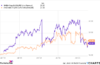
The S&P 500 is down 7.9% this year including dividends versus a 10% return in dollar terms for the Stoxx Europe 600 Index. Yet, judging by price-earnings ratios, European stocks still look like a bargain: They’re almost 30% cheaper than the US, much wider than the average 17% discount going back a couple decades.
Amundi, Europe’s largest asset manager, is among those favouring European equities with a preference for defensive, quality and value stocks. Chief investment officer Vincent Mortier says the continent is well-placed to capture inflows as the global trade system is rewired.
“Moments like these only happen once every 100 or 200 years,” he said in an interview. “Europe is back on the map.”