
Apparently, light travels faster than sound. Apologies to Galileo Galilei, but the 16th-century Italian physicist and engineer clearly never went to Portugal.
Because you hear them before you see them, Portugal fans.
Generally, Sion is a city all but overwhelmed by vineyard-streaked mountains in Switzerland’s Valais region. An unspoken serenity is all that can be found in this Swiss-French paradise.
That is until 4pm local time yesterday (Friday), five hours before Portugal’s must-win Euro 2025 group-stage finale against Belgium.
From this point, Sion is transformed into a pulsing heart, its beats per minute dictated by an innocuous-enough-looking Portuguese man who bangs a drum almost the size of a human being with the rhythm of a thousand jet-engine-propelled arms.
And it’s glorious, really. At full time in Sion’s Stade Tourbillon, after a dramatic 2-1 defeat for Portugal, it was still glorious. It probably shouldn’t have been.
The result means they are out of Euro 2025, the third successive major tournament where the Portuguese have boarded the plane home without tasting knockout-round football. This summer, they leave with two defeats and a draw, two goals scored and eight conceded.
For a team tipped by many to be the tournament’s dark horses, it is a disappointing way to go.
Like the Argentine clubs in the Club World Cup going on over in the United States, there is an element of sadness at having to wave this team goodbye so soon because, by association, it means saying goodbye to their fans.
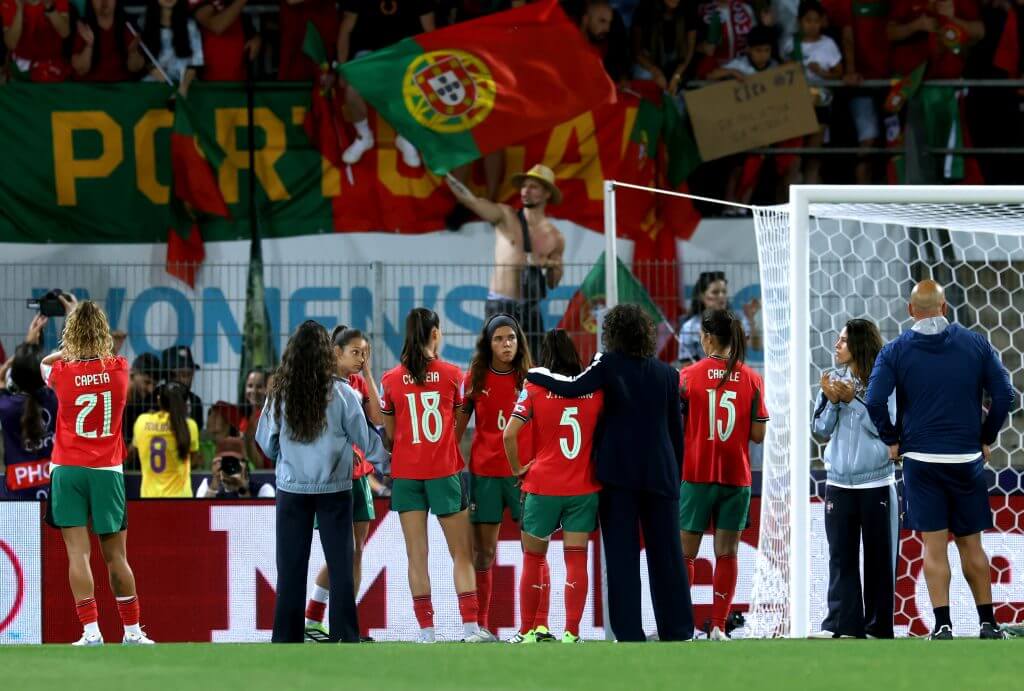
Portugal’s players salute their fans after full-time (Alexander Hassenstein/Getty Images)
In a sport that is angrily wrestling with its concept of fandom — what it means, who it is, do they like friendship bracelets and colour swatches or not — Portugal’s supporters here are a kind of weird harbour, a vociferous, green-flare-waving beast of passion and thunder that seems to never run out of juice.
And they were up for it on Friday.
Portugal’s mission before kick-off was simple enough: win, score loads of goals, pray for a Spanish favour against Italy in the group’s other game being played at the same time. Yet, the first two assignments (win, score goals) were the very ones they have been unable to complete this calendar year.
In their nine previous matches in 2025, Portugal had managed one win (1-0, handily enough against the Belgians, in the Nations League in February) and scored just six goals, failing to score in four (which were all among the five most recent fixtures). In their first two group games, against Spain and Italy respectively, Portugal managed expected goals (xG) figures of just 0.29 and 0.31. Across those matches, they registered a combined two shots on target from a total of 12.
Overall performances have been erratic: defence an elective choice, moments of brightness ultimately descending into bodies desperate flailing onto the grass, good chances agonisingly missed.
Portugal’s fourth shot, in the first half’s final minutes, on Friday was its own kind of metaphor for their struggle.
Bullied by their opponents for nearly 40 minutes, an errant pass bounced fortuitously above Belgium’s back line for Ana Capeta to pounce onto, only for the 27-year-old’s attempted lob of goalkeeper Lisa Lichtfus to be harmlessly snaffled in pure anticlimax.
Capeta’s head was immediately in her hands. It was not the first time, and it was certainly not the last.
Five minutes into the second half, the next best chance arrived as 22-year-old Barcelona midfielder Kika Nazareth — Portugal’s best player on the pitch despite ankle ligament surgery in March — softly laid the ball off into the path of Capeta. There was so much space. Time. Opportunity. The shot was straight at Lichtfus. Heads went into hands.
Still Portugal poured forward. Maybe not with the most composure or finesse, but damned if not with spirit and grit. And the challenge became not drawing a big, bold line between the unceasing pound of drums, the undulating flapping of flags, the rising tide of song, and the team’s breathless second-half charge.
As the night sky above Sion turned dark, Portugal adopted a sense of carnage or bust: an xG of 2.35, 30 shots with seven on target, including, finally, cathartically, Telma Encarnacao’s goal in the 87th minute to make it 1-1, assisted by Nazareth, who is so clearly the present and future of this football nation as it builds itself on the women’s stage.
The goal inspired an unleashing, a guttural cry into the blackness overhead from the sea of red and green behind Belgium’s goal. Because maybe all this noise, this song, this willing into life, was worth it.
It is why this tournament will miss the Portugal fans, their shirts twirling above their heads, swathed in burning green flare smoke.
Yes, the noise is great and unrelenting, but it is how they use it. Sometimes angrily, often in spite of what is happening before them, but specifically how they descend on a place and, rather than annexe it, amplify it, sweeping it up in solid sound. From there, you’re at their mercy, your pulse and subconscious now a Portuguese plaything, peaking and falling on their time, in line with their preferred crescendos.
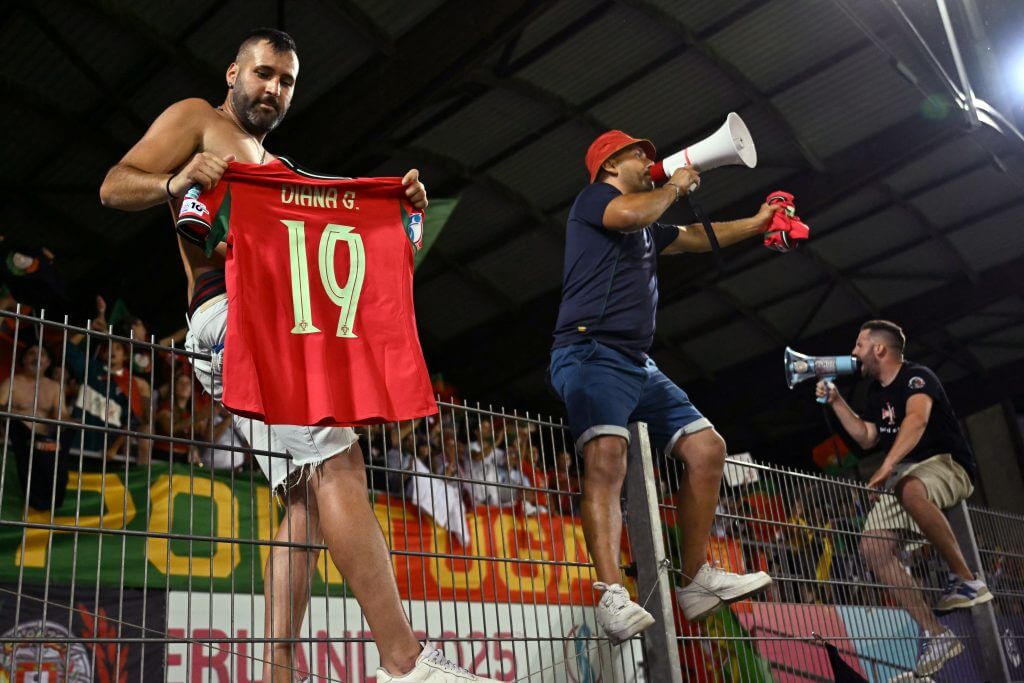
The Portugal fans making noise after full time on Friday (Fabrice Coffrini/AFP via Getty Images)
If only football were so controllable.
Portugal are not the only fans here who are like this. The Finns, Welsh and Dutch have also been transforming Swiss cities, however briefly, into their image. Already, Euro 2025 has had to say goodbye to two of these nations. By Sunday, it could be two more.
But the echoes remain, here in Switzerland, but potentially reverberating back home, where progress and evolution can take hold if harnessed. Because there is a difference between believing in something and simply being there.
As the stadium announcer read out Group B’s standings, with world champions Spain at the top, followed by Italy and Belgium, then Portugal, cradled at the bottom following Janice Cayman’s thumping added-time winner, the words of congratulations to the two sides advancing to the quarter-finals were swallowed up by Portuguese song.
As the players walked solemnly over towards their fans, they were embraced.
Their tournament is over, but their song is unceasing.
(Top photo: Fabrice Coffrini/AFP via Getty Images)