
For a long period, there were expectations that the US’s aggressive trade war policy would bring other industrialized countries and regions closer together. However, Thursday’s summit between China and the European Union (EU) points in the opposite direction. Tensions between Beijing and Brussels have not been this high in years.
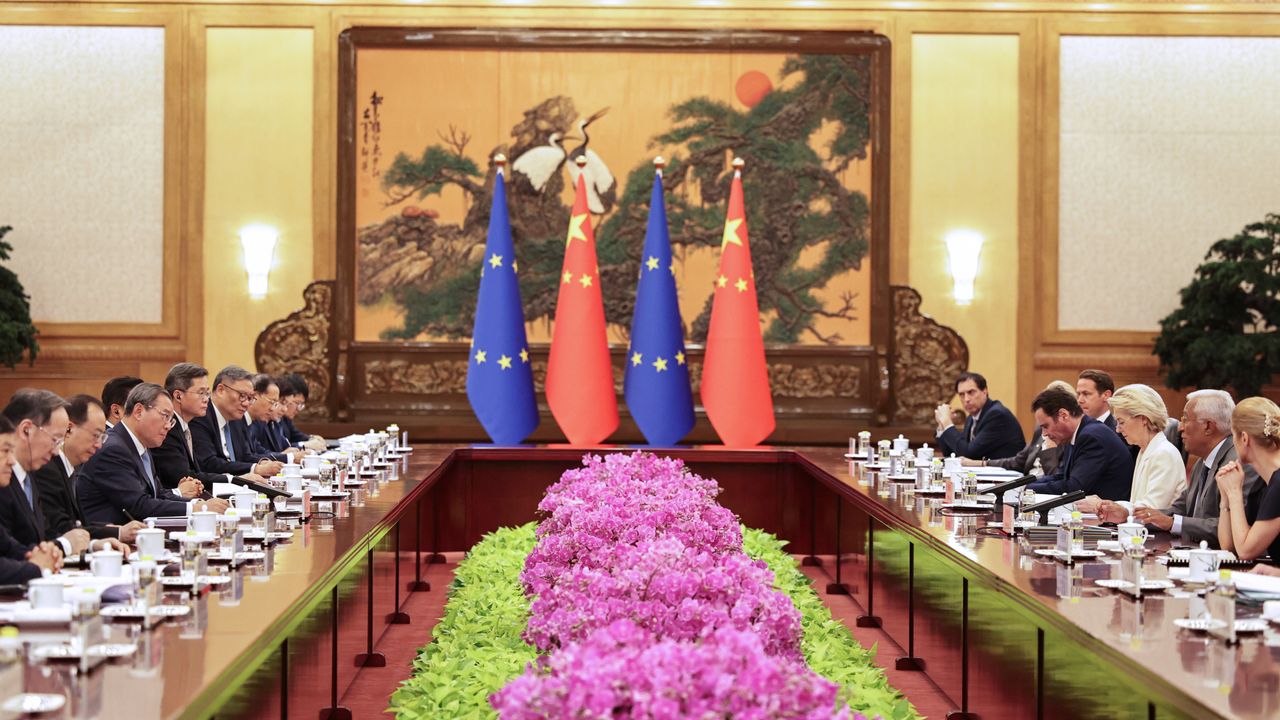
EU Commission President Ursula von der Leyen, who constantly accuses the US of harming all sides with its tariffs, threatened China with Trump-style trade sanctions. She warned that relations between China and the EU were at a “turning point.” The trade relationship was “highly unbalanced,” she said, adding that a rebalancing of bilateral relations was “essential.” If China continues to push into world markets with state-subsidized overcapacity, it would be “very difficult for the EU to maintain its current level of openness.”
Von der Leyen’s threat of trade war measures against China shows that imposing tariffs is not a personal quirk of US President Trump, but a reaction to the global crisis of the capitalist system. As on the eve of the First and Second World Wars, the struggle for raw materials, markets, and profits is no longer being waged through peaceful competition, but through coercion, blackmail, and military force.
The summit, the 25th of its kind, was intended to celebrate the 50th anniversary of the establishment of diplomatic relations between the EU and China. These relations have never been free of tension. There have been disputes over access to China for European investments and goods, the protection of copyrights and patents, dumping prices and subsidies, and numerous other issues. The EU has also exploited the situation of ethnic minorities in Tibet and Xinjiang to put pressure on China.
Nevertheless, economic relations have developed enormously. In 2024, the value of trade in goods and services between the EU and China was more than €845 billion. This corresponds to just under 30 percent of world trade. The EU is China’s most important trading partner, and China is the EU’s second largest.
Chinese exports exceed imports by more than double. In 2024, the EU recorded a trade deficit with China of more than €300 billion. The gap is widening, especially since China no longer serves merely as a low-wage platform and sales market for European corporations, but has risen to become a world leader in technologies such as electric cars, rare earths, and, increasingly, AI.
In 2020, Volkswagen was still the leading car manufacturer in China with a market share of 19 percent, but that share has since shrunk to 12 percent. Chinese brands, on the other hand, have increased their market share from 36 to 69 percent over the past five years. This is mainly due to the production of inexpensive, high-quality electric cars.
Last summer, the EU imposed additional surcharges of 17 to 35 percent on Chinese cars on top of the basic 10 percent tariff to prevent them from conquering the European market as well. China has a virtual global monopoly on rare earths, which are indispensable for many modern technologies.
The EU is reacting extremely aggressively to China’s economic rise. At the same time, it is trying not to sever economic ties completely. Together with the threatened punitive tariffs from the US, the EU’s largest trading partner, this would have devastating economic consequences.
For its part, the Chinese leadership has emphasized its interest in further economic cooperation, but it is not prepared to give in to European blackmail. During a meeting with EU leaders, President Xi Jinping stated that there were no fundamental conflicts of interest or geopolitical contradictions between China and the EU. It is hoped that the EU market will remain open and that the European side will “refrain from using restrictive economic and trade instruments,” he said.
Beijing also fears that the EU could purchase an agreement in the tariff conflict with the US by taking a tougher stance against China. The EU is already putting increasing political and military pressure on China.
The accusation that China is supporting Russia in its war with Ukraine by purchasing its oil and circumventing Western sanctions by supplying dual-use components, i.e., components that can also be used for arms production, was a recurring theme throughout the summit. The EU urged China not to provide material support to Russia’s military-industrial base and to use its influence to end the war.
The day before the summit in Beijing, EU representatives attended an EU-Japan summit in Tokyo and agreed on closer cooperation in the arms industry and on reducing strategic dependencies in the area of critical raw materials. Both decisions are aimed at China. Japan is intensively involved in the US’s preparations for war against China, which are also supported by NATO.
The EU-China summit ended accordingly without any tangible results. Originally scheduled to last two days, it had already been shortened to one day in advance. There was no joint final statement. All that was agreed upon was a consultation mechanism in the event of delayed delivery of critical raw materials and a non-binding commitment to climate protection.
Trade wars and wars are waged on the back of the working class, which has to bear the costs in the form of unemployment, social spending cuts, and being used as cannon fodder. It must not allow itself to be divided and harnessed to the service of nationalist agitation. It must unite internationally and fight for the overthrow of capitalism. Only in this way can the enormous technological developments be put at the service of social progress instead of being turned into a means of destruction.