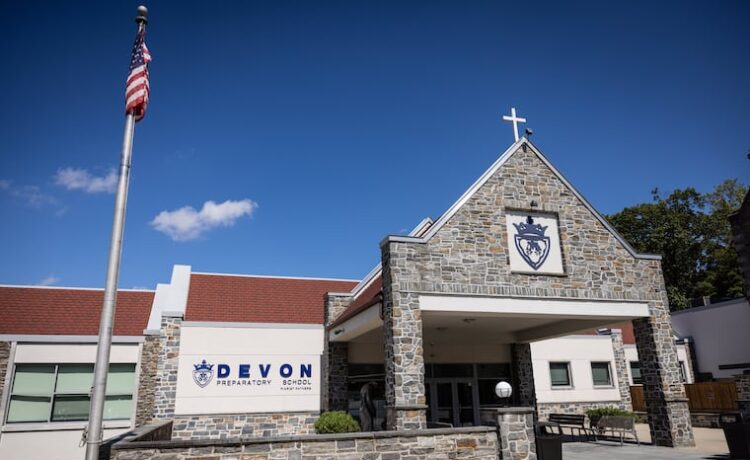
Devon Prep is receiving an $8 million gift from a foundation cocreated by the small Chester County Catholic school’s most prominent alumnus, Keith Dunleavy, a medical doctor who started a healthcare industry technology company that is now worth billions.
In an announcement Friday morning, the Dunleavy Foundation said it was making the donation to the all-male school, which is located in Tredyffrin Township and has an enrollment of 330 students, to launch the Dunleavy Scholars program supporting scholarships focused on persuasive writing and STEM education.
“We are grateful to the Dunleavy Foundation for their incredibly generous gift,” Father Nelson Henao, president of Devon Prep, said in a statement.
“We believe that the right combination of academic pursuit and faith experiences enriches each of our students’ lives and provides them with a solid foundation for pursuing a happy life. This gift will ensure that our highly skilled educators at Devon Prep will continue to shape the lives of our young men as they aim for their academic dreams,” Henao said.
The Dunleavy Foundation was cofounded by Keith Dunleavy and his wife, Katherine Kirby Dunleavy, who is also a medical doctor.
Keith Dunleavy, 56, graduated from Devon Prep in 1987 and went on to get degrees from Dartmouth College and Harvard Medical School.
In 1998, Dunleavy founded a company that would eventually become Inovalon, a cloud-based healthcare software and data analytics company. Dunleavy retired in March after serving 26 years as the CEO. Forbes reports that Dunleavy and his family have a net worth of $1.9 billion.
The Dunleavy Scholars program is establishing a total of 30 Scholarships each year across two tracks, one for STEM and the other for persuasive writing. At the end of the student scholar’s senior year, the Devon Assessment Panel and Program Advisory Board will award one Dunleavy Scholar from the persuasive writing program and one from the STEM program with a $10,000 gift to support their future educational pursuits.
In written responses to questions from The Inquirer, Dunleavy recalled his time at Devon Prep and why he and his wife believed it was important to make a big commitment to the school’s educational mission.
Dunleavy grew up in the Chester County area and followed his older brother Brian to Devon Prep. Their parents chose Devon Prep because of its rigorous academic program and strong religious foundation, he said.
He said his “most vivid and fondest memories of being a student at Devon Prep were the teachers who truly cared about what they taught and the students to whom they taught.” He mentioned Michael Collins, who taught AP European and AP American history, and Father Jim Shea, who taught AP physics and AP computer science.
Dunleavy ran cross-country and became captain of the track and field team. He proudly noted that he still holds the school’s shot put record of 53 feet, 10 inches.
The new $8 million gift to Devon Prep is the second donation from the Dunleavy Foundation. It gave a $1 million challenge grant in 2020 to bolster the school’s capital campaign and strengthen the school’s endowment.
For the new scholarships, the STEM focus seems a natural fit for Dunleavy and his background in medicine and technology.
He and his wife also picked persuasive writing because they believe it is a critical skill, that “after taking in information and formulating one’s thoughts, the ability to translate such into coherent, articulate, and well-organized communication is key — a skill that [we] fear is being lost in the world of increasingly short format SMS and text communications, and the like,” he said.
While Dunleavy was CEO of Inovalon, the company embraced uses of artificial intelligence. Last year, the Dunleavy Foundation awarded $6 million to Harvard Medical School to create the Dunleavy Fund for Clinical AI to improve healthcare and medical science.
The announcement of the $8 million gift to Devon Prep stressed that the student scholars would develop “critical thinking” through “rigorous advanced coursework.” The Inquirer asked Dunleavy what he thought about the use of AI by students and the general need to learn high-level skills instead of just relying on AI for answers.
Dunleavy said he believes AI will be everywhere and its capabilities will accelerate at a rate never before seen, and in ways that are obvious or unseen. It is already impacting healthcare with drug development, improving the interpretation of X-rays, and routing flights to avoid storms, he said.
“While AI is increasingly ‘everywhere’ and will be evermore so, we must still develop our brains to think on our own. We must still understand how (and what it means) to add 23 plus 18, or multiply 7 times 11,” Dunleavy said.
“AI is a powerful tool, but the greatest woodworking tools still require a trained craftsman to leverage them and arrive at the creation of beautiful cabinetry,” Dunleavy said.
As for students using AI, such as ChatGPT, to write papers, Dunleavy emphasized caution and limits, pointing to student codes of conduct that clarify what tools can be used and the importance of students not misrepresenting work they did not do.
“While asking ChatGPT to list the rulers of Prussia may be fine, asking it to compare and contrast one ruler vs. another may fundamentally usurp the intent of a homework assignment — let alone undermine the secondary element of an assignment’s effort to encourage a student to learn how to develop their own informed views,” Dunleavy said.
“These are challenging issues. Navigating them will be that much harder given how rapidly the capabilities available to students are evolving,” he said.