

Chris Dillmann/Vail Daily archive
Western Slope school districts could gain — or miss out — on a share of state funds to expand high school career readiness programs, depending on how the Colorado State Board of Education decides to divide the money.
The Colorado Department of Education’s strategic plan, in addition to reducing chronic absenteeism and strengthening the educator workforce, includes a goal for 100% of students to graduate with either an in-demand, non-degree credential, work-based learning experience or postsecondary credits by 2029 — what the department calls “The Big Three.”
In support of these goals, the Colorado General Assembly passed Senate Bill 315 during the 2025 legislative session, which establishes a distribution model for existing postsecondary and workforce-readiness program funds.
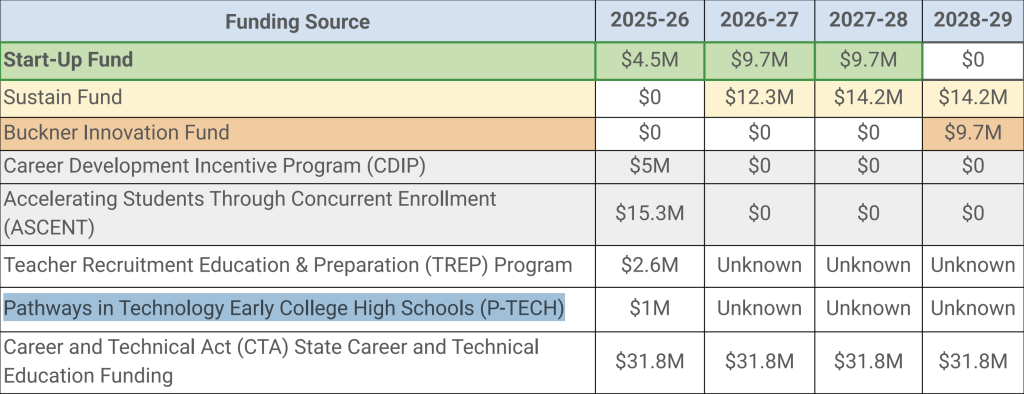
The existing programs are designed to boost in-demand career opportunities for high schoolers within the “Big Three” categories and are paid for by three types of funding included in the distribution model — the Start-Up Fund, Sustain Fund, and Buckner Innovation Fund — though the latter two don’t kick in until 2026-27 and 2027-28, respectively.
Start-Up Funding — the only of the three types of funding to be distributed this year — was created to help districts develop and expand postsecondary and workforce-readiness programs so more students can have access to the Big Three.

Support Local Journalism
“In the 2023-24 program year, there were 82 school districts, 46%, that did not access any of the funding from these post-secondary workforce readiness programs we’ve identified,” Danielle Ongart, assistant commissioner with the Student Pathways & Engagement Unit, said during Wednesday’s Colorado State Board of Education meeting. “Start-Up funds are intended to provide access to those districts in an easier, less burdensome way.”
Roughly $4.5 million in Start-Up funds, all coming from consolidated grant funding, has been allocated for school districts in the 2025-26 academic year, which will jump to $9.7 million in 2026-27 and 2027-28.
During one of their upcoming public meetings, members of the Colorado State Board of Education will vote on how to distribute funds to local education providers using two potential formulas.
In “Scenario A,” Start-Up funding is provided to select districts based on demonstrated need, thereby partially targeting districts with a lower percentage of students already participating in these programs.
Eligibility guidelines state that districts with 10% or fewer of their students participating in the identified postsecondary workforce readiness programs would receive Start-Up funding, since the fund’s goal is to create opportunities for more students to get involved.
“Scenario B” provides Start-Up funding to all districts, even those without demonstrated need. The amount of funding per district would still vary based on the same allocation metrics, including the percentage of students already enrolled in programs, chronic absenteeism rates and drop-out rates.
Under Scenario A, 148 districts — roughly 84% of rural districts and 75% of non-rural districts — would receive Start-Up funding, with an average of $30,543 per district and a range of $13,618-$103,497 in possible financing.
Meanwhile, Scenario B would provide funding to 100% school districts in Colorado, but result in approximately 15% less for the districts that would have received funding in Scenario A. The average amount per district would be slightly lower at $25,253, with a possible funding range of $5,864-$89,13.
During Wednesday’s meeting, multiple board members expressed concern that both scenarios propose minimums that are too low for the services they’re meant to fund, which could lead districts to have to reject the funding.
Board Member Kathy Gebhardt, who represents Colorado’s 2nd Congressional District, said she was in favor of an adjusted version of Scenario A, where smaller districts with fewer program resources would receive more funding dollars.
“I struggle with giving it to every district. I think we need better metrics, and I don’t think it needs to go to every district,” Gebhardt said. “I’m leaning toward figuring out a better metric … for getting more money to smaller districts.”
Because the fund uses a needs-based formula distribution, factors like high school population, percentage of students qualifying for free-and-reduced lunch, chronic absenteeism rate, drop-out rate and graduation rate are also weighed to determine how much funding each district receives. Districts with the capacity to meet the fund’s reporting requirements can opt in to receive it for eligible expenses; if a district does not want the funding, it goes back into the pot for redistribution.
Districts are reassessed for eligibility based on the funding distribution rules approved by the board, so districts that receive funding one year might not receive it the next, depending on changes in program participation and other weighted factors.
Survey responses on the two formulas — submitted by mostly rural district staff (74%) — showed a “slight preference” for all districts to receive Start-Up Funds (42%) rather than those with demonstrated need (30%), according to data presented by the department during Wednesday’s meeting. Eleven percent of district staff and high school educators said they were unsure or needed more information.
Feedback also requested the addition of eligible expenses under the Start-Up program, including transportation, outreach to help inform students and families about available opportunities, background check fees for employees working with students and student stipends — which have since been added to the rules.
Other state programs also exist to fund postsecondary workforce readiness programs in 2025-26, such as the Career Development Incentive Program, Accelerating Students Through Concurrent Enrollment (ASCENT), the Teacher Recruitment Education & Preparation Program, and the Pathways in Technology Early College High Schools, though some won’t provide funding past 2026.
Additionally, funding for these programs has declined slightly year over year. The state’s post-secondary and workforce readiness ecosystem totaled $59 million during the 2024-25 academic year. Next year, only $55 million will be available.
“$55 million is still a pretty good chunk of funding while the state is experiencing difficult budget times, but we know that this is still a decrease,” Ongart said.
The Colorado State Board of Education could vote on the Start-Up Fund rules as early as December 2025, with the possibility of pushing the vote into early spring. The funds, which will not have an expiration date, would be distributed to districts before the end of the 2025-26 school year.