
Small-cap exchange-traded funds can boost returns and improve diversification under the right circumstances. Still, recent results highlight that small-cap investing is not without risks, and that those risks may be amplified by the growing influence of private companies on public markets.
Certain small-cap ETFs still offer compelling opportunities, though. Declining interest rates help small caps more than most, and the group currently trades substantially cheaper than its large-cap counterparts. But given the shifting landscape, investors should be selective in which ETFs they take off the shelf.
Download: How Private Markets Are Reshaping Small-Cap Indexes
Opportunities and Risks of Small Stocks
Small companies are risky in part because they don’t usually possess the same robust competitive advantages as larger firms. Only 3% of companies in the Morningstar US Small Cap index boast a wide Morningstar Economic Moat Rating, compared with 78% of firms in the Morningstar US Large Cap index.
Financial performance of wide-moat companies is usually more stable and predictable than for narrow- or no-moat companies, helping the large-cap index lower volatility more reliably than the small-cap index.
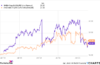
In investing, higher risk usually translates to better long-term returns, but that hasn’t been the case for smaller stocks lately. Shown below, the small-cap index lagged the large-cap index by 281% cumulative, or 1.1% annualized, from their joint 2002 inception through October 2025.
Long-term returns for the small-cap index slipped behind the large-cap index beginning in 2023. That means the index’s cumulative deficit was entirely realized in only the past 2.5 years. And over the past decade through October, the small-cap index lagged the large-cap index by a staggering 6.3% annualized.
Despite recent results, small caps should have an edge during bull markets. The relative size and competitive positioning of small companies allow them to quickly capitalize on new business opportunities. These opportunities may be risky but can lead to big payoffs for firms that execute effectively. For example, AppLovin APP caught lightning in a bottle with its artificial intelligence-powered software in 2024. The stock quickly grew out of small-cap territory that year, but not before helping Vanguard Small-Cap ETF’s VB returns more than any other holding in 2024.
Interest rates can have a meaningful impact on the returns of small companies. They’re typically more sensitive to interest rates than larger stocks and can perform especially well when interest rates are low and markets rise, which was the case through most of the 2010s. However, they may underwhelm when rates are high and markets are shaky.
Assessing Small-Cap ETF Risk
Relatively high interest rates likely contribute to recent small-cap underperformance. But other factors may be at play. There are two less visible risks small-cap ETF investors should be aware of:
- Small-cap stocks are tougher to trade than large-cap stocks, raising transaction costs that can erode returns.
- The growth of private markets may dim the growth potential of small-cap indexes, shifting the investment case.
Choosing an ETF with the smallest average market cap is not a recipe for success. Index funds periodically rebalance to maintain a close link to their benchmark. At each rebalance, an index fund must buy and sell sometimes billions of dollars’ worth of stocks. These trades cost very little for large stocks like Amazon AMZN and Nvidia NVDA. But costs can quickly escalate for tiny names and detract from returns.
ETFs that track the Russell 2000 index are particularly susceptible to this effect. The Russell 2000’s portfolio admits smaller names than many peers. Vanguard Russell 2000 ETF VTWO had an average market cap of just $3 billion at the end of September 2025, about half the small-blend Morningstar Category norm.
Finally, small-cap indexes may be losing their luster. Recent Morningstar research found three primary ways in which private markets are reshaping small-cap investing:
- Venture capital funding is keeping high-growth-potential companies private.
- Small-cap stocks are increasingly being taken out of public markets by private equity firms.
- Cash-rich private firms are competing aggressively with public companies, shifting the competitive landscape in some industries.
The result is a reduction in the number of public companies eligible for small-cap stock indexes, and a deterioration of the aggregate growth potential and relative quality of those companies. President Donald Trump’s August 2025 Executive Order, aimed at broadening access to private markets, could accelerate these effects, too.
The complexion of the Morningstar US Small Cap Index illustrates this. Relatively few small-cap companies have grown their market caps out of small-cap territory in recent years, while larger stocks have increasingly fallen out of the Morningstar US Large-Mid Cap Index and into the small-cap index.
Only once in the past seven years did more companies graduate from the small-cap index than fall into it. In the preceding 20 years, this occurred 13 times. This bucks the trend of the small-cap index graduating more companies during strong market years. Large- and mega-cap stocks are driving the market forward, leaving many smaller firms behind.
Finding the Best Small-Cap ETFs
ETFs that address the unique and evolving risks of small-cap investing earn higher Morningstar Medalist Ratings than those that don’t. Along with other top-rated ETFs, small-cap ETFs earning bronze, silver, and gold medals are well-diversified, usually charge a low fee, and stand a good chance at beating their category peers. The ETFs featured below also prefer stocks with sound fundamentals.
Index ETFs with strong liquidity requirements are viewed favorably because they make an index easier to track. Buffer rules at each rebalance are also important because they reduce turnover and associated trading costs. While not the only criteria considered, these are important building blocks of the best small-cap index funds.
Diversified small-cap active ETFs may also be appealing. Actively managed ETFs from Dimensional and Avantis spread risk across hundreds of small stocks and give managers trading flexibility to minimize transaction costs.
As investor interest moves away from small caps and toward private companies or large-cap stocks, many small-cap blend and small-cap value ETFs are left undervalued, according to Morningstar’s fair value estimate for ETFs. If stock prices converge with their fair value estimates, any of the ETFs noted above may offer compelling upside.
Editor’s Note: A version of this article was published on Feb. 10, 2025.