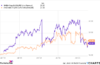

Asset manager Aberdeen’s (ABDN) influence in the UK investment trust sector is waning as the tally of its trusts being merged, wound down or handed to a competitor continues to grow.
Last month, the board of Murray Income (MUT) said it would replace its Aberdeen managers with a team from Artemis Fund Managers after a period of underperformance.
In the five years to 1 December, the trust delivered total returns of 36.4 per cent – one of the worst in the Association of Investment Companies’ UK equity income sector, whose average returns were almost double at 60.9 per cent.
The investment strategy won’t change formally, but Artemis will take a “core” approach focusing on stocks with “under-appreciated free cash flow and high returns on capital”. Murray Income’s chair Peter Tait said he is “confident” in Artemis’ “proven UK equity income investment capability, track record, and marketing expertise”.
Murray Income thus joined the long list of investment trust mandates lost by Aberdeen over the past three years.
To an extent, this is to be expected. The investment trust sector is undergoing a wave of consolidation, propelled by lower demand and higher discounts to net asset value. As a fund house running one of the largest number of investment trusts, it is inevitable it would be involved in this process. Yet you would expect more of these transactions to go in its favour.
What is going on?
Analysts say Aberdeen’s struggles stem from a range of factors, including performance. Investment trust boards are independent, so if a manager consistently underperforms, they can choose to move a trust to a different manager.
James Carthew, head of investment company research at QuotedData, argued that Aberdeen’s focus on quality is unhelpful. “If you look at all the different factors that have been influencing markets, the one style that is still not working is quality,” he said.
He suggested quality stocks had become too expensive, but that a buying opportunity will emerge. Struggling star managers Terry Smith and Nick Train also have a quality approach.
Read more from Investors’ Chronicle
Daniel Lockyer, senior fund manager at Hawksmoor Fund Managers, said the Aberdeen group “tried to get too big too quickly” and “lost focus” over the years. Now it is trying to reorganise and avoid running too many similar mandates, with the investment trust side of the business becoming a partial casualty of this effort.
“It’s a real shame, because Aberdeen is one of the founders of the investment trust sector. It was part of their heritage and something they’ve really been proud of,” he said.
However, Lockyer also recognised that Aberdeen was proactive in pushing for mergers in the sector to unlock better value for shareholders. The mergers between Abrdn New Dawn and Asia Dragon, and between Aberdeen Smaller Companies Income Trust and Shires Income (SHRS), were both between Aberdeen-run trusts.
However, the first did not end well for the fund house. Earlier this year, another merger followed and Aberdeen ended up losing the mandate to Invesco, which now runs Invesco Asia Dragon (IAD).
Charles Murphy, senior research analyst at Singer Capital Markets, agreed that Aberdeen’s reorganisation has had an effect. “Aberdeen, as a house, is trying to restructure. When you lose fund managers, often relationships are a bit frayed,” he said. This makes boards more willing to listen to someone else’s pitch.
On the plus side
It is not all doom and gloom. Aberdeen recently announced it will increase its stake in Tritax Management, which runs the £6.3bn logistics Reit Tritax Big Box (BBOX), from the current 60 per cent to 100 per cent by 2029. Last year, Tritax swallowed UK Commercial Property Reit, also managed by Aberdeen.
“As one of the largest managers of investment trusts, cyclical industry trends will sometimes become apparent, with fund management group changes one of the significant industry themes of recent years,” a spokesperson for Aberdeen said. “We continue to invest to grow and support our global range of closed-end funds.”
It added that last year it invested the equivalent of around six months of management fees in shares of their UK-listed trusts, “underpinning our firm commitment and long-term optimism in both the investment company business and the value of the underlying assets – a move we have seen no other asset manager follow across an entire closed-end fund range.”
Aberdeen also said that last year “a number” of its trusts posted “first decile performance” and they “have been making proactive policy changes to maximise value to shareholders”. It added that they have been lobbying on behalf of the investment trust sector, for example on cost disclosure issues.
It remains to be seen whether Aberdeen will lose more trusts as M&A activity in the investment trust universe continues apace. The fund house still has some degree of duplication within the UK equity income sector, where it runs three trusts – Aberdeen Equity Income Trust (AEI), Shires Income and Dunedin Income Growth (DIG).