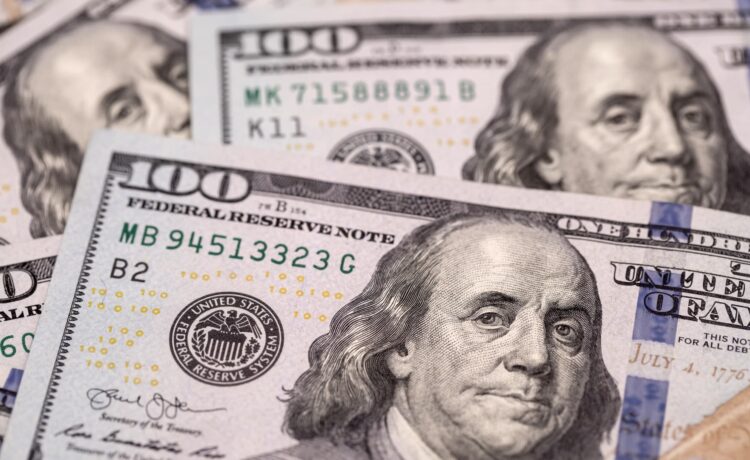
The dollar headed for its biggest monthly gain since July on Tuesday as war in the Mideast has set oil prices surging and raised the risk of global recession.
Bloomberg Creative | Bloomberg Creative Photos | Getty Images
The dollar slipped on Tuesday on a report of potential de-escalation in the U.S.-Israel war with Iran, though it remained on track for its best quarter since Q3 2024, supported by safe-haven demand amid lingering uncertainty over the conflict’s duration.
U.S. President Donald Trump told aides he is willing to end the military campaign against Iran even if the Strait of Hormuz remains largely closed and leave a complex operation to reopen it for a later date, the Wall Street Journal reported on Monday, citing administration officials.
Meanwhile, Tehran attacked and set ablaze a fully loaded oil tanker off Dubai on Tuesday, and Trump told countries that had not helped in the conflict to find “some delayed courage” to take the Strait of Hormuz and get their own oil.
“Even though we’ve had a variety of headlines out overnight, it’s difficult to keep track of who’s saying what and exactly what the implications of some of these comments are,” said Shaun Osborne, chief FX strategist at Scotiabank.
Osborne views the dollar as overvalued but expects it to remain supported as long as war concerns continue to weigh on risk appetite and the VIX stays elevated.
“Markets are concerned that it might go on for longer, that the conflict could broaden, and the aftershocks could be significant and long-lasting. There’s still a lot of uncertainty here about where we actually land on this,” he said.
The dollar has benefited from a safe-haven bid since the conflict began in late February. The United States is also relatively better positioned to handle oil disruptions than peers as a net energy exporter.
Trading on Tuesday was also likely influenced by investors repositioning for month- and quarter-end.
The dollar index , which measures the greenback against a basket of currencies including the yen and the euro, was last down 0.56% at 100.00. It is headed for a 2.5% monthly gain, the best since July, and a 1.85% return for the first quarter.
The euro gained 0.59% to $1.1532. It is facing a 2.5% monthly decline, the worst since July and a 1.9% quarterly loss, the worst since Q3 2024.
The pound strengthened 0.56% to $1.326. It is on track for a 1.75% monthly loss, the worst since October, and 1.65% quarterly drop.
The Japanese yen strengthened 0.37% against the greenback to 159.1 per dollar. The dollar is on pace for a 2% monthly gain against the Japanese currency and a 1.6% quarterly increase.
The Japanese yen rebounded for a second day after Japanese officials stepped up threats to intervene in the currency to stem recent weakness.
Finance Minister Satsuki Katayama on Tuesday repeated Tokyo’s readiness to respond “on all fronts” against volatile moves.
Katayama also labelled recent yen falls as speculative for the first time since the Middle East war began, shifting focus back to currency short-sellers as policymakers braced for a triple market selloff driven by fresh inflationary concerns.