European markets opened lower on Monday but were mixed by the afternoon as investor sentiment remains cautious amid rising oil prices and geopolitical tensions in the Middle East.
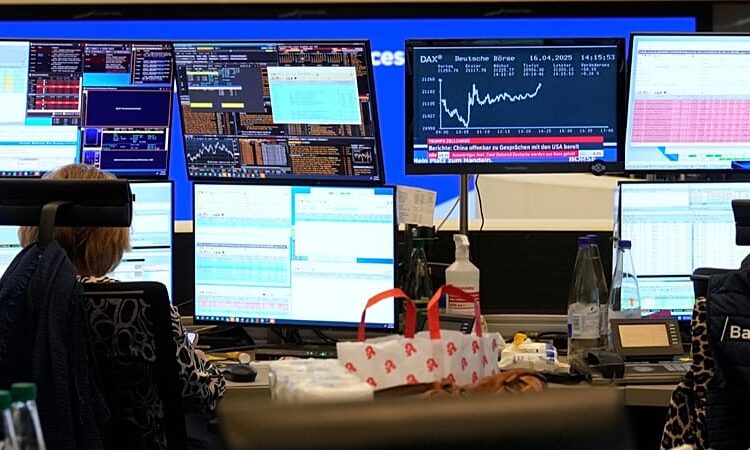
At the time of writing, Germany’s DAX was down around 0.04%, the FTSE 100 recouped earlier losses, up 0.59%, while France’s CAC 40 also edged back into the green, up slightly too, by 0.05%.
The weaker start followed losses in Asia, where shares mostly dipped overnight as concerns persisted around soaring oil prices and the potential for further escalation in the US war with Iran.
“Duration has been the main concern since the first few days of the conflict, and reports of US troops in the region edging nearer to 50,000 implied that a ground invasion could be imminent, despite the President’s protestations otherwise and more in line with the flat denials emanating from Iran,” Richard Hunter, head of markets at Interactive Investor, said in an email commentary note sent to Euronews.
“As the war lingers, so the cost and time of reversing the damage will increase, likely meaning that the oil price could remain elevated for a longer period of time, increasingly inflationary pressure globally,” Hunter added.
Related
The declines follow steep losses on Wall Street on Friday, marking a fifth consecutive losing week — the longest such streak in nearly four years.
“US equity markets remained under sustained pressure, with the S&P 500 falling 2.1% for the week and the Nasdaq 100 sliding 3.2%. The Dow Jones held up comparatively better, declining 0.9%, owing to its lower technology weighting. Both the Nasdaq 100 and the Dow Jones have now officially entered correction territory after recording drawdowns of more than 10% below their respective peaks,” IG market analyst Fabien Yip said in a commentary note.
Japan’s benchmark Nikkei 225 fell 4.5% in early trading, Australia’s S&P/ASX 200 dropped 1.2%, and South Korea’s Kospi slid 3.2%. Hong Kong’s Hang Seng declined 1.7%, while the Shanghai Composite edged 0.7% lower.
Investor worries have been particularly acute due to the risk of disrupted access to the Strait of Hormuz, a critical route for global oil shipments.
Related
Benchmark Brent crude rose above $116 a barrel in early trading, marking an increase of more than 50% since the Iran conflict began on 28 February. Prices were just over $70 a barrel when the war started. US benchmark crude was also up, at around $101 a barrel, reflecting continued volatility in global energy markets.