Miranda Donovan’s Second Act: Twenty Years of Urban Memory, Reframed for London
The British painter-sculptor has joined London Art Exchange ahead of a major mid-November presentation across Marylebone and Bloomsbury. For collectors, the more interesting story is not overnight hype, but what two decades of work may look like when they are finally catalogued, contextualised and seen as a whole.
By the Cash Insight Editorial Desk
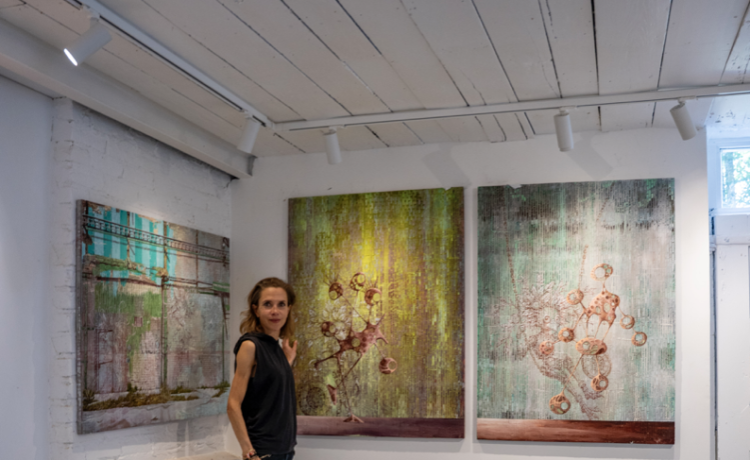
There is something cinematic about a Miranda Donovan painting. From a distance, it resembles a piece of London that has survived rain, neglect and reinvention: a brick wall, a corroded sheet, a surface shedding its history. Up close, the illusion changes. What looked found has been built. Paint becomes architecture; decay becomes biography.
That tension—between toughness and vulnerability, street and studio, collapse and renewal—has powered Donovan’s work for more than 20 years. According to information supplied to Cash Insight, the British artist has been signed by London Art Exchange, with a mid-November presentation planned across Marylebone and Bloomsbury. Four bodies of work are expected to trace her development from urban walls and abandoned interiors towards stranger, psychological figures.
For Donovan, this is less a debut than a reintroduction. Her work has appeared in major auction catalogues, London galleries, private collections and international exhibitions. London Art Exchange can add concentration: one narrative, sustained visibility and a structured catalogue for a long but sometimes fragmented career.
The artist who makes walls remember
Born in 1979, Donovan studied at the École Supérieure des Beaux-Arts d’Aix-en-Provence before completing her fine-art degree at the City & Guilds of London Art School in 2005. Her method draws from building sites as much as painting: acrylic and oil cover construction materials and polymers; miniature bricks are carved and resin imitates metal. These “sculptural paintings” sit between image and object.
Her central subject has long been the wall. In Donovan’s hands, walls divide and protect, preserve messages and absorb damage. Her Urbanscapes and works associated with Lost World of Innocence turn those surfaces into social landscapes, finding beauty in the evidence of human use.
Then the view moved indoors. The Home Unleashed, shown at Lazarides Gallery in 2010 and 2011, reconstructed traditional interiors on three-dimensional panels, then interrupted them with graffiti-like marks. The home became sanctuary and performance, where refinement, disorder and private anxiety occupied the same room. The Independentdescribed it as bringing Donovan’s street language into the domestic realm.
By Metaphors for Mankind at HIX Art’s CNB Gallery in 2016, detailed brickwork sat beside false steel, resin rivets and figures on cement. The argument had become more psychological: civilisation’s cracks were metaphors for the people who made them.
Recent work, including the 2024 Genesis exhibition, pushes into renewal, spirituality and the human form. Donovan’s Sentivars and humanoid figures feel like inhabitants of the world her earlier paintings documented—alert presences emerging after the wall breaks open. The November checklist remains under wraps, but place these chapters together and repetition becomes evolution: brick, peeling paint, ruptured edge and resilient figure form a vocabulary sustained across decades.
The Lazarides years—and the Banksy connection
Donovan’s early career coincided with street art’s move from subculture towards the contemporary market. Within a year of graduating, she was taken on by Lazarides Gallery, founded by Steve Lazarides, Banksy’s former agent and early commercial representative. Donovan was neither managed by Banksy nor derivative of him; she joined the dealer who built a serious market for artists working outside traditional gallery etiquette.
At Lazarides, Donovan exhibited in solo and group presentations alongside a generation that challenged the border between street and fine art. Her own position was always distinctive. She was not simply transferring graffiti onto canvas. She was constructing the wall itself, then using its invented age to ask what cities, homes and people reveal under pressure.
That history gives the forthcoming survey cultural weight. Donovan’s career connects the mid-2000s urban-art surge to a contemporary practice now concerned with ecology, psychology and collective repair. It also helps explain why her work has attracted collectors associated with art, design and hospitality, among them restaurateur Mark Hix, with whom she collaborated on menus, Christmas cards and a suspended work for HIX Soho.
The institutional description requires precision. Donovan has exhibited at the New Art Gallery Walsall and in a presentation at The Public drawn from the Frank Cohen Collection, alongside exhibitions connected with Christie’s, Sotheby’s, the Royal Society of British Artists and the British Art Fair. It is an institution-facing record. The next step is sustained scholarship, documented public placements and wider curatorial recognition. “Institutional” should describe evidence, not serve as a marketing adjective.
Reading the auction record without the hype
Donovan’s secondary market contains both striking successes and visible gaps. The high point remains You Can’t Escape, sold at Sotheby’s London in July 2008 for £37,250 against an estimate of £12,000–£18,000. MutualArt records the result as roughly $74,213 at the exchange rate of the period. A year earlier, Smoke achieved £13,700 against a £5,000–£7,000 estimate. Those sales established that collectors would compete strongly for the right early painting.
The record is not a straight upward line. Rise Through the Web realised £5,250 at Sotheby’s in October 2008, below its £8,000–£12,000 estimate. At Phillips New York, Skip On sold for $8,750 in 2011, within estimate, while later appearances included bought-in works. In 2016, Data, Data, Data, More Data—Piss Data sold at Phillips London for £1,625 against a £3,000–£5,000 estimate.
The most useful recent benchmark is Restored. Offered by Sotheby’s New York in its 2021 Contemporary Art sale with a $30,000–$40,000 estimate, it realised $30,240, according to published auction records. It did not reset Donovan’s record, but it demonstrated renewed demand for a substantial example more than a decade after her first auction peak.
The pattern calls for discernment. Donovan has a public auction history across Sotheby’s and Phillips, but results vary by scale, date, condition and provenance. Works on paper, smaller objects and major constructed paintings belong to different categories. Comparisons should be like for like, and buyers should distinguish hammer price from totals including premium.
For more on the liquidity challenges surrounding niche assets such as fine art, see our examination of interval funds and alternative investments. https://financefundsupdate.com/funds/interval-funds-are-they-worth-what-you-give-up/
What London Art Exchange can change
Kylie James, chief executive of London Art Exchange, has positioned the gallery around what she calls “rigour, integrity and thoughtful curation”. Its published model combines traditional gallery work with structured documentation, digital discovery, catalogue research, collector advice and aftercare. Applied seriously to Donovan, those tools address the central weakness in her market: not an absence of achievement, but an absence of continuous, unified storytelling.
For a broader view of how collectibles fit within modern portfolios, read our analysis of investment management trends in 2025. https://financefundsupdate.com/investments/investment-management-trends-in-2025-working-smarter-not-harder/
The immediate task is catalogue architecture. Two decades of works need consistent titles, dates, dimensions, media, exhibition histories, provenance and condition records. The four-series presentation can then do more than fill rooms: it can show scarcity within each period and clarify why an early constructed wall, a domestic interior and a recent humanoid work should not be priced as interchangeable objects.
The second task is controlled visibility. Studio films, interviews, critical essays, collector conversations and artist talks can reveal the labour hidden inside Donovan’s surfaces. Marylebone and Bloomsbury offer useful contexts—one connected to collectors and commercial London, the other to universities, museums and literary culture. The most effective campaign will avoid turning 20 years of work into a week of noise. Repetition, documentation and access matter more than a single viral moment.
Finally comes market discipline. A credible near-term outcome would be firmer, more consistent primary pricing and stronger sell-through, not an instant auction record. In a constructive medium-term scenario, comparable major works could consolidate around the 2021 $30,240 benchmark, move through the $30,000–$40,000 band, and eventually test the historic 2008 record.
For scale only, $40,000 would represent an increase of about 32 per cent over the 2021 result; $50,000 would be about 65 per cent higher. Neither figure is a forecast. A true record reset above approximately $74,000 would require repeat bidding, exceptional material and evidence that demand extends beyond one gallery’s client base.
The indicators to watch are therefore concrete: sell-through across the November exhibition; waiting lists for specific periods; repeat buyers; independent critical coverage; public or museum acquisitions; and subsequent auction results for comparable works. London Art Exchange itself states that it does not promise future value, resale, liquidity or financial return. That is the correct frame. Art is an illiquid, highly selective market, and cultural significance does not move in a neat percentage line.
A career ready to be seen whole
The strongest case for Miranda Donovan is not that she has suddenly arrived. It is that she never disappeared. She has continued to build, chip, layer and paint while the market around urban art expanded, corrected and matured. Her work has travelled from the street-facing energy of the Lazarides years to a broader consideration of identity, fear, resilience and connection.
November offers London Art Exchange the chance to make that continuity visible. If James and her team can bring curatorial clarity to the archive, widen serious critical engagement and keep supply measured, Donovan’s catalogue may acquire what its best works already possess: depth, legibility and staying power.
That would be more meaningful than a speculative spike. Markets eventually ask the same question as museums and collectors: does the work continue to speak after the excitement has left the room? Donovan’s walls have been answering for 20 years. They remember what happened—and, more importantly, they leave space for what comes next.
Reporting sources
- Miranda Donovan: exhibitions and career chronology
- Woolff Gallery: biography and Genesis works
- Sotheby’s: 2021 Contemporary Art catalogue
- Phillips: Miranda Donovan auction history
- Art.Salon: selected results and estimates
- MutualArt: auction-record overview
- London Art Exchange: message from Kylie James