Financial inclusion has expanded significantly over the past decade, however access to the financial system, while necessary, is not sufficient on its own.
Between 2021 and 2026, the Principles for Responsible Banking Commitment to Financial Health and Inclusion helped catalyze a shift in banking practice: from financial inclusion understood mainly as access, to financial health and inclusion understood as measurable improvements in customers’ financial lives.
The Commitment-helped move financial health and inclusion from aspiration toward operational banking practice, translating an already-emerging concept into accountable banking practice through shared accountability mechanisms, institutional capability and reporting. It aimed to raise the level of ambition from expanding access to the financial systems to also asking banks to show how access, products, services, data and relationships could support financial health and inclusion in measurable and accountable ways.
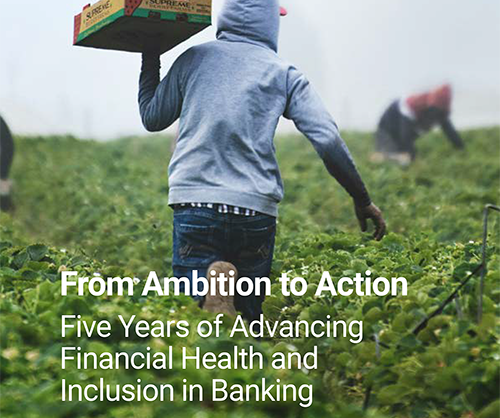
Our new report, “From Ambition to Action: Five Years of Advancing Financial Health and Inclusion in Banking” explores the meaningful actions banks involved in the Commitment have taken in these five years of work.
Of the 30 active banks, 28 have delivered a target, and 26 of those have moved beyond access- or output-only measures towards outcome-oriented assessment of customers’ financial health. Stronger target-setting practices are also emerging more broadly across the wider UN Responsible Banking Community.
The report looks at how banks are putting financial health and inclusion into practice, and what remains for the sector to build on. This includes examples of actions participating institutions have taken across five areas: strategy, internal policies & processes, portfolio composition & financing, client engagement and advocacy & partnerships.
Diverse by region, context and implementation pathway, these case study examples demonstrate that institutions committed to common objectives can adapt implementation measures to fit different business models, customer segments and market realities, thus contributing to a growing body of practical experience across the sector.
As the Commitment moves into its next phase, the focus shifts towards implementation, evidence and continuous improvement, building on the accountability mechanisms, institutional capability and shared approaches this work has developed.
Download the report to learn more about the initial goals of the Commitment to Financial Health and Inclusion, and the five years of work that followed including outcomes, bank practice and next steps.