
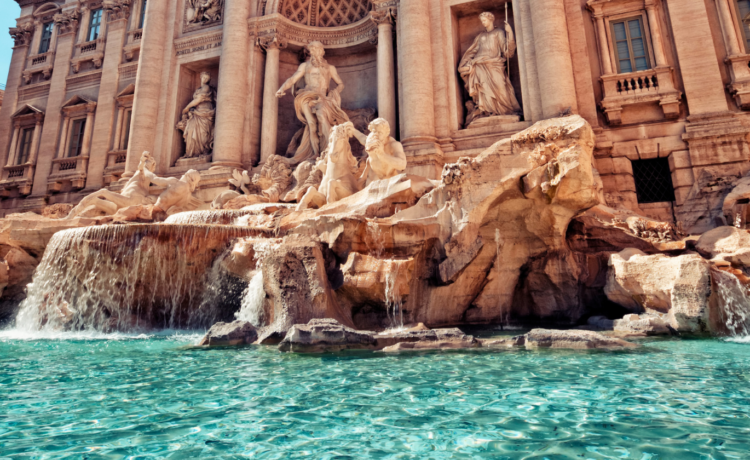
Every day, tourists toss about three thousand euros into the Trevi Fountain to make a wish. That loose change adds up fast. Roughly €3,000 a day comes to close to €1.5 million a year. None of it stays in the basin, though. The city collects it and gives it to a charity that feeds people.
Most people throwing a coin never think about that. The gesture is pure superstition. The result is a welfare budget.
Where the number comes from
The exact figure shifts a little year to year. In 2022 the charity collected €1.4 million from the fountain, and expected more the next year. An older count put the 2016 total at nearly $1.5 million. The range, across the years we have figures for, sits somewhere around €1.4 to €1.5 million annually.
The ritual is older than most tourists realize. It was made famous by the 1954 film Three Coins in the Fountain: toss one and you’ll come back to Rome one day. Enough people believe it, or just enjoy the theatre of it, to keep the basin filling up week after week.
How the crew gets it out
The coins don’t collect themselves. The regional utility ACEA drains the fountain and sends in a small crew to gather the money. The collection happens twice a week with up to four workers, and the fountain gets a proper cleaning a couple of times a month.
The tools are low-tech. Workers balance on the edge of the basin, sweep the coins into piles with long-reach brooms, then vacuum them up with suction hoses. Speed matters, because a dry fountain isn’t much of a landmark. As Francesco Prisco, a manager at ACEA, put it, “The collection and cleaning operations are carried out as quickly as possible to try to reduce the downtime of the fountain.”
Coins aren’t the only thing that turns up. Alberto Colajacomo, a spokesman for Caritas, once described the odder finds: “Among the coins often we find other objects, including glasses, religious medals and even a couple of dentures.”
Where the money goes
Once bagged, the money is handed off. As Colajacomo described the handover, “The [city] council hands over to us bags full of coins thrown into the fountain.” It goes to the Rome branch of Caritas, the Catholic charity that has received the coins since 2001, when then-mayor Francesco Rutelli formalized the arrangement and shut down the freelance coin collecting that had gone on before.
What it funds is concrete. The money runs a food bank, a soup kitchen, a low-cost supermarket known as the Emporium, and other welfare projects. It makes up about 15 percent of the charity’s annual budget. A meaningful slice of a real charity’s income is, quite literally, wishes.
The charity’s people describe it in warmer terms than a balance sheet would. Rev. Benoni Ambarus, who directs the charity, said “The gift that comes from the Trevi Fountain in Rome is a rain of coins that creates a sea of good.” And some tourists know where their coin is headed. Yula Cole, visiting from Brazil, told reporters, “But I also know that this coin is not just staying there but will help needy people.”
Whose coins are they, anyway?
There’s a question under all this: once you throw a coin, is it still yours? Legally and practically, no. The city treats the money as its to give, and the deal to route it to Caritas has held for more than two decades.
Other people have had their own ideas about who it belonged to. The most notorious was Roberto Cercelletta, nicknamed “D’Artagnan,” who scooped coins out of the fountain for 34 years before he was finally caught in 2002. At the height of tourist season, he was reported to have hauled out 22 kilos of coins in 15 minutes. Rutelli’s 2001 reform put an end to the free-for-all and sent the money to charity for good.
What we keep coming back to is how small the individual act is. One person, one coin, one half-remembered movie superstition, tossed and forgotten before the ripples settle. Multiply that by a few thousand a day across a full year, and the wish stops being a wish. It becomes a shelf of groceries, a hot meal, a supermarket a family can actually afford to shop in. Not a bad return on a coin most people never expect to see again.