
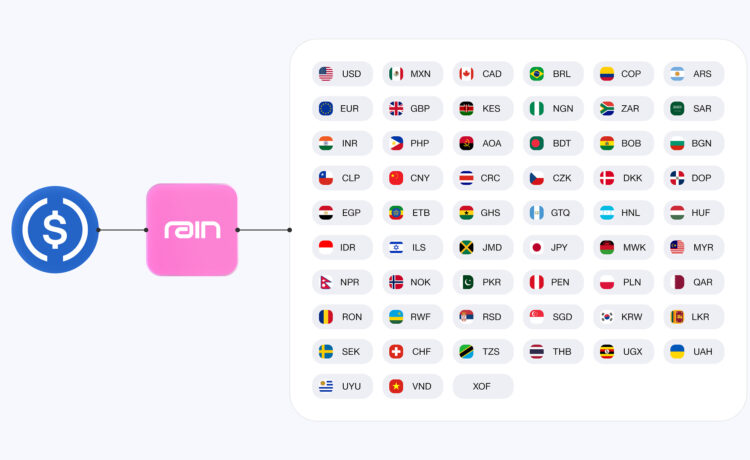
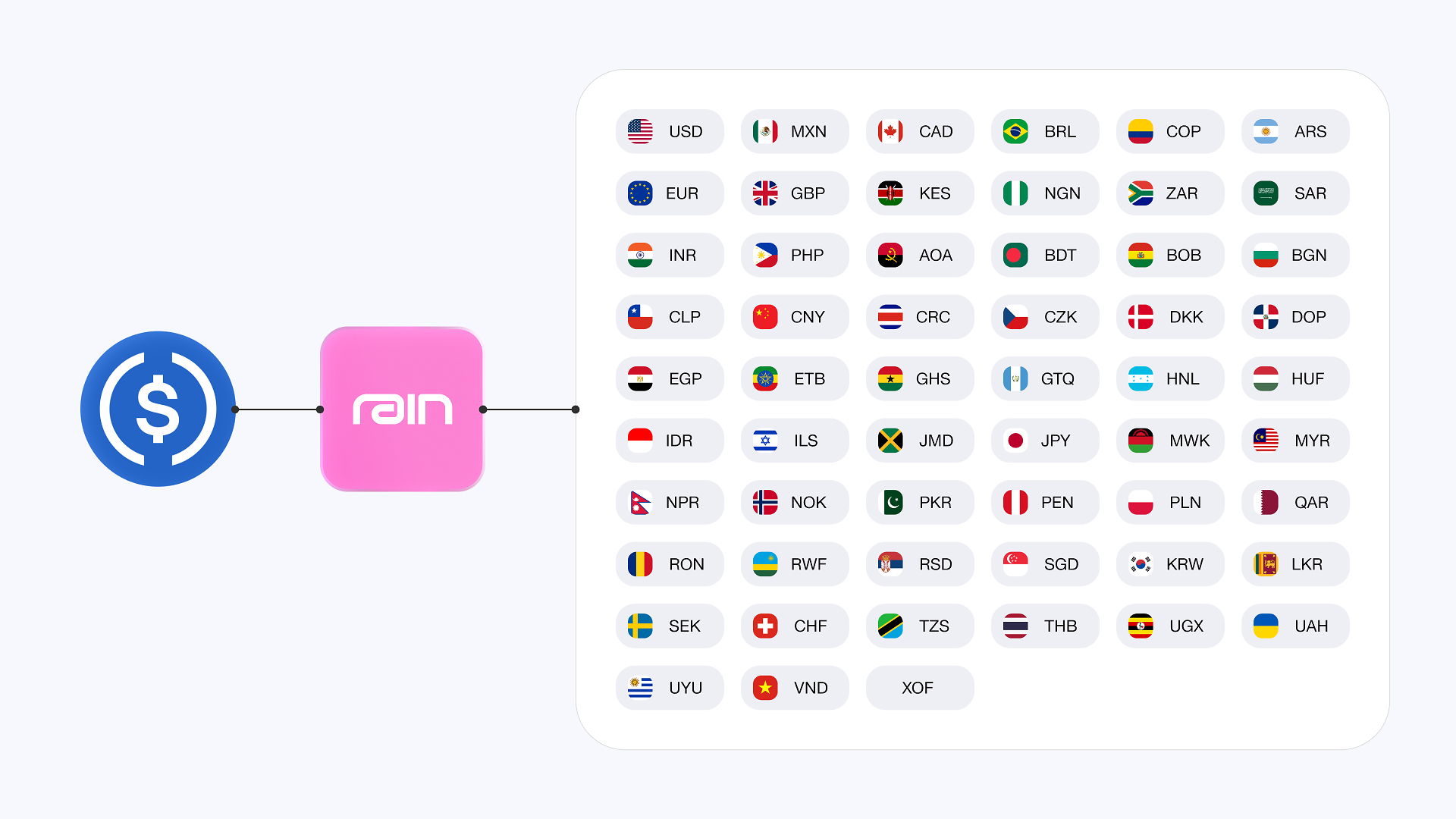
Rain has expanded its global money movement infrastructure to support stablecoin-funded payouts in more than 80 countries and 50 currencies, giving businesses and financial platforms a way to move funds from onchain balances into recipients’ local bank accounts.
The New York-based stablecoin payments company plans to extend the service to 95 countries and more than 60 currencies by the end of 2026. Global payouts are currently available to a select group of beta partners, with broader availability expected later this year.
The expansion addresses a practical constraint in stablecoin payments: moving digital balances into the local currencies and banking systems that businesses, contractors and consumers use for everyday transactions. Rain’s system allows partners to initiate payments directly from stablecoin balances, with licensed partners handling conversion into local currency and delivery through local payment rails.
The infrastructure supports business-to-business, business-to-consumer, consumer-to-consumer and consumer-to-business transactions. Payments can be directed to a partner’s own account or to third parties, covering use cases including supplier payments, contractor disbursements, marketplace payouts and consumer transfers.
Settlement speeds vary by destination and payment rail. Rain said many corridors can settle in real time, while others require as long as two business days.
The capability expands Rain beyond its original focus on making stablecoins spendable through payment cards. With its card infrastructure, purchases are authorized through conventional card networks while Rain handles settlement in stablecoins behind the transaction and merchants receive fiat currency. The global payouts product applies a similar bridge between stablecoins and traditional financial infrastructure to transfers that do not involve cards.
Rain already offers virtual accounts that allow partners to move funds between fiat currencies and stablecoins. The new service extends the payout side of that infrastructure across additional local currencies and domestic payment networks.
In practice, a partner could use a virtual account to bring Mexican pesos onchain, maintain the value as stablecoins and subsequently initiate a payment to a vendor in Argentina. A licensed partner would then deliver Argentine pesos to the vendor’s bank account.
That architecture is intended to reduce the number of banking relationships and payment providers companies must manage when operating across multiple markets.
“Partners don’t want to stitch together several vendors every time they need to pay someone in a new country,” said Charles Yoo-Naut, Rain’s CTO and co-founder. “They want one platform that powers the whole flow of funds, from stablecoins to local currency, wherever that money needs to land.”
The operating model could be particularly relevant for marketplaces and contractor platforms managing large numbers of cross-border payments. Instead of prefunding separate accounts in each country, those businesses can initiate local-currency payouts from a common stablecoin balance. Neobanks can similarly add cross-border money movement without establishing and maintaining their own banking relationships in every supported market.
Businesses can also use the infrastructure to pay overseas suppliers from onchain balances without requiring recipients to accept stablecoins themselves. That distinction is important for commercial adoption because it allows stablecoin infrastructure to operate behind existing payment workflows rather than forcing vendors or contractors to change how they receive money.
Global payouts becomes another component of Rain’s broader payments stack, which includes card issuing, rewards, embedded wallets, virtual accounts, and fiat and stablecoin onramps and offramps. Partners can use the platform as an integrated system or deploy individual components.
Rain serves enterprises, neobanks, platforms, developers and AI agents and is a Visa and Mastercard Principal Member. Its cards operate at more than 175 million merchant locations across more than 200 countries and territories, and the company says its infrastructure is used by more than 100 organizations worldwide.
The payout expansion pushes Rain further into the infrastructure connecting stablecoins with conventional banking and payment networks. Rather than requiring recipients to participate directly in an onchain transaction, the system handles conversion and routing behind the scenes, allowing funds originating as stablecoins to arrive in the currency and bank account the recipient already uses.