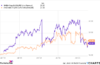

European oil shares pulled away from the broader market on Monday morning. In delayed quote snapshots at about 07:10 UTC, BP gained 1.4% to 572.3 pence, Shell rose 1.0% to 3,587 pence, TotalEnergies added 1.1% to €79.66 and Equinor advanced 1.3% to NOK421.10. The Euro Stoxx 50, by contrast, was down 0.5%.
The split is a concise market verdict on $107 oil. Investors are rewarding the producers’ near-term cash exposure while marking down businesses that must absorb dearer fuel, freight and financing. It is a relative trade, however, rather than an unqualified vote of confidence in the energy sector.
Brent futures traded at $107.31 a barrel at 06:55 UTC, up 2.6% from Friday’s $104.61 reference. The supply backdrop predates Monday’s move: Brent briefly exceeded $108 and settled at $107.63 on Thursday as the war with Iran continued to obstruct crude flows, according to an Associated Press market report. AP put the benchmark below $72 in early July. That scale of increase turns oil from an industry earnings input into a wider inflation risk.
Why the shares lagged the barrel
The four stocks rose by less than Brent on Monday. That is rational. Integrated producers do not deliver a one-for-one exposure to a daily futures quote: realized prices can lag, gas and power have separate benchmarks, tax takes rise with profit, and refining or chemicals can suffer when feedstock costs jump. A disruption may also lift the commodity price while reducing the volume a company can move.
The latest company accounts show why the cash-flow benefit still matters. Shell reported $9.8 billion of adjusted earnings and $21.4 billion of cash flow from operations for the second quarter, while keeping its 2026 cash-capital-spending outlook at $24 billion to $26 billion. TotalEnergies reported $9.8 billion of second-quarter cash flow, $6 billion of adjusted net income and gearing of 13%. Equinor generated $7.68 billion of cash flow from operations after tax, against $3.35 billion of organic capital expenditure, as production rose 3% from a year earlier.
The operating mix separates the names. Equinor realized $97.90 a barrel for liquids in the second quarter and $15.80 per million British thermal units for European gas; higher prices fed an adjusted operating profit of $11.48 billion. Shell’s quarter paired record upstream production in Brazil with record refinery utilization. TotalEnergies explicitly attributed its cash increase to a high-commodity-price environment and its integrated model.
That difference can change the share-price response. Equinor offers greater production and European-gas sensitivity, while BP, Shell and TotalEnergies have larger refining, marketing and customer businesses that can offset or amplify an upstream gain. Trading can add value in a volatile market, but it is not predictable from the Brent screen. Monday’s near-identical gains therefore do not establish that the four companies have identical earnings leverage.
Those figures use different company definitions and should not be treated as a league table. For Shell, TotalEnergies and Equinor, they establish a cash buffer behind Monday’s move. Equinor’s 10.4% adjusted net-debt ratio and TotalEnergies’ 13% gearing also suggest more room to preserve distributions if the price shock proves temporary.
The test is duration, not Monday’s percentage
The bullish case requires Brent to remain elevated without a matching loss of production or a collapse in demand. Under that combination, analysts can lift realized-price assumptions and cash-flow estimates, strengthening dividend and buyback capacity. Equinor has already framed its 2027 buybacks around oil of $60 to $80 a barrel; its June capital-markets update set a $2 billion to $4 billion annual range at those prices. Oil above $100 creates headroom, but only while barrels keep flowing.
The counterargument is visible in the red Euro Stoxx screen. Persistent $100-plus crude can weaken consumption, keep inflation sticky and restrain rate cuts. Those effects eventually reach oil companies through slower demand, weaker refining margins and lower non-energy equity valuations. Higher windfall taxes or physical outages would take another slice of the upside.
For the next leg, the useful signal is not another intraday Brent spike. It is whether the majors retain their relative gains when crude steadies, followed by higher realized prices and operating cash flow in their next reports. If the shares surrender Monday’s advantage while oil remains near $107, the market will be saying that disruption and demand risk outweigh the extra revenue per barrel.