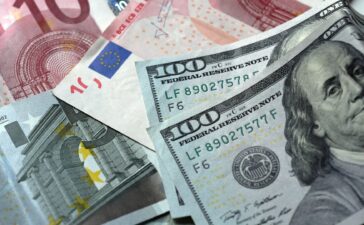

Whither the US dollar? That was the question which dominated discussion among the leaders of the global financial system as they gathered in Washington last week for the spring meetings of the International Monetary Fund and the World Bank.
A report by Colby Smith in the New York Times captured some of the atmosphere.
The article began by referencing remarks by US Treasury Secretary Scott Bessent to a crowd of policymakers, regulators, and investors at which he tried to calm their nerves by assuring them the US wanted a “strong dollar” and they would want to hold it.
The aim was to provide a “salve,” the article said, after “violent swings in stocks, coinciding with the weakening of the dollar,” and moves by investors out of US government bonds, had “incited panic.”

“The fact that Mr. Bessent found it necessary to emphasize the message in front of such a big crowd underscored how precarious the situation had become since Mr. Trump returned to the White House less than 100 days ago. What now looms large are uncomfortable questions about what happens if the international community starts to lose faith in the dollar and other US assets.”
According to Nathan Sheets, the chief economist at Citigroup: “People are playing through scenarios that previously would have been judged unthinkable, and they’re playing them in a very serious kind of way in the spirit of contingency planning.”
Regulators, government officials and investors would like to believe that the present turbulence is a passing phase, that things will settle down and there will be a return to “normalcy” before too much damage is done.
But a historical analysis shows that whatever the ups and downs in the market in the coming period, a fundamental shift has taken place.
The period of what is referred to as the global economic order falls into two phases: the period from 1945 to 1971 and from 1971 to today.
In the first period, the international financial system was based on the Bretton Woods Agreement of 1944 under which the dollar, backed by gold at the rate of $35 per ounce, became the global currency. It was aimed at ending the mayhem of the 1930s when the trading system all but collapsed, and the world was divided into rival blocs.
That system ended on August 15, 1971, when President Nixon withdrew the gold backing from the dollar under conditions where the US could not honor its commitments because of a widening of its balance of payments and balance of trade deficits. It was a sign that the economic dominance of the US—the basis of the Bretton Woods Agreement—was significantly weakening.
After major finance turbulence and rampant inflation, the dollar conditioned to function as the global currency. But it did so on an entirely different foundation.
No longer was it backed by gold—the embodiment of real value. It was a fiat currency resting on international confidence in the financial power of the US state. This system had major effects.
Freed from the constraints imposed by its nexus with gold, the dollar became the center of a vast system of international credit that grew every year as finance capital sought to appropriate profit via market operations.
As part of the Bretton Woods system, currency rates were fixed and, consequently, there were major restrictions on the flow of US and international finance capital. Now it was cut loose as the US, the UK and other major governments scrapped virtually all their previous regulatory measures, many of which went back to the 1930s.
This system rested on confidence in the financial power of the US state. No less important was confidence in the stability of its political structure and the rule of law.
Now they are all being called into question.
As Mark Soble, the US chairman of the Official Monetary and Financial Institutions Forum, told the Times: “The dollar’s role in the system was not ordained from above. It’s a reflection of the properties of the United States.”
Those included: a large economy transacting with the rest of the world; the financial system’s deepest, most liquid markets; a credible central bank, and the rule of law.
These foundations have either been shattered or are in an advanced stage of disintegration.
The policy of the Trump administration, in conditions of a globalized economy, is grounded on virulent economic nationalism, such that, with tariff hikes of 145 percent on China, it has placed a wall between the US and the world’s number two economy.
And what future for “transacting with the rest of the world” when it is regarded as the enemy “ripping off” the US, as Trump endlessly repeats.
And what of the “deepest and most liquid markets?” Ever since the global financial crisis of 2008, set off by the speculative activity of US banks and financial institutions, the stability of the now $29 trillion US Treasury market has been of increasing concern.
In March 2020, at the start of the COVID pandemic, the market froze. For several days, there were no buyers for US government debt—supposedly the safest financial asset in the world. A complete meltdown was only prevented through a massive intervention by the US Federal Reserve to the tune of trillions of dollars.
The credibility of the Fed, the US central bank, a key factor in necessary stability identified by Sobel, has been called into question with the threats by Trump to sack its chair, Jerome Powell. Trump has walked back that threat, after receiving warnings that it would tank the financial system, but the damage has been done.
The question now being raised is who Trump will appoint to the post when Powell’s term expires next year. Will it be someone who maintains the Fed’s so-called “independence”—that it steadfastly adheres to the demands of finance that it contains inflation—or someone who toes the Trump line, whatever that may be on any given day?
As for the “rule of law,” that is being trashed daily as the president and his supporters declare themselves to be above the law, defy court orders and have even started arresting judges.
In the present turmoil, erupting in the month since “liberation day” when Trump unleashed his economic war against the world, the most concern in financial circles has been caused by the reversal of a long-established trend.
The many storms of the past period—going back nearly 40 years ago to the stock market crash of October 1987—have been characterized by a move into the US dollar and American financial assets in the search for a safe haven.
Not on this occasion. Rather, there has been a sell-off of US Treasury debt, leading to a rise in yields, or interest rates—the two move in the opposite direction—and the dollar has continued to fall in international currency markets.
An article published on The Hill by Vivekanand Jayakumara, a professor of economics at the University of Tampa, noted that the “textbook viewpoint” was that the imposition of tariffs by the US would strengthen the dollar.
“Yet reality has turned out to be quite different … For the first time in living memory, the American dollar is not the automatic ‘flight-to-safety’ currency, sought by investors worldwide during crisis periods and in moments of acute uncertainty.”
In fact, the overwhelming sentiment in financial markets is “sell America.”
Long-time historian and student of the international monetary system, Barry Eichengreen, told the Times that a “dire scenario is now on the table.”
“A chaotic rush out of the dollar would be a crisis. All of a sudden, the world would not have the international liquidity that 21st-century globalisation depends on.”
And there is no other currency which can play the international role of the dollar.
BNP Paribas chief economist Isabelle Mateos y Lago told the Times the search for “diversification” had to be realistic as “reserve assets, by definition, have to be liquid.”
China did not meet these criteria, lacking deep and liquid capital markets and its currency did not float freely. The European Central Bank would like to promote the euro, but the amount of euro-denominated assets “pales in comparison with that of US capital markets.”
But having made these correct observations, she went on to say: “A multipolar system can totally work.”
This claim appears to be based on nothing more than the “common sense” assumption that if the US can no longer play the role of international reserve currency, then there is safety in additional numbers.
Demonstrating the worthlessness of “common sense” when grappling with the contradictions of the capitalist system, the assessment of a multipolar world ignores both present day reality and history.
The US regards maintenance of dollar supremacy as an existential question because it enables the state to run up massive debts both to prop its economy and finance its vast war machine.
In the election campaign Trump, said losing it would be the equivalent of losing a war and since coming to power has said any effort by the BRICS group of countries to fashion an alternative, along with other countries, would be met with retaliation from the US.
The lessons of history are likewise ignored. There has been a multipolar world in the past. In the 1930s there was no universally recognised international means of payment, apart from gold, and the world fractured into rival blocs, which played a not inconsiderable part in creating the conditions for World War 2.
Today a multipolar world would reproduce those conditions in an even more explosive form.
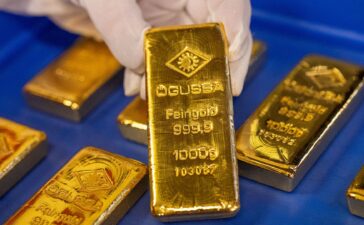
And any return to gold, which has been rising to record highs, reaching as much as $3500 per ounce would mean a collapse of the financial asset and credit mountain based on the US dollar, leading to a global depression.
This issue has arisen before. In 1971, Nixon was aware the only way gold backing for the US dollar could have been maintained was to plunge the American and global economy into deep recession. He rejected this because of the upsurge of the class struggle and the threat of social revolution it would have produced.
The present crisis is not merely the product of the madness of Donald Trump. He is the malignant personification of tendencies and contradictions that have been building up for decades. The crisis of the dollar and the financial system resting on it is a crisis of the entire capitalist system which has no way out unless war, fascism, depression and social devastation be considered a solution.
Confronted with this historic breakdown, not a threatening storm cloud on the horizon but a present reality, the international working class must adopt and fight for its own independent socialist strategy. That will at the very centre of the May Day meeting to be held on May 3.