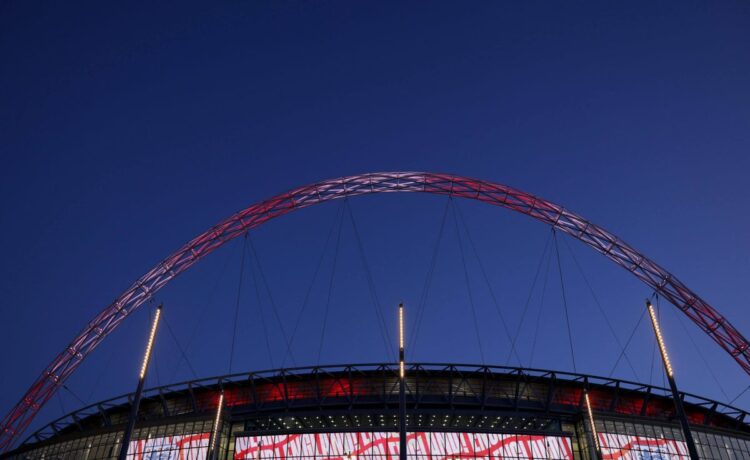
For the second time in three tournaments, Wembley Stadium will host the final and both semi-finals of the next European Championship, UEFA has announced.
Just as in Euro 2020, the English national stadium in London will be the venue for the final three matches of Euro 2028, as well as playing host to one of the four quarter-finals.
England, Scotland, Wales and the Republic of Ireland will jointly host the tournament — following on from the continent-wide finals in the summer of 2021, and Euro 2024 in Germany.
Each host nation will play all three group games in front of their own fans if they qualify directly, with England to begin the tournament at the Etihad Stadium before two games at Wembley – while Wales, the Republic of Ireland and Scotland will play them in Cardiff, Dublin and Glasgow, respectively.
The other three quarter-finals will be played in each of the other host nations: Cardiff’s Principality Stadium in Wales (listed as the National Stadium of Wales by UEFA); the Aviva Stadium (Dublin Arena) in the Republic of Ireland; and Hampden Park in Glasgow, Scotland.
The 24-team tournament will open in Wales, with the Principality Stadium hosting the opening game on Friday, June 9. The final will take place exactly a month later on Sunday, July 9.
There are nine host stadiums in total, also including the homes of five clubs from the English Premier League: Newcastle’s St. James’ Park; Everton’s Hill Dickinson Stadium (Everton Stadium), Aston Villa’s Villa Park, the Tottenham Hotspur Stadium and the Etihad Stadium (Manchester City Stadium), home of Manchester City.
The Dublin Arena will host five group-stage matches and Villa Park three, with the remaining seven venues hosting four each. Wembley is the only venue which will not stage one of the eight round-of-16 matches.
Each host city will stage a minimum of two different groups to provide local fans with a variety of teams to watch. There will be 51 games in total, with matches kicking off at 2pm, 5pm and 8pm GMT.
What are the venues?
Nine stadiums will host matches; the traditional homes of the four host nations, as well as five clubs’ grounds which are spread across England.
They are (listed in order of capacity):
- London — Wembley Stadium (90,652)
- Cardiff — National Stadium of Wales (73,952)
- London — Tottenham Hotspur Stadium (62,322)
- Manchester — Manchester City Stadium (61,000)
- Liverpool — Everton Stadium (52,679)
- Newcastle — St James’ Park (52,305)
- Birmingham — Villa Park (52,190)
- Glasgow — Hampden Park (52,032)
- Dublin — Dublin Arena (51,711)
Weren’t Northern Ireland also supposed to be hosts?
Yes. Casement Park in Belfast was initially named as a tenth host venue but it was stripped of its status in September 2024 because the UK government could not commit to providing the funding for it to be rebuilt in time for the tournament.
At the time, the government cited a “significant risk” that the stadium would not be completed for summer 2028, and estimated the project could cost over £400million.
Northern Ireland were subsequently removed as a host nation, having initially been part of the joint UK and Ireland bid, and will have to qualify for the tournament via the traditional route in order to take part.
Belfast will, however, host the qualifying draw on December 6 at the ICC Belfast, with UEFA saying “Northern Ireland (remain) as a valuable partner (and) will contribute to the Tournament’s success and celebration”.
Why is Old Trafford not a host venue?
Manchester United’s Old Trafford is the largest club football stadium in the United Kingdom, with a capacity of just over 74,000, and was initially shortlisted by the English Football Association (FA) as a potential Euro 2028 venue.
However, following consultation between United and the FA, it was mutually agreed that Old Trafford — which was one of eight host venues at Euro 1996 — should not be included because, as the club announced in 2023, there is an intention to redevelop the stadium.
United therefore did not want to commit to being involved, amid fears they may be forced to pull out nearer the time because the stadium was behind schedule.
In announcing the plans in March United’s co-owner Sir Jim Ratcliffe said he expects “a five-year project rather than a 10 year”.
Who does the schedule appear to favour?
All four home nations will benefit from home advantage but, as the only traditional European heavyweight, the schedule appears most favourable for England.
For the second time in three European Championships, England would have home advantage in both the semi-final and final, should they progress that far.
The Three Lions can also expect to play the majority of their games at their traditional home, with widespread reports suggesting they are likely to play five of their seven matches at Wembley if they reach a third successive final.
England can expect to open the tournament in Manchester before two games at Wembley, although with no last-16 games at the English national stadium, they could then be forced to travel.
How will teams qualify?
As with UEFA qualifying for both Euro 2024 and next summer’s World Cup, 12 qualifying groups will be formed of either four or five teams.
Unlike for Euro 2024, when hosts Germany did not take part in qualifying, hosts England, the Republic of Ireland, Scotland and Wales will participate, drawn into separate groups.
The 12 group winners and eight best runners-up (20 teams in total) will advance directly to the tournament.
Two spots in the finals will then be reserved for the two best-ranked host nations who do not qualify as group winners or best runners-up after the group stage.
The remaining spots will be assigned via play-offs between the remaining runners-up in the qualifying groups, and the best-ranked 2026/27 Nations League non-qualified group winners.
Depending on the number of places taken up by host nations, the number of final tournament spots decided by play-offs will vary between two and four.