The issue
Trump’s unpredictable trade policy has diminished faith in US assets, and the euro has risen as an attractive alternative destination for investors. That wasn’t the consensus at the beginning of the year when some analysts were expecting we’d see parity between the two currencies, but now JPMorgan Chase & Co., BNP Paribas SA and Danske Bank A/S predict a euro will buy $1.20 or more by year end. While Trump’s policies were expected to stoke inflation leading to expectations of slower Federal Reserve rate cuts or even hikes that would have benefitted the dollar at the euro’s expense.
The euro rally persists despite a widening two-year sovereign yield discount to US Treasuries. The deviation from interest-rate differentials follows a strong correlation last year. Looking at a 10-year chart shows the 2Y US-Germany spread has been wide for extensive periods before, including periods of euro strength and low correlation.
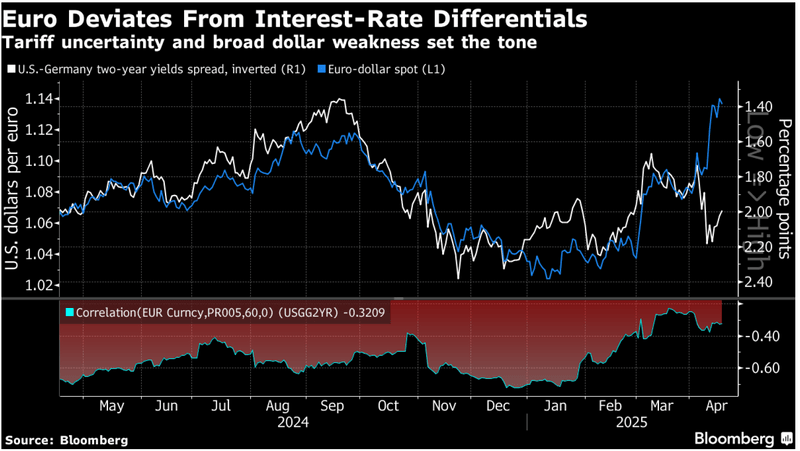
European debt may present as a better alternative to US bonds for many global investors and the ECB’s interest rate cut is likely to have less of a negative impact on the euro than it has had in the past. “Tariff uncertainty and broad dollar weakness remain the dominant drivers in spot and options, decoupling FX price action from traditional rate differential narratives,” Vassilis Karamanis, an FX strategist for Bloomberg News, wrote in his ECB Cheat Sheet.
Tracking
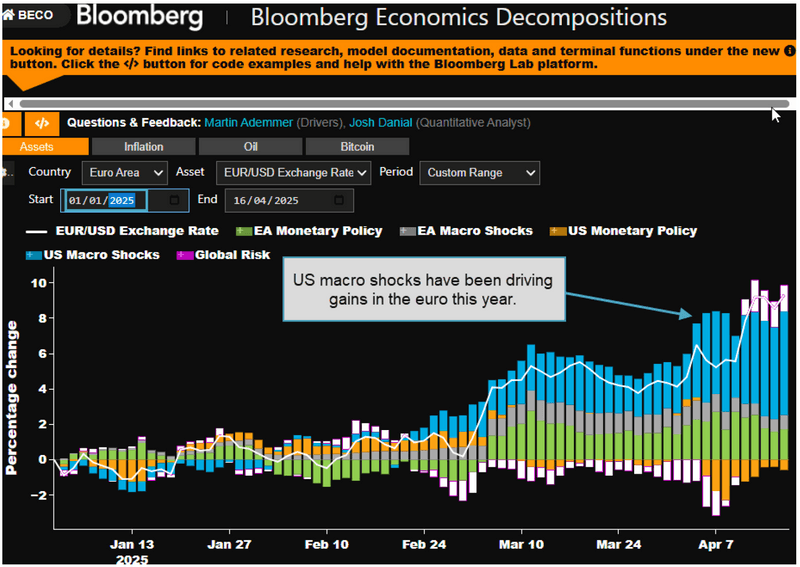
US macro shocks have fueled the euro’s ascent. Track the shift in global risks and their impact with BECO MODELS DRIVERS
For more information on this or other functionality, click here to request a demo with a Bloomberg sales representative. Existing clients can press