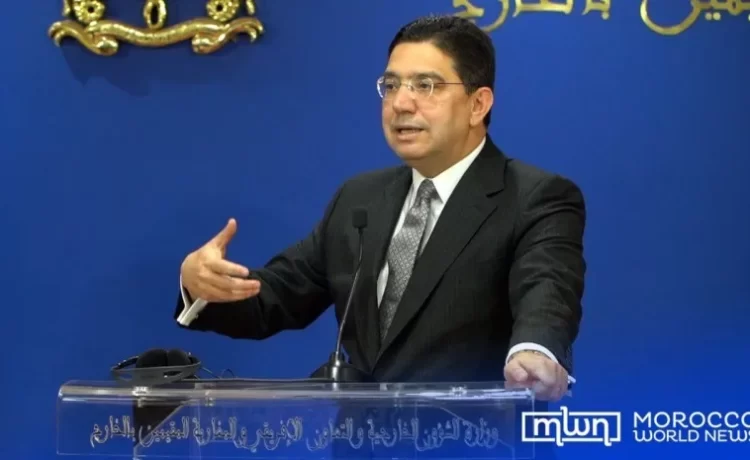
Speaking at the opening of the High-Level Retreat on Future of Euro-Mediterranean Relations, held by Morocco’s Ministry of Foreign Affairs, Nasser Bourita gave a frank assessment of the Union for the Mediterranean (UfM) and the Euro-Mediterranean process, advocating an ambitious and concrete roadmap for its revival.
“Far more than a sea or a border, the Mediterranean is an ecosystem and a shared asset that must bring us together,” he said. “When we treat the Mediterranean as a mere file, it eludes us; when we treat it as a shared asset, it brings us together,” the minister said on this topic.
Explaining Morocco’s initiative to act as the “legitimate and obvious host” for this strategic reflection, Bourita highlighted Morocco’s “reliability, experience, and method,” emphasizing its pioneering role at the heart of the Euro-Mediterranean Partnership for three decades.
Morocco, he recalled, was the first country to embody the Advanced Status, to set up a Human Rights Subcommittee, to benefit from a Mobility Partnership, and to make environmental commitments.
On an operational level, the North African country has always been a pioneer in concretizing political commitments into action, through tangible cooperation with Spain, France, and Germany, among others, the minister noted.
Bourita also spoke of Morocco’s vision, which is to “no longer treat the South as the periphery of a program, but as the second half of a space to be built together.”
Recalling that King Mohammed VI has based Morocco’s foreign policy on two principles—clarity and ambition—, Bourita then made a clinical diagnosis of the Euro-Mediterranean process.
In this regard, he referred to “ontological uncertainty” about the identity of the process, showing that more efforts are needed to develop a “clear common vision” on the concrete objectives of the partnership and its operational implications.
The minister also noted “asymmetry of motivation” among Euro-Mediterranean partners, reflecting the mismatch between the expectations of the North, which prioritizes stability and security, and the South, which aspires to development and mobility.
Bourita also highlighted “geopolitical divide” in a region rife with tensions, where Euromed has lost its central role amid a proliferation of initiatives. He also noted “a failure to manage crises,” particularly in health, energy, and food, as well as “a lack of social visibility,” given that the project is perceived as elitist and does not sufficiently engage with citizens.
In this context, he called for a mutually beneficial partnership, outlining Morocco’s vision on this subject, structured around four concrete pillars, namely “securing all strategic supplies,” particularly in the areas of energy and food security, “connecting economies” by optimizing Euromed as a platform for co-production and creating strategic corridors linking the Mediterranean, Africa and the Atlantic.
He also urged “mobilizing skills” by turning migration into an opportunity through smart mobility and sustainable mechanisms for training and recognition of qualifications, as well as “rebuilding political dialogue” by establishing a frank dialogue to overcome obstacles through a “Mediterranean Political Forum” using the UfM as a political umbrella.
To implement this vision, Bourita proposed an innovative mechanism of “voluntary coalitions,” composed of at least one country from the North and one country from the South, which would act in an agile and concrete manner on specific projects, without being blocked by non-participants.
Funding would be provided through the creation of a Euro-Mediterranean Cohesion Fund, based on a hybrid guarantee mechanism, he said, adding that mechanisms for accountability and responsibility to citizens should be put in place in order to regain social legitimacy.
With a view to transforming the Euro-Mediterranean area into a genuine geopolitical partnership, this high-level retreat brings together leaders, economic operators, and academics for an open dialogue to anticipate future challenges and meet the expectations of the people.
MWN with MAP