Spain’s 3-1 win against Italy in Bern on Friday confirmed their position as Group B winners, maintained their 100 per cent record at Euro 2025, and also secured themselves the weakest knockout-stage opponents in the quarter-finals.
The world champions have been the best side of the tournament’s group phase. But, of course, the best side in a group phase doesn’t always end up winning the tournament.
And that feels a particularly pertinent sentiment in Bern, the Swiss city that was the scene of the greatest example in football history of a dominant group-stage side falling short.
At the 1954 World Cup, Hungary were clearly the best side in the opening phase, defeating West Germany 8-3 and South Korea 9-0. It seemed unlikely anyone else would win the competition. It was even more unthinkable that one of their group-stage opponents would do so. But, somehow, it was West Germany who beat them 3-2 in the final, here at the old Wankdorf Stadium in the so-called Miracle of Bern.
This was Spain’s least impressive group-stage display of the three.
They were playing at half-pace against Italy for much of the match, with manager Montse Tome having rotated her side to leave out key players in attack and the full-back positions, having all but qualified for the quarter-finals already. Spain simply needed to avoid defeat, which was briefly on the cards when Elisabetta Oliviero opened the scoring against the run of play. But that only produced a frenetic four-minute spell of Spanish dominance, which ended when Athenea del Castillo played a one-two with Alexia Putellas and then fired into the top corner for possibly the goal of the tournament so far.
It was a sudden, blatant demonstration of Spain’s ability to go through the gears when required; almost a warning sign for future opponents not to dare to go in front against them.
In the second half, a low shot from the magnificent Patri Guijarro put Spain ahead, before the rested — and somewhat missed — Esther Gonzalez came off the bench to belt home a rebound from a yard out in stoppage time. She now leads the Golden Boot standings on four goals, and her closest challenger is her team-mate Putellas, albeit with half the 16 teams in the tournament yet to play their third and final group match.

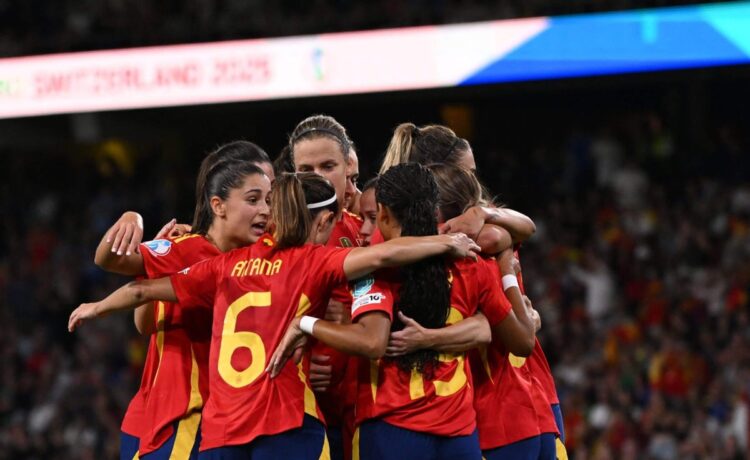
Guijarro celebrates her goal (Miguel Medina/AFP via Getty Images)
Spain’s quality in possession throughout this group stage has been phenomenal, significantly superior to anything they produced in winning the World Cup two years ago.
At that tournament in Australia and New Zealand, they used possession to control the match, but lacked penetration. Here in Switzerland, the understanding between the attackers, particularly with the use of quick one-twos and triangles to get in behind opponents, has been marvellous to watch and highly effective.
It’s not an exaggeration to say that this is significantly in advance of anything the women’s game has seen before.
The closest thing might be the football played by Japan during their first four matches at that 2023 World Cup, which included a 4-0 group-stage destruction of the Spanish. They too played flowing combination football, with a revolving cast popping up in goalscoring positions.
There’s a place in football for direct attackers dominating through one-on-one duels, as France showed here in their opening 2-1 victory over England. But the greatest teams always advance the game with their combination play, and this Spain side belong in that category.
Tome’s XI for last night’s contest was nevertheless a little more direct than that of their previous game, with Salma Paralluelo offering speed in behind up front — which proved largely ineffective against a deep defence — and Del Castillo bringing dribbling quality from the right. But these players are likely to be used from the bench in the knockout phase, alongside Vicky Lopez, who started the tournament in the side but is now a reserve, due to the return of Aitana Bonmati.
The only question about Spain in the final third is whether Bonmati is at her best after a recent illness. The reigning Ballon d’Or winner hasn’t looked as sharp as her attacking colleagues.
The caveat to all this praise is that the Spanish do give opponents chances. Italy repeatedly launched quick breaks that should have progressed into more promising situations. They found it relatively simple to get in behind, even if a couple of their missed chances might have been offside, with VAR likely to have intervened if the ball had ended up in the net.
Tome seems to accept this as a consequence of the way her side play, although you suspect she’ll be working on their offside line in training before the quarter-finals, as this might prove Spain’s most useful route to preventing opponents getting through on goal.
Like when they won that World Cup two years ago, Spain’s first knockout game will be against Switzerland. They were 5-1 winners in Auckland then, although it’s clear that the Swiss, with home advantage this time, are now a more fearsome prospect.
Then again, so are the Spanish.
They are likely to break Swiss hearts back here on Friday, and going down to this magnificent side might be a dignified way for the hosts to exit. But who knows?
As 1954 shows, in Bern, miracles can happen.
(Top photo: Miguel Medina/AFP via Getty Images)