
How finance leaders evaluate nonprofit budgeting software for grant tracking, reporting, and multi-department financial planning.
Key Capabilities of Modern Nonprofit Budgeting Software for Finance Teams

NEW YORK, NY, April 11, 2026 (GLOBE NEWSWIRE) — Nonprofit organizations are facing increasing financial complexity as they manage multiple funding sources, grant requirements, and distributed teams. As a result, finance leaders are re-evaluating how they approach budgeting, reporting, and financial oversight, driving demand for modern nonprofit budgeting software that replaces spreadsheets with structured, collaborative systems.
Today’s nonprofit finance teams must manage restricted and unrestricted funds, multi-department budgets, grant compliance, and board-level reporting requirements—often within the same financial framework. Traditional spreadsheet-based workflows struggle to scale under this complexity, leading to errors, inefficiencies, and limited visibility across the organization.
_____
Key Facts: What Defines Modern Nonprofit Budgeting Software
-
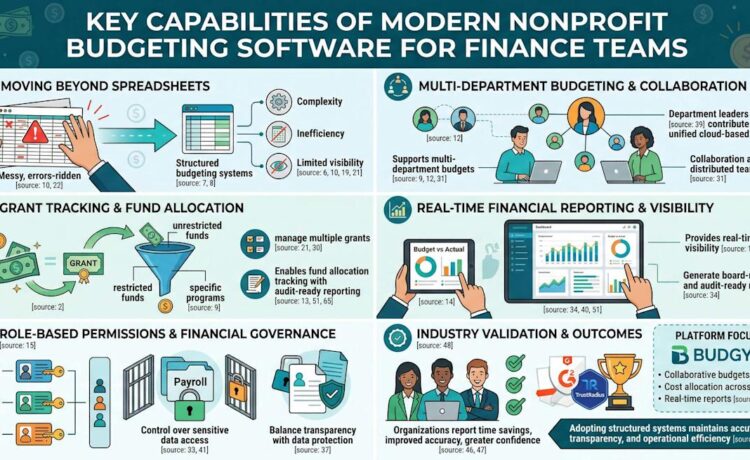
Supports multi-department budgeting across distributed teams
-
Enables grant and fund allocation tracking with audit-ready reporting
-
Provides real-time budget vs actual visibility
-
Includes role-based permissions for financial governance
-
Reduces reliance on spreadsheets and manual workflows
_____
Why Nonprofits Are Moving Beyond Spreadsheets
For many organizations, spreadsheets remain the default tool for budgeting. However, as nonprofits grow, this approach becomes increasingly difficult to manage.
Common challenges include:
-
Managing multiple grants with evolving funding requirements
-
Allocating payroll and expenses across programs
-
Maintaining version control across departments and contributors
-
Preparing accurate, audit-ready reports for boards and stakeholders
These challenges often result in time-consuming manual processes and increased risk of reporting errors. As financial oversight requirements increase, nonprofits are adopting purpose-built systems that provide greater structure and accountability.
_____
How Finance Leaders Evaluate Nonprofit Budgeting Software
As organizations transition away from spreadsheets, finance leaders are prioritizing platforms that support the full nonprofit financial lifecycle.
Key evaluation criteria typically include:
-
Flexibility: Ability to manage multiple funding sources and adapt to changes in grant funding
-
Collaboration: Support for distributed teams contributing to budgets across departments
-
Accuracy: Reduction of formula errors and improved data integrity
-
Governance: Control over access to sensitive financial data through role-based permissions
-
Reporting: Ability to generate board-ready and audit-ready financial reports