But advocates for campaign finance reform hope the next stop could be the US Supreme Court.
The Maine law at the center of the case limits contributions to any super PAC to $5,000 per donor. If upheld, it would replace the current system that allows unlimited contributions to groups supporting or opposing candidates, as long as they don’t coordinate directly with campaigns. The case will determine whether such limits violate the First Amendment or whether states can once again place guardrails on the flow of big money into politics.
In 2021, a Canadian power company spent $42 million using a super PAC to earn the rights to build a corridor of power lines connecting a hydroelectric power plant to the New England power grid via Maine’s hinterlands, one of the state’s most high-profile and controversial projects in recent memory.
The effort ultimately failed, but residents, alarmed at the sheer number of dollars pumped into the attempt, passed two different referendums to head off any similar efforts in the future.
One, passed in 2023 with 86 percent of the statewide vote, banned any company in which a foreign government owns at least 5 percent from donating to any state or local ballot measures. Further, it required media outlets to add a disclaimer about the foreign government investment on any ads those companies buy.
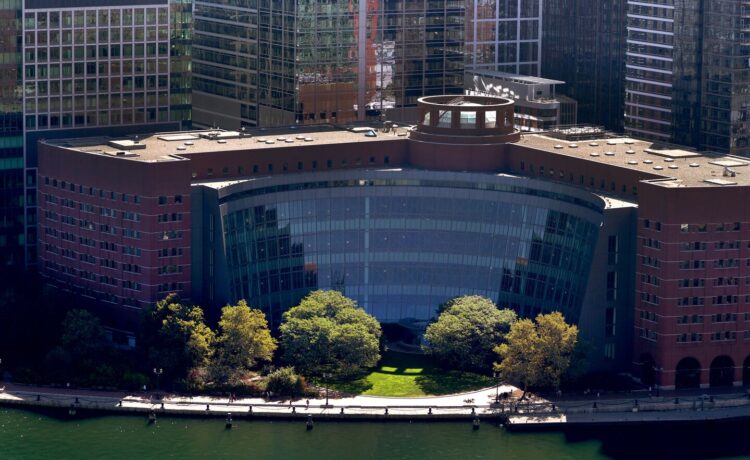
It was soon challenged by pair of super PACs from the political right, one of which has been actively supporting an unrelated referendum in Maine this fall. With help from lawyers at the Washington-based Institute for Free Speech, these super PACs got the 2023 law struck down as an unconstitutional measure against free speech by the First Circuit Court of Appeals in Boston.
In the wake of that came the law being questioned today. In 2024, 75 percent of Maine voters approved a referendum that limited contributions by anyone to a super PAC to just $5,000. Previously, there wasn’t a limit.
In July 2025, a federal judge in Maine struck down that law, citing a 2010 ruling by the District of Columbia Court of Appeals, SpeechNow.org v. Federal Elections Commission, which allowed super PACs to raise and spend unlimited amounts of money as long as they didn’t directly coordinate with a candidate’s campaign. Since 2010, super PACs have become a dominant staple of how presidential campaigns work and how wealthy individual donors attempt to wield more power over American politics.
Now that the first brief is due on Wednesday, and we will see what happens when that law appears before the same federal appeals court early next year.
With the legal battle now shifting to the courts, attention is turning to the core arguments on each side. Advocates for campaign finance reform argue that the SpeechNow decision, which followed immediately after Citizens United, was wrongly decided and opened the floodgates to unlimited money in politics.
Harvard Law School professor Lawrence Lessig’s Boston-based group, EqualCitizens.US, helped craft the referendum and assisted stakeholders with the legal strategy. In an interview with the Globe, he said he hopes the matter will eventually make its way to the US Supreme Court. But first, he will need the Boston court to agree with him.
Should the Supreme Court then rule to keep the Maine law, it would apply nationwide to all super PACs.
“It would be the biggest victory we’ve had in a generation,” said Lessig. “It not everything. It’s not like solving the problem. But it returns us to back to a place where people could really have a way to solve a problem.”
Perhaps because of the conservative tilt of the current Supreme Court, Lessig said that the argument for the Maine law is originalist in nature. The Maine law, after all, doesn’t cap the spending of a super PAC. It limits the amount of donations to a super PAC.
This latest effort to limit contributions to a super PAC is based on a 40-year-old ruling saying contribution limits could be set for regular candidate committees.
The 1976 Supreme Court decision in Buckley v Valeo said these limits were constitutional because they limit how much influence any single donor could have over a politician.
Under current law, super PACs can raise and spend unlimited sums of money to influence elections, so long as they don’t coordinate directly with a candidate’s campaign. Critics of the system say that distinction is meaningless in practice. For example, just because Elon Musk set up a separate super PAC to aid Donald Trump’s presidential campaign, didn’t mean Trump was unaware of it — or that Musk wouldn’t seek influence or access afterward. The same logic applies to major Democratic donors.
However, Charles Miller, one of the Institute for Free Speech’s lawyers representing a pair of super PACs in Maine contesting the law, said he felt that making an argument about the original intention of the Constitution based on what the Supreme Court wrote in 1976 is absurd.
“Including SpeechNow and cases after that, there have been about 36 federal court of appeals judges who have ruled on this issue. They have, to a judge, all sided with us on this — that the Constitution does not allow limits to be placed on outside contributions,” said Murray. “When you have 36 judges from all political perspectives say that, no, Citizens United controls this case there’s just not really any room for movement here.”
Ray La Raja, a nationally recognized campaign finance expert at the University of Massachusetts at Amherst, tends to agree with Murray.
“I think it is highly likely the Supreme Court will say that contribution restrictions are unconstitutional for independent spending,” said La Raja. “The court’s majority are First Amendment absolutists. Strict scrutiny all the way. The decision is likely to enshrine no limits on contributions to super PACs. That means future challenges are futile for a long time.”
And yet, if Murray and La Raja are wrong and if the Supreme Court both takes up the matter and rules in favor of Lessig and the plaintiffs, the decision’s fallout would be much like the Dobbs decision on abortion, where the preexisting laws — which already limited contributions to outside groups to $5,000 — would be back in place nationwide.
It would still be technically possible for someone to spend unlimited amounts of money completely on their own, but they would have to put their own name (or their company’s name) on each ad instead of hiding behind an innocuously named group without any campaign finance records.
“It’s a first critical step,” said Lessig. “It doesn’t end the opportunity for super rich people to be involved, but it does change the dynamic of super PACs dramatically and that would be a huge, huge, win.”
James Pindell is a Globe political reporter who reports and analyzes American politics, especially in New England.