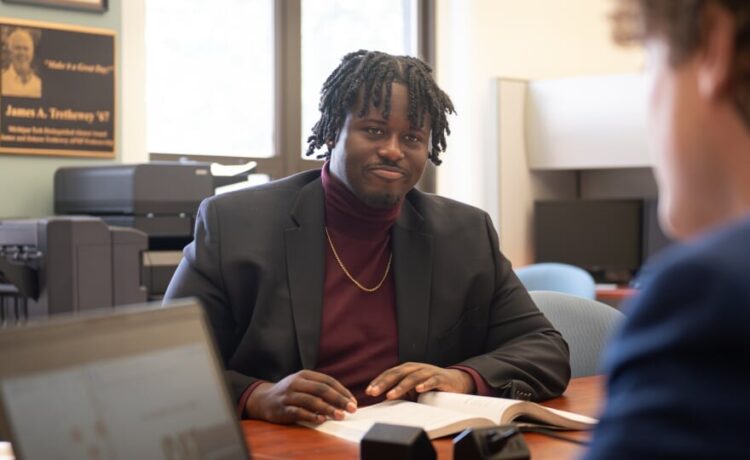
The 2024-25 academic year was a big one for Elijah Joseph. What lies ahead this fall
is even bigger, as the finance major with a financial technology (FinTech) minor gets
ready to walk the stage at Michigan Tech’s 2025 Midyear Commencement.
In this Q&A, Joseph looks back on the experiences that have shaped his education and
forward to what’s in store after his milestone moment.
Q: We always say that Business Huskies are going places. As president of the College
of Business Economics Club, where did you go last year, and why?
EJ: The Econ Club took a road trip to Milwaukee to visit Russell Investments, because
what’s more fun than talking about asset management and market strategies in person?
(Okay, maybe a few things, but trust me, this was cool.) We wanted to see how professionals
analyze investments, manage risk, and—let’s be honest—make money. It’s one thing to
study this in class, but another to hear real analysts break it down. Plus, any excuse
to visit a big city is a win!
Q: You also traveled to New York City as part of the Applied Portfolio Management Program (APMP). What was a big takeaway from the New York trip experience?
EJ: One big takeaway, besides learning that Midtown traffic is basically a financial
crisis of its own, was just how eye-opening it is to hear directly from professionals
at the top of their game. At the Quinnipiac GAME Forum, you’re not just talking theory; you’re hearing real-time takes on market trends,
AI, crypto, and why the yield curve inversion is everyone’s favorite party trick.
Q: What excites you about the stock market? What do you say to people who freak out
over its ups and downs? How do you view market volatility?
EJ: What excites me most about the stock market is that it’s this living, breathing
reflection of human psychology, innovation, and global events constantly in motion.
Every tick, every swing, tells a story. It’s part strategy, part emotion, and I love
trying to make sense of it all. There’s nothing else like it. To people who freak
out over the ups and downs, I say this: Volatility isn’t a bug, it’s the feature.
It’s what creates opportunity. Without it, there’d be no edge to gain, no mispricings
to take advantage of. The key is understanding that markets move in cycles, and short-term
noise often distracts from long-term value.
“To me, market volatility is like weather. You don’t cancel the journey just because
it rains. You bring an umbrella, check the forecast, and keep moving. Same goes for
investing. Have a plan, manage your risk, and let time do the heavy lifting.”
Q: Back on campus, the College of Business sponsored a campuswide stock-picking contest during spring semester. You won. What was your strategy?
EJ: My strategy was grounded in risk management with selective upside. Given how volatile
the market was at the time, my first goal was to build a portfolio that could stay
resilient under pressure. I focused on companies with lower correlation to broader
indices; names with strong fundamentals and more idiosyncratic drivers.
On the other side, I took short positions in overvalued or speculative stocks that
historically underperform during market pullbacks. To keep my process disciplined,
I used the scorecard my APMP team and I built from the ground up, incorporating metrics
like earnings quality, balance sheet strength, and strategic tailwinds. Every idea
had to pass through that filter before making the cut. One of the standouts was Janover,
now known as DeFi Development Corp. It aligned well with the scorecard’s framework
and gave my portfolio exposure to a crypto-adjacent theme through Solana. It ended
up driving a significant portion of my performance. But overall, the success came
from staying consistent with the process, managing risk thoughtfully, and being willing
to act when others were hesitant.
Q: Tell us about buy reports. Is that something you do regularly?
EJ: In the trading room, deep in our weekly APMP team meetings—that’s where the real
magic happens. We usually meet once a week to go over how the portfolio’s performing,
talk through market shifts, and present buy reports. After someone presents their
pitch, we don’t just clap and move on, we vote. And not just a simple yes or no. We
require a supermajority to add anything to the portfolio. If the room isn’t strongly
behind the pick, we pump the brakes and ask more questions. Disagreement isn’t a dealbreaker;
it’s a sign to dig deeper. That’s the beauty of the process. It forces us to challenge
ideas, sharpen our thinking, and make sure every move we make is backed by conviction,
not just vibes.
Q: Why did you decide to go into finance? What made you choose the FinTech minor?
EJ: Honestly, I think finance chose me. While most kids got pulled out of school for
dentist appointments, I was getting signed out to attend stock market seminars and
investment competitions. (Sorry, Mom, but at least it wasn’t for something reckless—unless
you count derivatives.) My dad and I would talk markets, long-term strategy, and why
chasing quick wins usually leads to long-term losses. That mindset stuck with me;
it taught me to zoom out, think strategically, and trust the process.
What hooked me wasn’t just the money talk, it was the energy. The ideas were fast,
the learning never stopped, and there was always a puzzle to solve. I’ve always loved
movies, and when I watched The Big Short, something clicked: Finance isn’t just about numbers, it’s about thinking differently,
spotting cracks before anyone else, and using that insight to make a real impact.
“Eventually, I realized that finance could be more than a career, it could be a way
to help people live better, more secure lives. That’s what sealed it for me.”
As for the FinTech minor, finance is changing fast. Digital payments, robo-advisors, blockchain—you
name it, it’s not the future, it’s the now. I didn’t want to just keep up with the
industry; I wanted to lead it. The FinTech minor gives me the tools to pair financial knowledge with technological fluency, so I can
help build solutions, not just understand them.
Q: Why did you decide to come to Tech?
EJ: Sure, Michigan Tech has a great business school. That was a big draw. But there
are a lot of schools with strong academics. What really made Tech stand out was the
way they treated me like a person, not just a number. After my first visit, they remembered
my name, my parents’ names, and even sent personalized cards. That stuck with me.
It wasn’t just about selling the school; it felt like they genuinely cared.
I chose Tech because it felt like a place where I’d matter, where I’d belong, and
where people would actually invest in me as much as I was investing in my education.
And honestly? That gut feeling was spot-on. From professors who know you by name to
opportunities I never imagined I’d have, Tech has delivered on everything that made
it feel special from the start.
Q: What’s your favorite thing about the College of Business?

the conference Huskies attend annually. From left are Joseph and fellow finance majors
Sam Eisenman, Noah Jukuri, and Connor Cook, all ’25 graduates, and Marguerite Goldman
’26.
EJ: Hands down, it’s the personality and passion of the professors. You can tell they
genuinely love what they do, and that energy is contagious. They don’t just teach
from a textbook; they bring real-world experience, personal stories, and a ton of
enthusiasm into the classroom. It makes learning feel less like a chore and more like
a conversation you actually want to be part of. Plus, they take the time to get to
know you, which makes a huge difference. You’re not just earning a degree here, you’re
building real relationships.
Q: What’s a big goal for senior year and what accomplishments are you most proud of
so far?
EJ: One of my biggest goals for senior year is to sit for and pass the CFP (Certified
Financial Planner) exam this fall. It’s something I’ve been building toward for a
while, and earning that certification before graduation would be a huge step forward
in my professional development.
Looking back, one of the things I’m most proud of is the work I’ve done with the Econ
Club as president. This year, we pulled off two major trips: one to Milwaukee, where
we visited Russell Investments, and another to Chicago, a collaborative effort with
the Finance Club and KSI (Kappa Sigma Iota) Accounting Club that included visits to
William Blair, JMG Financial, and the Federal Reserve.
We also kept our annual Econ Game Night going, giving students a fun way to connect
with faculty and test their econ knowledge. I’m incredibly proud of how much the club
has grown and how engaged our members have become. But none of it would’ve been possible
without the amazing E-Board. Their dedication, creativity, and energy made every event
and initiative a success, and I’m genuinely thankful to have worked alongside such
a strong team.
Q: Tell me about your involvement in Michigan Tech Summer Youth Programs. Why should
kids know about finance at a young age?
EJ: My involvement with Michigan Tech’s Summer Youth Programs has been one of the most exciting parts of my journey. I helped build a curriculum
focused on real-time trading simulations, where students weren’t just watching, they
were doing. From making split-second investment decisions to navigating risk, they
got a real taste of the market in action. I also led lectures on financial derivatives,
using slides and worksheets I created to break down complex topics like options into
something anyone could understand.

the annual Applied Portfolio Management trip.
Why should kids learn this early? Because the earlier you start, the more powerful
your financial future becomes. Compounding interest isn’t just some theory, it’s your
best friend. The longer you let it work, the more it does. Learning how to invest
young builds more than wealth; it builds confidence, discipline, and a long-term mindset.
I was proud to be back with SYP again this past summer, leading sessions on options
and strategies.
Q: What kind of career are you interested in? How are you preparing for your career
with the coursework and activities you’re doing here?
EJ: I’m aiming for a career in financial planning and wealth management somewhere
I can combine my love for markets with helping real people make smart, confident money
moves. I’ve always been drawn to the idea of turning financial knowledge into real-world
impact. There’s something powerful about helping someone retire earlier, save smarter,
or just feel less stressed about their future. That’s the kind of difference I want
to make.
To get there, I’ve been stacking both the skills and the reps. Programs like APMP
have given me hands-on experience managing real money and pitching investment ideas
in high-pressure settings. I’ve also led finance workshops through the SYP program,
taught credit-building basics in Econ Club, and taken on leadership roles that pushed
me to communicate clearly and think on my feet. Everything I’m doing now is designed
to build not just the technical know-how but the trust, clarity, and confidence clients
will need from someone guiding their financial journey.
Q: Did you do a co-op or internship over the summer?
EJ: I was originally planning to do an internship, but due to my grandparents’ declining
health, I shifted gears to stay closer to home and help care for them. Family’s really
important to me, and I wanted to step up when they needed support. That said, I still
made the most of my time. My main focus has been studying for the CFP exam. I’m diving
deep into the material and treating it like a full-time commitment, so when the time
comes, I’ll be more than ready.
Q: What do you like to do in your free time?
EJ: I’m definitely a people person, so in my free time, I really value being around
others. Some of my favorite moments are just simple ones: playing board games with
friends, grabbing some pizza, and sharing a few laughs. I’m also a fan of getting
outside when I can, whether it’s hiking or just being active. For me, it’s all about
staying connected, unwinding, and enjoying good company. That’s what keeps me recharged.
Michigan Technological University is an R1 public research university founded in 1885 in Houghton, and is home to nearly 7,500 students from more than 60 countries around the world. Consistently ranked among the best universities in the country for return on investment, Michigan’s flagship technological university offers more than 185 undergraduate and graduate degree programs in science and technology, engineering, computing, forestry, business, health professions, humanities, mathematics, social sciences, and the arts. The rural campus is situated just miles from Lake Superior in Michigan’s Upper Peninsula, offering year-round opportunities for outdoor adventure.