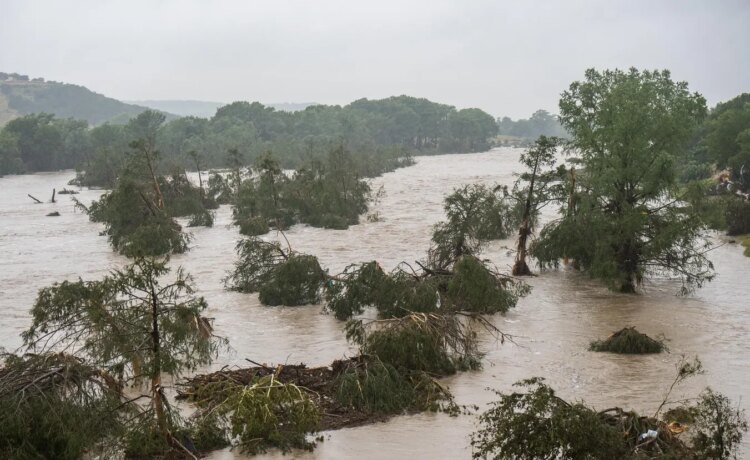
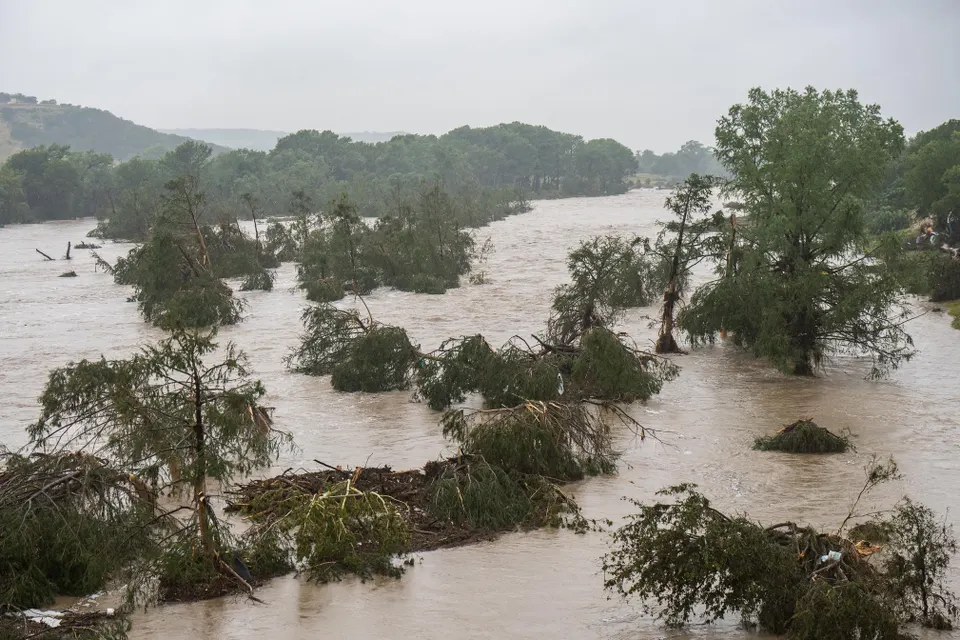
KERRVILLE, TEXAS – JULY 04: Trees emerge from flood waters along the Guadalupe River on July 4, 2025 in Kerrville, Texas. Heavy rainfall caused flooding along the Guadalupe River in central Texas with multiple fatalities reported. (Photo by Eric Vryn/Getty Images)
Getty Images
As adaptation takes centre stage at the climate negotiations in Brazil, the latest UNEP data reports adaptation finance declining amid rising geopolitical and economic pressures. This comes at a moment when climate shocks are becoming impossible to ignore, and experts warn the world’s financial plumbing is not built to manage what comes next.
At the release of UNEP’s Adaptation Gap Report 2025: Running on Empty, executive director Inger Andersen warned, “Every nation is facing climate impacts”. The UNEP report estimates that developing countries will need $310–365 billion per year by 2035 for adaptation. Meanwhile, actual international public flows fell from $28 billion in 2022 to $26 billion in 2023.
Physical shocks are no longer isolated events but compound across seasons and regions, heat amplifies drought, drought amplifies fire risk, and storms strike weakened infrastructure. For a decade, adaptation has been framed chiefly as an equity agenda or humanitarian imperative. But this year’s data, and the increasingly systemic lens emerging from global experts, suggests the world is underinvesting in the systems that uphold macroeconomic and financial stability.
A Systemic Risk The Financial System Does Not Yet See
In a paper presented at COP30, climate economist Delton Chen has described climate damages as a form of “systemic externality”, where physical shocks cascade across balance sheets and supply chains faster than conventional models can capture. His argument is that climate impacts behave more like cross-border financial contagion than localized hazards.
Research from Dr. Nicola Ranger at the London School of Economics echoes this. She and co-author Emma O’Donnell recently argued that forests, watersheds and other ecosystems are macro‑critical infrastructure that, if degraded, could trigger “global cascading economic shocks larger than the 2008 global financial crisis.” Their proposal, the introduction of Global Systemically Important Natural Systems (G‑SINS), mirrors how regulators treat banks deemed too big to fail.
The implications for adaptation finance are straightforward: underfunding resilience is a systemic-risk failure, not a budgetary inconvenience.
Why Adaptation Is Penalised By Today’s Financial Architecture
Natalie Unterstell, president of the Brazilian climate-policy institute Talanoa, argues that the core problem is structural. “We are still running 21st century climate risks through a 20th century financial plumbing system,” she said from Belém.
Countries investing in resilience can paradoxically face harsher market conditions. She says they may be “penalized in terms of higher borrowing costs, tighter debt sustainability constraints or weaker investor confidence”. For many developing countries, these dynamics collide with already-strained public finances. Rising climate losses now compete directly with health, education and infrastructure budgets, forcing governments into difficult trade-offs that weaken long-term resilience.
Unterstell points to two reforms with immediate payoff: redefine MDB capital adequacy so resilience investments are treated as risk‑reducing, unlocking “tens of billions in headroom,” and create “pooled guarantee and FX stabilization facilities” so adaptation doesn’t deepen debt.”
Her concern mirrors the Adaptation Gap Report’s warning that the Glasgow Climate Pact target of $40 billion per year by 2025 will not be met, nor will the newer goal of at least $300 billion per year for mitigation and adaptation by 2035. Andersen was blunt saying, “Neither of these goals are even close to enough.” UNEP suggests that the private sector could contribute up to $50 billion a year, ten times its current contribution.
The Road to Belém: A Blueprint For Financial-system Reorganisation
The Baku to Belém Roadmap argues resilience must be integrated into how capital flows globally, not treated as niche development finance. It outlines five areas for reform — fiscal space, instrument redesign, prudential rules, coordination, and concessional capital — and suggests raising $1.3 trillion per year by 2035 is feasible with systemic redesign.
This matches Unterstell’s view that, “until resilience shows up in the balance sheets, ‘awareness’ won’t move capital.” She notes that central banks and supervisors “are still in the diagnostic phase”.
The roadmap also points to non-debt instruments as a priority. Unterstell sees alignment here saying, “There is a good opportunity, if the Roadmap is turned into an implementation plan, rather than just a report.” But success will depend heavily on political coalition-building. “If Brazil can turn COP30 into a coalition for architecture, not pledges, it will have changed the game,” she said.
Foundation And Public Funding: Essential But Insufficient
A recent ClimateWorks Foundation analysis shows foundation funding hit a historic high of $873 million, but remains far from aligned with risk. Philanthropy is growing, as the number of foundations funding adaptation rose 55%, but cannot fix a structural market failure. Public climate finance remains stretched. This is why institutions like the Green Climate Fund (GCF) have become essential to closing the gap.
As Henry Gonzalez, Chief Investment Officer at the Green Climate Fund, explains, “While progress has been made, adaptation finance is still falling short. That’s exactly why the Green Climate Fund exists, to take on those risks, invest where others won’t, and make climate resilience an investable opportunity.”
The GCF committed $2.2 billion in 2024, roughly 8% of global public adaptation funding, and now manages a $19 billion portfolio. Yet even this pace is insufficient for the scale of physical risk. “The scale of the crisis demands much more,” Gonzalez said.”
Why Markets Alone Won’t Close The Gap
As Claire Habron, chief executive at Howden Foundation explains, “The business case for investing in adaptation and resilience efforts is clear. A recent report from WRI calculates that every dollar invested in adaptation pays off with a $10 return. Yet today structural barriers limit private investment in a number of different ways: long-term benefits rarely show up in project-level IRR; risk-perception premiums inflate borrowing costs; and few financial institutions have mandates that reward avoided physical losses or the potential benefits of adaptation.
As a result, many high-return investments remain chronically undervalued. Unterstell is blunt about this challenge, “We need to stop treating it as an equity issue alone. It’s now a macro-stability problem.”
The Missing Successor To Glasgow
One of the most striking concerns in the UNEP report is the absence of a post-2025 mechanism for adaptation.“Now we’re standing at the edge of the adaptation finance cliff,” Unterstell said. “As the pledge expires, there’s no successor mechanism in place, no predictable flow, and no structure to keep countries from falling back into the cycle of underdelivery.”
A successor is essential because adaptation operates on long time horizons. “Even amid tight budgets and competing priorities, the smart choice is to invest in adaptation now,” Andersen said. “It is pay now or pay far more later.”
The Economic Case For Urgent Action
Physical shocks are already contributing to inflation volatility, insurance-market stress, sovereign credit downgrades, and supply-chain disruptions. The erosion of insurability is effectively transferring climate risk back onto households and governments, increasing fiscal exposure and macro-financial fragility. Research cited by Ranger and O’Donnell shows that nature degradation alone can impose GDP losses comparable to those of major financial crises.
Yet the same investments that reduce these shocks also deliver opportunity. Unterstell emphasises measures that, “bridge mitigation and adaptation as inseparable: cooling efficiency, nature-based flood control, and climate-smart agriculture.” These generate resilience dividends while supporting emissions reductions, an alignment investors increasingly seek.
Dr Harald Heubaum at SOAS University of London, one of the co-authors of the WRI study, told me that resilience “is a quantifiable driver of growth and shared prosperity, not just a shield against losses from climate change.”
A Financial Inflection Point
As negotiations continue in Belém, adaptation finance is moving from peripheral concern to a central pillar of global stability. Andersen’s call is unambiguous stating, “We need a global push to fill up the adaptation finance tank from both public and private sources.”
The costs of delay are rising, the risks are compounding, and the architecture that governs global capital flows is no longer fit for purpose. Today, adaptation is becoming one of the decade’s most important macro-financial tests.