


By Roy Lederman
No matter their age, everyone can benefit from financial education. Clients need context to better understand how our financial plan recommendations can help them reach their goals.
Just as every plan is customized to the client’s specific needs, your approach should be tailored to each client’s communication style. My work with Gen Z has taught me the importance of meeting clients halfway and providing guidance on tricky financial terminology to empower them to take charge of their financial future.
In working with families and being a parent myself, I know that clients with children want to equip their kids with all the skills to thrive throughout their lives. I often learn about children in annual life insurance planning and/or estate meetings when we discuss beneficiaries, especially in cases when we create a trust.
If the beneficiary is their child, I’ll ask the parents if they would like me to talk to their kids about the basics of financial planning. The answer is almost always: “Yes please! I’ve tried to talk to them, but when it comes from me, they don’t listen. Let’s schedule a time right away!”
I start those meetings at a very high level, asking if they have any goals they are working towards. This could be something like an upcoming trip, their own car or college. Whatever the case, making it personal to them helps them to apply the concepts to their own life. We work through a calculator to determine how much money they need to save and about how long it will take to achieve that goal.

‘That’s a lot of money’
Then we also look at how that money could grow over time if invested in a retirement fund. The response is usually “Woah, that’s a lot of money.” From this point, I have their attention, and they are eager to hear what advice I provide.
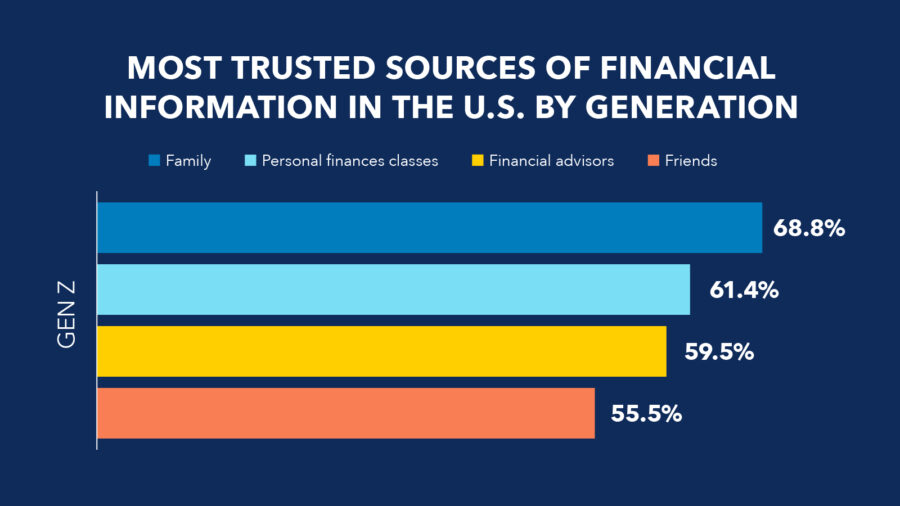
According to a recent MDRT study that compared financial literacy trends in the U.S., Japan and Singapore, 59.9% of U.S. Gen Zers consider an advisor a trusted source of financial information, which is behind Gen Z’s trust in family and personal finance classes, but ahead of their trust in their peers.
I was not surprised by these findings as they mirror what I observed in my practice; it takes time to build trust with Gen Z clients, so I have to adjust my expectations. What I have found though is that once younger generations have met me and are intrigued by what I shared, they are more likely to seek me out without their parents to learn how they can have a sound financial future.
I work with a wide array of people who are very young in their career and want financial advice that they can understand. This often means changing how I present financial advice from the way I work with their parents.
Changing communication
For example, I’ve needed to change how I communicate with my Gen Z clients. Most in this generation prefer texting over phone calls or emails. They also likely aren’t keen on driving to your office, with virtual meetings via Zoom or Teams more convenient and less time-consuming.
Gen Z is used to leveraging technology for efficiency’s sake and will be more likely to meet with you if you adjust your process to their needs. I’ve found that my laid-back approach to their meetings, (casual clothing, meeting virtually, using simple language) helps build trust and lower barriers. This shows your young clients you “aren’t like other advisors, you’re a cool advisor” and someone that can count on for ongoing advice.
Financial planning is a very personal experience. We ask clients to be vulnerable and expose their financial details to develop a plan that best meets their goals and values. We can meet them halfway to ease worries and help clients see we can be trusted. Working with Gen Z is no different; young clients want to work with you if you speak their language.
I’ve found that many of my young clients are determined to create a sound financial future and want a mentor to help them get there. By offering to speak with children about finance basics, you are creating a connection founded in trust and curiosity for years to come.

Roy Lederman is a personal finance representative for Allstate where he leverages his extensive financial knowledge to help families protect what’s important to them. Lederman is a five-year MDRT member and a one-time Top of the Table member.