The alternative is taxation and greater deficits
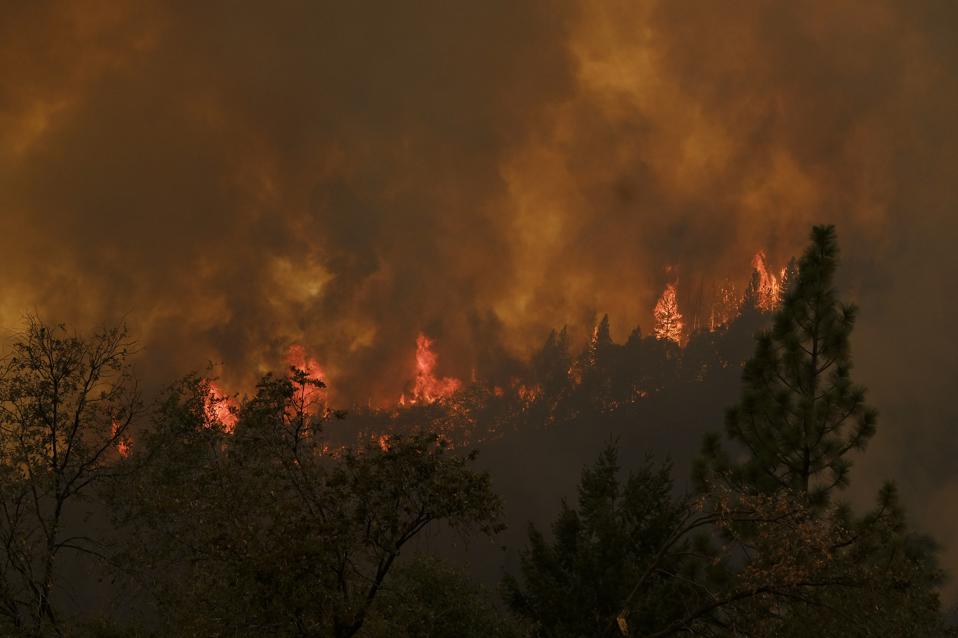
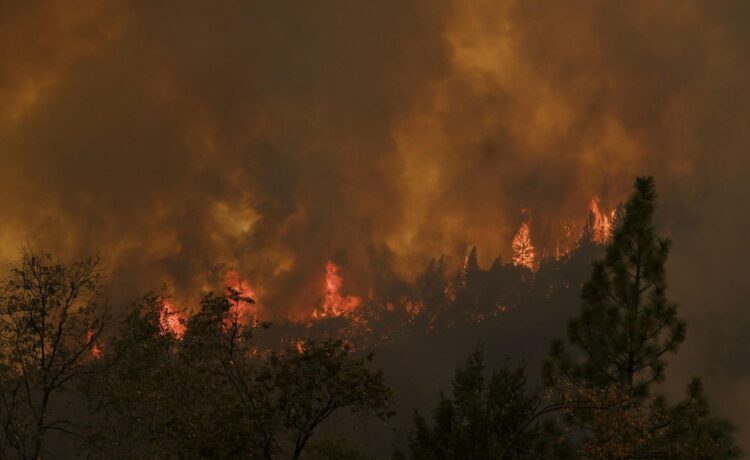
Burning trees and heavy smoke during a wild fire. Photographer: Jen Osborne/Bloomberg
© 2024 Bloomberg Finance LP
Climate week just concluded in New York City. Instead of joining the chorus on how the US has withdrawn from the conversation, I thought I might write about something constructive. I have always worried that climate losses will eventually be socialized via greater deficits and eventually via greater taxation. What might an alternative look like? A private sector funded financing vehicle that can transfer risk from victims to a more risk loving investor, in exchange for appropriate returns. That is, something like CAT bonds.
How do CAT bonds work?
For those who may not be familiar, CAT bonds are effectively insurance on tightly defined catastrophic climate events. The actual structure is a bit complicated. An SPV (special purpose vehicle) is formed by an insurance company. Investors pay let’s say $100 million to the SPV. This money will be used to pay out insured parties should the insurance company have to pay up if disaster strikes. Let’s say the disaster is a 7.0 earthquake in a specific tightly defined region. The cash that comes in from investors is usually invested in US treasuries, which pay say 5% per annum.
The insurance company hands off the premiums it receives from selling coverage of $100 million to the SPV. Let’s say that the premium is 6.5% on $100 million. The cumulative returns of 6.5% plus 5% on T-bills invested is passed on to investors every year till the disaster strikes. If disaster does not strike, the $100 million is returned to CAT bond investors at the end of the pre-arranged term, say at the end of three years. If the earthquake of 7.0 or higher does strike, the insurance company pays off the $100 million to insured parties.
The mechanism works because the returns to investors from a portfolio of CAT bonds exceed the loss payouts. To understand the nuances associated with the idea of US issuing CAT bonds at scale, I approached Andrew Poreda, and Sean McShea, friends and thoughtful commentators on climate finance. Their firm, Sage Advisory, has just launched a private fund consisting of traditional fixed income investments and CAT bonds. Before we hear from Andrew and Sean, a quick primer for folks who are not familiar with CAT bonds.
Various types of CAT bonds
Andrew clarifies, “there are multiple types of CAT bonds (e.g., parametric vs. indemnity), and each one comes with advantages and disadvantages. Indemnity based cover actual claims but are slow to payout and have some potential biases to the insurer (third party modelers and auditors help with this weakness). Parametric based CAT bonds can use independent data sources (e.g., NOAA or the National Oceanic and Atmosphere Agency ) and have fast payouts (a huge plus when disasters strike) but have the basis risk in not always aligning with actual losses.” Basis risk arises from mismatch created by the trigger used to pay out on the bond, say wind speeds exceeding 120 mph (miles per hour), may not be correlated with the actual losses from such winds or the resultant storms.
Why should the US consider issuing CAT bonds to finance climate losses?
The obvious advantage is that this is a private sector initiative not a giveaway financed by either taxation or subsidies. On top of that, the return performance of CAT bonds has largely been uncorrelated to the fixed income and equity markets. So, any asset allocators that have added it to their portfolios have been handsomely rewarded. A nice added feature of insurance linked securities (ILS) is that the exposure to social inflation is limited (e.g., as costs of repairs or climate risks increase, contracts are adjusted accordingly). Finally, from a societal or from an impact front, the flow of capital into the space would help buttress the traditional insurance or reinsurance markets, while also providing coverage in markets (such as in developing countries) where current insurance or reinsurance coverage is limited.
The disadvantages of CAT bonds are:
- These contracts are written on very precise parameters such as the magnitude of the earthquake’s severity on the Richter scale and these parameters are ideally independently verified by an independent government agency or reliable third parties;
- Are other climate events geared for such precise measurement and verification?
- CAT bonds are organized around ex-post disasters. Can we design them to be useful for prevention and mitigation before the disaster strikes? and;
- Does the risk appetite and capital needed to fund CAT bonds at scale exist?
Now, let’s hear from Andrew and Sean whether my proposal has even a remote chance of working.
We need affordable and accessible climate insurance
To begin with, Andrew points out the need for a bipartisan consensus to ensure that insurance is accessible and affordable (the extent of affordability is where we likely get into some messiness). State legislatures and regulators dealing with insurers have difficult but important jobs ahead of them (especially in high-risk states like CA, TX, LA, FL, and each of them have some unique challenges that are unrelated to climate risks).
Significant climate losses are being socialized right now
Andrew points out, “FEMA in essence has acted as an insurer of last resort, providing billions each year through the Disaster Relief Fund (average of $16 billion spent since 2005, and spent ~$50 billion in 2024). Obviously, moral hazard is a big concern here, as this funding among other factors does not fully encourage communities and individuals to be resilient or fully insured against potential losses. From a fairness perspective, should New Yorkers be paying for losses of all their neighbors that have left them and moved down to Florida?
Some propose for the Federal Government to act as an insurer of last resort (which I would argue already happens in principle with FEMA’s efforts). The INSURE Act was introduced last year to accomplish this mission, but this type of effort already happens at the state level in many instances, which is more appropriate for a variety of reasons (but is still problematic).”
There could be a market for US issued CAT bonds
Andrew suggests that “investors through the capital markets (e.g., CAT bonds and private Insurance Linked Solutions (ILS)) have the potential to support insurers and help support robust reinsurance programs. The ILS market is still small relative to other markets ($121 billion August 2025), but those that have invested in the past have been rewarded with attractive risk-adjusted returns with low correlations to other asset classes. One would surmise that demand would be strong for future CAT bond issuances.”
Sean is bit more circumspect: “scaling CAT bonds would require a deep pool of investors comfortable with uncorrelated risk and opaque modeling. The good news? Appetite is growing, especially among institutional investors seeking diversification. But it’s not yet a buffet.”
CAT bonds need not rely exclusively on parametric triggers
Sean states, “CAT bonds are inherently reactive in that wind speed, quake magnitude, etc., work well for post-disaster payouts, but climate change is more of a slow burn (pun intended). Can we design parametric triggers for chronic risks like sea-level rise or heatwaves? Maybe, but it’ll require creative underwriting and robust data infrastructure. To pivot toward prevention, we’d need to rethink the structure—perhaps blending CAT bonds with resilience-linked bonds (like California’s proposed Resilience Bond or Chile’s sovereign green bond) or ESG-linked triggers that reward mitigation efforts.”
What are resilience bonds? One example would have communities pay premiums for catastrophe protection of their infrastructure but would get lower premiums when they take measures to better protect themselves from various disasters.
Andrew suggests that “CAT bonds don’t have to be tied to parametric triggers (majority are indemnity based), but the ability to quickly provide capital in times of crisis has a lot of utility relative to the basis risk (and though never perfect, the industry has gotten better at crafting triggers). Those bodies that are responsible for the measurement of parametric triggers (e.g., NOAA for wind and US Geological Survey for earthquake) provide unbiased, quality observations and that was an endearing feature of parametric CAT bonds relative to indemnity, index and industry-loss.” To clarify, an indemnity CAT bond pays out on the actual, verified losses from a catastrophic event. An index loss on a CAT bond occurs when an industry-wide index of insured losses from a disaster exceeds a predetermined “trigger.”
The idea may have legs with caveats
I will let Sean have the last word, “on the idea of CAT bonds at scale as a climate solution: I think it’s bold and absolutely worth exploring. The private sector angle is compelling, especially given the current administration’s preference for market-based approaches. If structured properly, a federal CAT bond program could be a creative way to fund climate resilience without leaning on taxation.” He goes on to add, “CAT bonds aren’t a silver bullet, but they could be a powerful arrow in the climate finance quiver, especially if we evolve the framework to address chronic risks and incentivize resilience.”
In sum, CAT bonds, with appropriately designed triggers, with the backing of the US government would be a potential win-win for all parties. Climate losses get funded by risk seeking and yield seeking investors. The taxpayers need not pay for climate losses, which will only escalate over time. I am surprised by the somewhat slow evolution of innovations in climate sovereign finance relative to financial innovation in other areas such as crypto, stable coins, and applying AI to finance.