Fort Wayne and Allen County have until the end of next year to spend the more than $124.5 million they received in American Rescue Plan Act dollars from the federal government during the coronavirus pandemic.
So far, more than $52.3 million of that money has gone to projects, including public health, neighborhood infrastructure and revenue replacement. Revenue replacement was important because city and county tax income plummets when businesses were shuttered and some residents weren’t allowed to work, officials have said.
But as the deadline approaches, officials have to shuffle around money returned to the city because it was more than the recipients needed. The extra dollars must be spent on projects already designated for financial support.
The American Rescue Plan Act distributed $130 billion to local governments across the country. Allen County received more than $73.6 million, and Fort Wayne was awarded about $50.8 million.
The funds have specific uses. Federal rules said the funds could only be used to respond to the effects of COVID-19.
That included medical programs, offsetting economic loss and government expenses during the pandemic. Governing bodies had to wait for federal guidance before spending because misuse would have caused them to lose that money. The federal treasury oversaw the use of those dollars through reports sent back by local governments.
Neighborhood needs
In 2022, Mayor Tom Henry’s administration announced the city would put $13 million toward improving the mental and physical health of the community, $18.2 million toward neighborhood infrastructure, $6.3 million to help boost the city’s economy and $13.3 million toward city operations.
That accounted for the full award. But the larger task of choosing specific projects and recipients remained.
Valerie Ahr, deputy controller, said city officials were required to designate how all the federal money would be used by the end of last year. The city has about $4.7 million left to spend before the end of next year. About $3.2 million is dedicated to neighborhood infrastructure, she said.
“Those projects do take a little bit longer because you have to pick which neighborhood and what kind of project,” Ahr said. “Then, you have to get engineering done and so on, but I don’t believe the city of Fort Wayne is going to have any issue spending every single one of our (American Rescue Plan Act) dollars by the end of 2026.”
Ahr said the money could be used for various types of neighborhood infrastructure projects, including improving sidewalks, curbs, alleys, streets and streetlights.
“Obviously, there’s always a long list of public works things that need to be done,” she said.
Smaller grants
About $5.35 million, most of which s from $6.3 million intended to boost the economy, went to four subgrant programs: nonprofit, public health, small business and tourism/arts. Through an application process, 25 small businesses and 37 nonprofits received grants.
Estela Perez, grant administrator, said awards ranged from $10,000 to $100,000, and some organizations received more than they needed.
“As of right now, we’re getting into the nitty-gritty where some are giving the money back,” Perez said. “That fund has to get reallocated. Any funding that’s remaining has to get reallocated right back into any project that we have with the city that is an (American Rescue Plan Act) project already.”
Perez said 92 organizations received awards, including Amani Family Services, Boys & Girls Clubs of Fort Wayne, Camp Red Cedar and Heartland Sings.
Community Harvest Food Bank of Northeast Indiana, Inc. was one of the organization’s to receive the maximum $100,000 award. Katie Savoie, director of development, said the money paid for enough fuel to buy 3,100 holiday food boxes for people in need.
“We were able to get food boxes that had protein in it,” she said. “That’s actually something we’re not normally able to do. We don’t have the resources to be able to purchase that much food for a holiday box.”
Last year, Fort Wayne was the only Indiana municipality to be recognized by the Institute on Race, Power and Political Economy for its handling of American Rescue Plan Act funds. The institute is an organization that studies ways to promote equity. It scored Fort Wayne in the top third of the 170 U.S. cities and counties it evaluated.
County concerns
Allen County earmarked the more than $73.6 million it received to projects in multiple categories: infrastructure, public health, administrative expenses and revenue replacement.
Chris Cloud, chief of staff for the Allen County commissioners, said because the federal government distributed the money toward the end of the pandemic, it was difficult to award it while following federal rules.
“The county gets this $74 million, but we don’t really have a large need to respond to COVID,” he said. “So, what’s the best use of this money for the community beyond that? The commissioners came up with a couple of buckets.”
Cloud said the largest bucket was water, sewer and stormwater, which was awarded almost $38 million for government-run utilities including in Huntertown, Leo-Cedarville, Maysville and Grabill. Those town had projects on their wish lists.
“They ended up with these projects that were just more than they could assess to their ratepayers, but they really needed to get done for their district,” Cloud said. “So, the commissioners said, ‘Hey, all of you public utilities, what projects do you have?’ ”
Cloud said the money funded more than 30 water and sewer projects in the county.
Rebuilding the fort
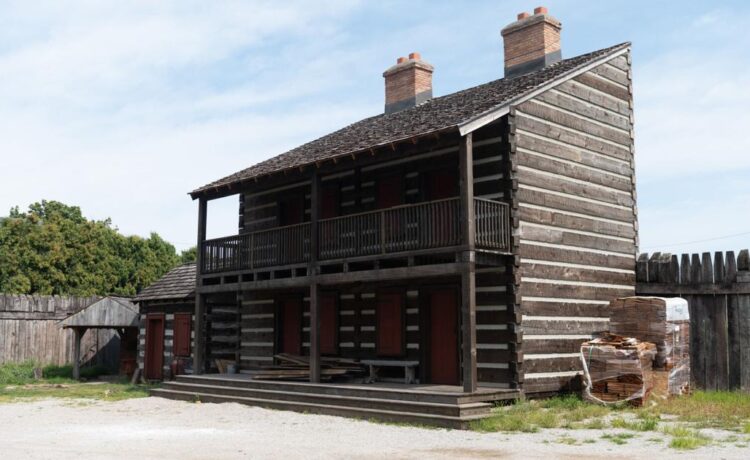
The county also distributed money to help the historic Old Fort renovate its property. The tourist destination received $250,000. Tom Grant, treasurer of the historic Fort Wayne, said the money was crucial to updating the property The grant paid for materials volunteers needed to tear down and rebuild replica doctor’s quarters.
“It provided the impetus for fundraising and kept the momentum going,” Grant said. “When we finished the top of the blockhouse, we had a little bit of a lull and then (the American Rescue Plan Act dollars) came through from the county, and we were able to immediately get our demolition contractor in here and take the building all the way down to the foundation. We ordered the logs and rebuilt that building.”
Grant said work is moving to tear down and rebuild the junior officers’ building.
“That really provided a spark to get things moving,” Grant said of the county funding. “With the doctor’s quarters basically completed, I was able to approach a foundation and get a substantial grant to pay for the junior officers building.”
Work on the junior officers quarters has already begun. Volunteers are removing all reusable materials from it before demolition crews arrive in less than two weeks.
Veterans’ shrine
The Veterans’ National Memorial Shrine and Museum also received $250,000 in COVID relief dollars from the county.
Eric Johnson, first vice commander, said the money helped pay for projects including maintenance of the Vietnam Wall and completion of the Sterling Chapel.
“This is really a cool place,” Johnson said of the chapel. “We had a reunion of a Vietnam group of guys. They came from all over the country, and they had a ceremony here and paid tribute to all the guys who were killed in Vietnam. There were 26 or 28 of them. It was the 34th Engineering Group, and they loved it.”
The county’s money helped pay for a new roof on the property’s pavilion and an enclosure for a rail car exhibit.
“We enclosed a box car that was given to us by the French government in 1949 after the war,” Johnson said. “That’s a historic artifact, and that’s got its own room now. (American Rescue Plan Act dollars) paid for the insulation and cement work in there and the ceiling, and we re-insulated everything. So, yeah, those funds really helped that project, too.”
The money made the property more accessible because it paid for a new sidewalk that now connects all the monuments in the park, Johnson said.
“We get a lot of veterans that come out here with walkers or canes or wheelchairs,” he said. “I’ve got to make sure I can get these guys all the way around here without any interruption and for their own safety.”
The memorial still has about $28,000 to spend before the end of next year. Johnson said there’s already a plan for it.
“Security cameras and upgrades in the museum,” he said, listing the planned additions. “Anything that has to do with new monuments, we’ve got to get people there. So, any more of that money might go to more concrete work and just improvements that we can make around here.”
Johnson said he and other volunteers routinely fundraise, but the boost from the county’s pandemic dollars was immense.
“The (American Rescue Plan Act money) was like frosting on a cake that hasn’t been cooked or built yet,” he said. “(Commissioners) Rich Beck, Nelson Peters and Therese Brown have been out here. They’ve seen what we’ve done, and I think if they could give us even a small amount of that money, they would and they did. Every dime has gone towards improving (the site), and it’s not going to stop.”