
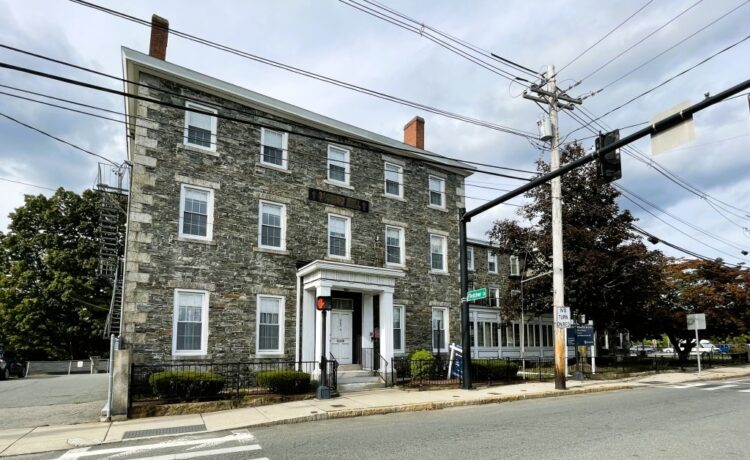
LOWELL — The Stone House on Pawtucket Street, the Smith Baker Center and Cobblestones Restaurant along the Merrimack Street corridor, and the city’s Affordable Housing Trust were some of the applicants before the Community Preservation Committee, which met in September for the first of several meetings to determine funding under the Community Preservation Act.
Every year, organizations submit eligibility funding requests to the CPC for open space, historic preservation, recreation and affordable housing projects under the CPA.
The committee received 11 proposals by its Sept. 25 deadline, and reviewed four of those applications that evening. While historically more than $1 million is allocated each year, this amount can fluctuate based on the city’s property tax surcharge and the state match.
“The majority of our business this evening is to determine the eligibility of a number of proposals that are before us,” Chair Adam Baacke said.
The state Legislature passed the CPA in 2000 to help cities and towns preserve the character of their communities. Almost 20 years later, Lowell residents voted to adopt the CPA and approved a surcharge on property taxes to the program. The state provides a match for the CPA trust fund from documents filed at the Registry of Deeds.
Since 2019, the CPA continues to drive citywide investments and improvements, as well as grow Lowell’s affordable housing stock.
Past approved projects have included preserving Rollie’s Farm, now called Pawtucket Farm Wildlife Sanctuary, as conservation land and agricultural education, restoring stained glass windows at City Hall, and affordable housing projects like Acre Crossing, MassMills and Suffolk Place.
September’s applicants that were determined to be eligible included:
• Cobblestones Restaurant for $468,670.95 to replace its windows at 91 Dutton St.
• The Bridge Club for $500,000 to convert the existing historic building at 267 Pawtucket St. into 29 affordable housing units for homeless veterans.
• Smith Baker Center for $859,236 to remediate hazardous material at the historic property at 415 Merrimack St.
• The city of Lowell’s Affordable Housing Trust Fund for $310,000.
Although applicants are not required to appear for an eligibility application hearing, both Bob Cox, the executive director of the Bridge Club, and Dennis McCarthy, for the Smith Baker Center project, addressed the committee.
The Bridge Club has not yet purchased the historic “Stone House,” also known as Bachand Hall, across from University Crossing, but Cox said, “We’re hoping to become the next owner of the property.”
Baacke cautioned that CPA funds could not be used to acquire property, even as the building itself checked the boxes for historic preservation and affordable housing.
“I think that’s the sort of thing that can be worked out administratively in terms of the sequence of acquisition and when the funding is disbursed,” Baacke said. “Mr. Cox, we look forward to hearing more from you later in the fall, when you present the application and we evaluate it for its merits and not just for its eligibility.”
Likewise, the committee found the overall Smith Baker Center project eligible as a historic preservation project, but questioned whether funds could be awarded for remediation. The nonprofit has not received City Council approval to purchase the historic, but dilapidated building across from City Hall on Merrimack Street.
“I suspect there is an eligible project there, but I do want to warn you that hazardous material abatement might or might not be an eligible historic preservation use,” Baacke said. “Mr. McCarthy, before you finalize your formal application, do consult with the staff at the Department of Planning and Development to review what you’re proposing the money to be used on to make sure it does align with the program criteria.”
The committee is required to allocate a minimum of 10% of its funds to each of the four funding categories, with the exception of the city’s affordable housing trust application, which is a set figure of 20%.
Besides Baacke, who is the commissioner for the Division of Capital Asset Management and Maintenance for the commonwealth, the CPA board includes DPD Director/Assistant City Manager Yovani Baez-Rose, and members of the city’s historic, planning and parks boards, and other appointees.
CPA funding is a two-step process. The nine-member board first determines eligibility of each application for program funding, before inviting eligible applicants to submit a full application for presentation for potential funding. In January the committee votes approval based on the criteria outlined in the city’s Community Preservation Plan, as well as the state’s Community Preservation Act guidelines. All recommendations are then sent to the City Council for final approval in May.
Of the 11 proposals, seven are for historic preservation, three for affordable housing and one for open space.
The remaining seven applicants will be heard for eligibility at the CPC’s Oct. 23 meeting.
“We do a fair amount of meeting in the fall when we are determining eligibility and actually hearing from applicants about applications,” Baacke said. “We then have deliberative meetings around New Year’s to make recommendations to the City Council for appropriations.”