
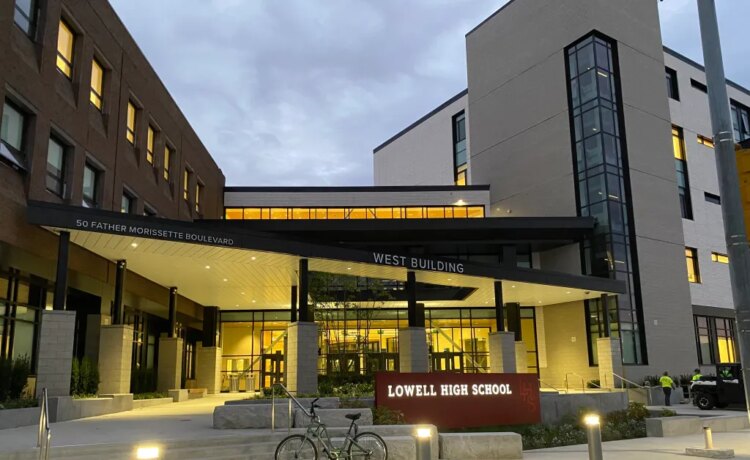
LOWELL — The School Building Committee approved a $2.2 million budget revision request to replenish the depleted construction contingency associated with the ongoing Lowell High School renovation project during its Oct. 30 meeting.
The money is needed, Skanska Project Manager Jim Dowd said, “to keep the project running.”
Dowd told the committee that without approval to shift $2 million from the furniture, fixtures and equipment fund and $200,000 from the owner’s contingency fund that the project is “getting critically close to running out of the construction contingency” funding to continue to pay invoices.
“The key number here is the construction contingency,” Dowd said. “As we reported before, we are going to exceed that number, which was the presentation on June 24 to the City Council on looking for additional funds to replenish the construction contingency.”
A construction contingency is money set aside to pay for change orders from new requests or unforeseen construction requirements. The initial $21.2 million was built into the overall budget figures, but in June, the project team of construction manager Suffolk, architect Perkins Eastman and the owner’s project manager, Skanska, told the Lowell City Council that project was over budget by nearly $40 million.
The $40 million bombshell was the result of serious and “unforeseen” structural issues with the renovation of the basement slab in the 1922 building among other issues including unforeseen asbestos, plumbing and wall construction issues.
The 1980s building opened for the start of the 2025-2026 school year in September, but due to the basement slab issue, the 1922 building will not be turned over until the end of the year, delaying the Phase 4 renovation of the 1892 Coburn Hall. The delays push the project completion date from August 2026 to August 2027.
The delays extended not only the work schedule by one additional year, but also increased the cost of the project from the amount originally approved by the Massachusetts School Building Authority from $381.9 million to almost $422 million.
The project got off to a rocky start thanks to COVID. In March 2022, representatives from Suffolk Construction and Skanska told the city that construction costs were $38.5 million higher from the originally approved $344 million price tag from supply-chain increases due to the pandemic.
The MSBA increased its maximum facilities grant by $36.9 million to cover that shortfall, but it is unlikely to do so for this latest overrun, which will require city taxpayers to absorb the additional debt through an increased loan order.
The temporary transfer of money to keep paying the bills was in part due to timing on the city amending the original bond loan order, said Assistant City Manager for Fiscal Affairs/Chief Financial Officer Conor Baldwin.
“We are in position almost to bring that loan order forward,” he said. “However, there is a legal process for authorizing loan orders. A first reading will come before the City Council that will be referred to a public hearing. At the end of the public hearing, pursuant to the statute, there’s a 20-day referendum period — this applies to all loan orders — it’s not special for this.”
The funding doesn’t become available until after the city has cleared the referendum period at which time there can be spending against it.
If the council approves the loan order, that money will reimburse the FFE and owner’s contingency funds for the amount advanced to cover outstanding and anticipated invoices through the end of 2025.
“When the loan order comes through and we have a project funding agreement amendment with the MSBA in January, those funds will be replenished to FFE,” Dowd said.
School Operations and Maintenance Director Rick Underwood asked Dowd if the project has enough money to complete what will be an almost seven-year project.
“In renovations,” Dowd said, “nothing is absolute.”
The four-phased construction project was approved in 2016 and broke ground in 2020. Phases 1 and 2 consisted of new construction and are completed, including the opening of the new Riddick Athletic Center, the five-story Freshman Academy, and the three-story addition that connects the academy, the gym and the new school entrance off the Father Morissette Boulevard entrance.
Phases 3 and 4 are more complicated renovation projects of the 1980s, 1922 and 1892 buildings that have drained the original construction contingency fund.
The motion to approve the budget revision request passed with SBC and School Committee member Fred Bahou voting no.
Bahou noted that sidewalks that were poured in August needed to be replaced.
“They got rained on and are going to have to be replaced by Suffolk,” Bahou said. “Is that an added cost?”
Dowd said that the sidewalks were a quality assurance/quality control issue that “would be addressed by Suffolk … next summer” at no cost to the city.
John Leahy, school deputy facilities director in the Facilities Department of Lowell Public Schools, raised concerns about the condition of the newly installed bike racks in front of the high school on Father Morissette Boulevard.
“A lot of the bike racks are pretty loose,” he said. “Is that on a punch list?”
Dowd said it was the first time the project team was aware of that problem.
“I don’t mean to be a wiseass about this,” Leahy said, “but if this is the first time that the bike racks are coming up to Suffolk, who’s going to go around and check everything else? It’s kind of obvious outside. Nobody noticed that? It just concerns me.”
The School Building Committee meets again on Thursday, Nov. 20, at 6 p.m. in the Mayor’s Reception Room on the second floor of City Hall, 375 Merrimack St.