Macomb County officials are instituting a myriad of programs to take advantage of a financial windfall from the opioid settlements with the goal to helping those who have use disorder to recover.
County Community Corrections Director Barbara Caskey is overseeing the implementation of jail-diversion, treatment and recovery programs to spend from the opioid lawsuit monies that garnered over $15 million through this year, with an additional $3 million to be received next year that will be fully spent, based on the proposed 2026 county budget.
Some of the programs are add-on services to Community Corrections and some help fill gaps in services that are currently provided through Macomb County Community Mental Health, which offers many mental health and substance-abuse services.
“A lot of individuals end up dealing with both of those things together,” Caskey said. “So you’re dealing with a lot of the same population regardless of whether you’re targeting mental health or substance use, because it’s both in a lot of cases.”
People with both needs were identified as a priority along with those who only use opioids, she added.
Macomb County is slated to receive some $50 million in Opioid Settlement Fund (OSF) dollars through 2040 in annual installments due to national lawsuit settlements with many opioid suppliers.
The initial payment came in 2023.
“When we sat down and started planning this, we did it as a continuum of crisis solutions, whether those things would be funded by opioid settlement funds or whether they were going to be funded by CMH or some other funding,” she said. “This is really a comprehensive plan for these services across Macomb County. Some of it is coming from opioids settlement funds, some of it is not.”
The expenditure of funds through this year has been limited, resulting in the $15 million fund balance, as programs have just begun and will be in full force next year, Caskey reported.
“Some of the programs are relatively new,” she said. “We’ve obviously been planning for a couple of years but a lot of those programs didn’t really get up and going until (within) the last year. I think next year’s budget will be more reflective of what is going to be spent.”
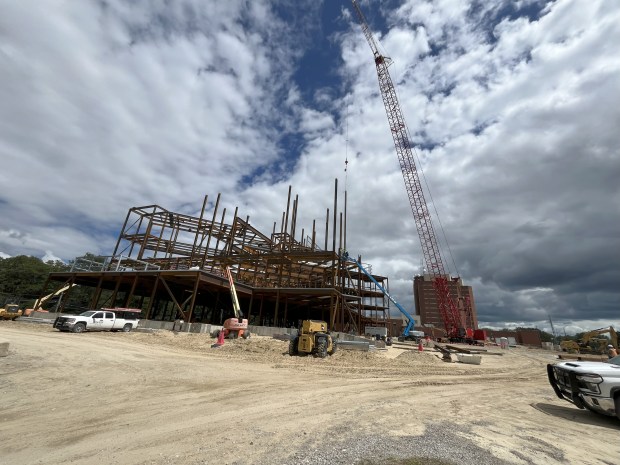
A large percentage of the funding will go toward programs at the existing county jail, which should increase with additional space in the new Central Intake and Assessment Center, the centerpiece of the $229-million jail expansion and renovation. It is expected to be done in late 2027 or early 2028.
Caskey said one of the first questions that arose when the county began receiving funding was whether the funds had to be strictly spent on the opioid crisis. She learned while opioids are the focus, officials recognized substance-use disorder often encompasses other substances.
“When we reached out for guidance, they (Michigan Association of Counties officials) told us the focus should be on individuals using opioids but that if you have individuals who are alcohol dependent or other substances, that they shouldn’t be ruled out of those services,” Caskey said.
MACOMB COUNTY COMMUNITY CORRECTIONS PHOTO
The most common combination now is opioids and alcohol, said Nicole Gabriel, director of the Office of Substance Abuse, a part of CMH. The most most common illegal opioid is the dangerous, higly-potent fentanyl, which sometimes is disguised as heroin, officials said.
County Community Mental Health Director Traci Smith told the county Board of Commissioners in June at a meeting in Mount Clemens that her agency provides a variety of services that address substance-use disorder in relation to their mental and physical health.
“We don’t just assist somebody experiencing a substance-use challenge,” Smith said. “We help them conquer any type of life experiences, including their physical health, social elements of their health, and tracking them and their performance to help them succeed.”
Engagement center provides stabilization
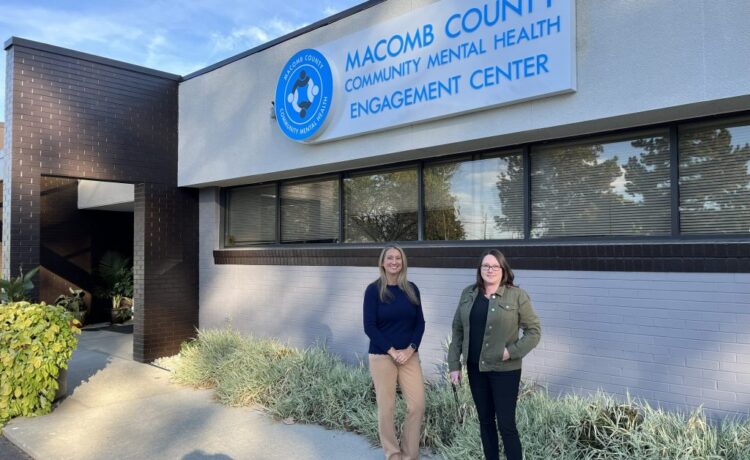
One example of the blending of CMH monies and OSF is the Oct. 28 opening of the new CMH Engagement Center.
The center, located off Van Dyke near 16-½ Mile Road, will provide an up to 23-hour location for those experiencing a substance-abuse and mental-health crisis, oftentimes when police are called.
“The idea is you can come here, stay for 23 hours or less, get stabilized … and then link you to treatment hopefully the next day,” said Gabriel, who is spearheading its opening. “The main goal is get the person linked to services so they’re not in crisis any more.”
Gabriel said she expects most Engagement Center visitors will be referred from a call by an individual or police officer to CMH’s crisis hotline at 586-307-9100 or 988.
The person answering the hotline will determine whether the Engagement Center is the appropriate place or perhaps a mobile crisis team can respond to where the person is located in the county, Gabriel explained.
Center staff will connect the person to services such as recovery organizations and coaches, and treatment referrals.
Gabriel thinks the 12-capacity facility will be used frequently, often by people who would have been arrested or taken to a hospital for a potential commitment, though many times the person is not admitted.
“A lot of times it’s somebody under the influence and they’re at home fighting with their family,” Gabriel said. “The police don’t just don’t want to leave that person there because they’re going to be called back.
“People are going to the hospital and going to the jail that don’t need to. We’re hoping that this is going to be an alternative for those people. You don’t really have a medical issue and you don’t really have a (criminal) charge, but you need to go somewhere.”
The facility will be staffed around the clock. Gabriel expects a majority of visitors will come on weekend or weekday nights.
It will be funded by dollars from the opioid settlements, state grant funding and local funding. The total annual cost is expected to be about $900,000, including the $39,000 annual lease, as well as staffing, utilities and operations.
Crisis training, response
A Mobile Crisis Response team consists of two people, a master’s level clinician and peer recovery coach, visiting the person at their location. If a child is involved, a “parent-support partner” will join to work with the parent or guardian, Smith said, adding a psychiatrist is on call around the clock.
“They try to de-escalate the situation, see if there’s any other resources that they can provide, be set up with service, to stabilize the person where they’re at instead of going to the hospital,” Caskey said.
While the mobile teams are funded by CMH, Community Corrections is using OSF to provide “crisis intervention training” to first-responders in the county.
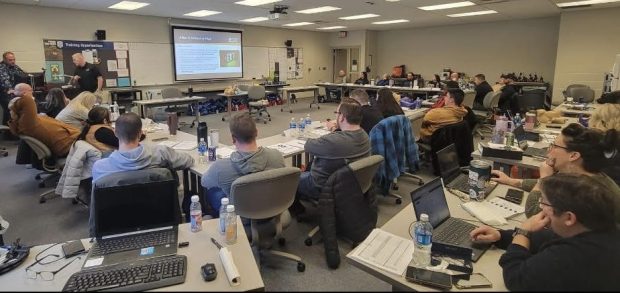
“It bridges the gap between law enforcement and behavioral health, brings resources to law enforcement, and helps de-escalate individuals who are in a mental-health or substance crisis,” she said. It is further described as a “collaborative training with first responders and behavioral health providers, facilitated by Macomb Community College Public Safety Institute,” in a document provided by Caskey and Smith.
To date, 150 first-responders from 11 departments in the county have received the free training, which has been held quarterly since last October, Caskey said. In addition, a handful of police agencies and about 10 other community organizations in and outside of the county have taken the training, she added.
“The 40-hour training includes education from law enforcement officials and behavioral-health experts, real-life scenario training, information on behavioral health resources and services available in our county, and an ongoing link to providers in the community to assist in improving the outcomes of those in crisis with mental health, substance use disorder, and other behavioral health needs,” Caskey said.
She said her office also was working on developing a “pocket guide” for police officers to carry to help determine what service someone they encounter may need.
‘More than a jail’
Despite efforts to try to help those struggling with substance abuse disorder avoid jail, they sometimes end up there.
Caskey said at the June board meeting she and her staff are working on how to “expedite referrals” of those arrested who are good candidates for diversion — typically those charged with a nonviolent crime — from a potential criminal sentence to “jail programs, specialty courts and other providers.”
CMH staff have partnered with Community Corrections peers “to collaborate and determine which avenue is best for that particular individual to avoid duplicative efforts in planning and diversion services.”
“Pretrial supervision also increases the likelihood of court appearance and decreases the rate of reoffending while on bond,” she said.
Officials are excited about the likelihood to expand programming that will be available in two years due to the additional space at the new four-level Central Intake and Assessment Center that is part of the jail expansion and renovation project.
MACOMB DAILY PHOTO
The CIAC will transform the county facility into “more than a jail,” Caskey said, adding the CIAC will be staffed around the clock with “mental health professionals, inter-disciplinary case workers, volunteer mentors, and specially trained correctional staff” to assist in identifying, diverting and treating inmates in need.
“The focus will be on increased identification of issues at the earliest point possible when someone is in contact with first responders, early intervention for mental health assessment and treatment, access to detox and MAT (Medication Assisted Treatment) services as well as expanded programming with the Macomb County Jail,” Caskey said.
She said in a document staff are developing “technology to automate referrals for jail-based programs,” and working with outside agencies, specialty courts and other entities.
In addition to MAT, specific treatment include peer recovery coaching and cognitive behavioral programs.
Cognitive behavioral programs for males include Moral Reconation Therapy and New Direction, Caskey said.
JAMESON COOK — THE MACOMB DAILY
“Both programs are evidence-based with several studies showing a reduction in recidivism post-completion,” she said.
A program for women, Beyond Trauma, is available to address “addiction and trauma,” she added. Access to peer recovery coaches is available to anyone incarcerated in the jail.
“Peer Recovery services can establish a relationship with someone with lived experience and provide an early link to positive supports that can transition from the jail into the community and can assist in accessing resources like supportive housing and recovery services,” she said.
MAT was described by Caskey as “evidence-based programming that provides medications, treatment services, and transition planning for those with opioid use disorders.” Sacred Heart Rehabilitation runs the MAT program at the Macomb Jail.
It also provides the service at their outpatient locations in St. Clair Shores, Richmond and Madison Heights, “allowing for a seamless transition to services in the community” for post-release, according to Caskey. Sacred Heart is limited to prescribing Suboxone, Sublocade, Vivitrol and Methadone, Caskey said, and Methadone can only be prescribed as a continuation of an existing prescription.
OSF also will be used for services after the person is released from jail via “re-entry case management,” Caskey said. Dollars will be used for “immediate placement in a supportive environment after release from jail or residential treatment through New Hope, Live Rite, and Fifth Coast Recovery” for inpatient or outpatient services, she said. The program is designed “to ensure a connection to immediate treatment and recovery services at re-entry,” she said.
“Fifth Coast Recovery is one provider of these services that is contracted for supportive, structured housing that includes case management services and connection to behavioral healthcare while residing in their facility,” she said, adding Community Corrections also has relationship with Team Wellness, Salvation Army Harbor Light and “several transitional housing providers for residential” placement “upon discharge from inpatient treatment.”
OSF also will pay “for placement for individuals who were not eligible for Healthy Michigan or Medicaid funded beds,” including 10-day “residential relapse prevention programs” and a 30-day program for substance users.
Prevention efforts
Strengthening Families program, which is facilitated by CARE of Southeastern Michigan, provides skills training for families affected by substance use.
“Parents, or guardians, and children attend weekly skills training classes to increase positive parenting, communication, and decrease youth substance use and other issues,” Caskey said.
Families can receive scholarships to fund “pro-social” extracurricular activities, such as athletics, arts and theater programs.
Caskey noted that 17,000 children in the county lost one or both parents from 2000 to 2022.
“There’s a history of issues with these kids,” she said, adding the Macomb Intermediate School District has been involved, and the program includes grandparents raising grandchildren.
OSF also were used to purchase “medication deactivation bags” for the county Medical Examiner’s office “to prevent medications from being improperly used or disposed of and to prevent narcotics or other medications from being used by anyone other than who the medication was prescribed to,” Caskey said.
Community Mental Health says it offers “evidence-based” programs, such as parenting classes, classroom education and afterschool programs. It also provides overdose education and distribution of nalozone (Narcan), including training, which is an opioid antidote that has been credited with saving lives. Officials believe that reduced 2023 fatal overdoses in Macomb County can be attributed to the increased use of Narcan.
For questions about CMH’s substance use services, call 586-469-5278 or email [email protected]. To access treatment or with other questions, call 855-99-MCCMH (855-996-2264).
Statistics revealed
OSF will be used next year for a “data integration project” to gather and evaluated statistics about programs. Officials believe it will result in “better integration of data between MCSO, the courts, behavioral health providers, Community Corrections, for those booked into the jail, in order to connect them to services faster and more efficiently and also ensure their cases are being tracked to prepare for release,” Caskey said.
The number of people who have benefitted from OSF programs is on pace to exceed last year’s participation, according to Caskey. There were 1,306 people who received services last year, and 1,129 people received services through early October this year.
MACOMB DAILY FILE PHOTO
At the jail, as of last June, 451 inmates used peer recovery coaches at the jail, 384 of those incarcerated have received medication treatment, 79 participated in the Moral Reconation Therapy program and 76 have been provided transitional housing, she said, adding added those receiving the transitional housing would have been homeless or stayed in a “high risk environment.”
While the funding is robust now, Caskey noted the amount will decreasing over the years until the over $50 million in funds run out in 2041, prompting officials to take a cautious approach.
“While the fund balance is high now … you’ll see that they reduce over time and eventually end,” Caskey said. “Macomb County has been very mindful of the intent of these funds, identifying the gaps that exist, and not duplicating services or spending the money just because it’s there.”
The amount will vary between $2.3 million and over $3.5 million from 2026 through 2035, and will drop below $2 million in 2036 and will be about $1.5 million each of the last four years, according to data provided by Caskey.
She noted OSF could be used to offset cuts that may come to Medicaid and Healthy Michigan “that could create lengthy waitlists for treatment services like we saw several years ago that we are watching very closely.”
OSF spending for programs and personnel so far this year is $2.1 million of the $2.5 million that was budgeted, according to Caskey.
Following is the break down for the slightly over $3-million proposed budget for next year:
- $840,000 for jail-based Medication Assisted Treatment
- $455,000, Strengthening Families; $313,000, substance-use-disorder clinician, targeted case management clinician and special-projects advisor
- $292,000, pretrial services
- $260,000 peer recovery services and cognitive behavioral programming
- $200,000, Fifth Coast Recovery housing
- $172,000, administrative personal and related costs
- $134,000, CMH Engagement Center and Live Rite youth programs
- $120,000, Community Programs Inc. residential treatment services
- $100,000, crisis intervention training; $100,000, data integration project
- and $42,000, other residential services.
Though the hotline is paid for and operated by CMH, it leads people CMH, Community Corrections and/or OSF programs.
In 2024, there were 17,538 calls, an increase of about 2,000 from 2023, Smith said. Of the 2024 calls, 80% were made to the number 586-307-9100, with the remaining 20% to the 988 number.
Smith said Macomb is the only county in the state in which a hotline goes directly to a Macomb County CMH staffer.
“When you’re in Macomb County, you’re going to receive Macomb County resources,” she said.