A major credit rating agency slapped the city this week with a credit downgrade, citing risky financial management practices, lagging economic growth and shrinking revenue. Moody’s Ratings said New Orleans is in “a very narrow financial position” and warned of further downgrades if it doesn’t correct course.
“Governance is a key driver of this rating action, reflecting budget management practices that have led to escalating reliance on reserves,” Moody’s said in its report.
The downgrade, from A2 to A3, is largely due to the city’s use of emergency funds to cover operating and one-time costs. It could lead to higher borrowing rates for a $510 million bond issue city officials are asking voters to approve on the Nov. 15 ballot. If approved, that money would be targeted to affordable housing, drainage projects and a smattering of infrastructure upgrades.
Bonds like those on the November ballot are repaid through a special property tax that fluctuates according to what is needed to cover the annual debt service. Higher interest rates would mean more debt, but the direct impact of a downgrade on borrowing costs depends on numerous market factors.
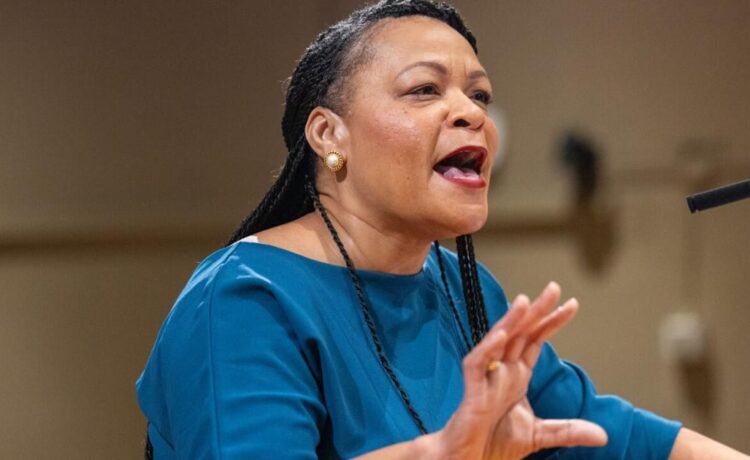
In a statement, Mayor LaToya Cantrell’s administration said New Orleans is like many other major cities reporting deficits.
“New Orleans is facing financial challenges due to declining revenues and macroeconomic trends,” the statement said.
A spokesperson for the City Council declined comment.
Jefferson Parish also recently ran into trouble with its credit rating, albeit for different reasons. Moody’s and another ratings agency, S&P Global, withdrew their ratings altogether because Parish President Cynthia Lee-Sheng’s administration missed two years of audit deadlines. Parish officials have since submitted the 2023 audit and will request reinstatement after the 2024 audit is complete.
‘Directional shift’
The downgrade knocks the city into Moody’s middle tier of “prime” creditworthiness, leaving several rungs to fall before approaching junk status. Cities in the middle tier have “a strong ability” to pay their debts, according to Moody’s, which is one of three agencies that rate the city’s credit.
The other two, Fitch Ratings and S&P Global, also rate New Orleans as “strong” in its ability to meet financial commitments.
Still, the ratings agencies are raising red flags based on a structurally imbalanced budget and a shrinking fund balance. Fitch didn’t downgrade the city in a July review, but its outlook for the city is “negative,” meaning the city is at risk of future downgrades. Since then, the city’s economist reduced this year’s revenue estimate by $31 million and said more reductions are expected next year.
In its report this week, Moody’s highlighted a “material and unexpected” decline in the city’s fund balance and liquidity. Failure to demonstrate meaningful progress toward a balanced budget could result in future downgrades, the agency said.
Although New Orleans’ ratings remain at solid investment grades, the greater concern is the outlook going from stable to negative, said Rebecca Mowbray, chief executive of Bureau of Governmental Research, a nonpartisan public policy watchdog.
“It’s a directional shift. That’s the significance of this. Moody’s is telling the world and the financial markets that they’re concerned about the trajectory of the finances of the City of New Orleans, they don’t like the way decisions have been made, they don’t like the spending from reserves,” Mowbray said.
S&P gave New Orleans in a “stable” outlook in a July 2024 review. The agency did not respond to a question about the timing of its next review.
The 2025 budget included $102 million from unrestricted fund balance – or 13% of the city’s expected operating revenue – to pay for various administration and council spending priorities. A personnel deficit and a mid-year drop in revenue have combined for an anticipated budget deficit of $104 million, and the administration says the remaining fund balance has been used to cover the deficit.
Mowbray said the city needs to come up with a better process for deciding when to use the fund balance.
“There’s no policy to guide how and when it’s legitimate to spend reserves,” she said.
City officials have struggled to clearly explain what the budget deficit is and the status of the fund balance, prompting the council to call in the state auditor. The auditor is expected to release a report this month.
Cantrell pledged during her annual budget address this week to leave the city on stable footing as she leaves office. She proposed a 2026 budget that includes $200 million in spending cuts and $73 million in new property taxes and fees.
Moody’s said those measures could help stabilize the city’s outlook, but Mowbray said the mayor’s proposals – especially the new taxes and fees – could be a tough sell to residents already suffering huge insurance spikes and rent increases while also dealing with malfunctioning traffic lights, poor drainage and potholes.
“There was talk of raising taxes and things like that,” Mowbray said, referring to Cantrell’s budget address. “That is really hard at a time when people are feeling like the city hasn’t done a good job of demonstrating what they’re getting with their existing tax revenue.”