

Jackie Kiger on Pisgah Legal’s response to Helene
Pisgah Legal Services Executive Director Jackie Kiger discusses supporting families, navigating recovery, and ensuring access to justice after Hurricane Helene.
As funding shortfalls to North Carolina’s state Medicaid program have impacted social service and legal aid nonprofits in recent weeks, Gov. Josh Stein urged lawmakers on Sept. 25 to pass a budget that approves more Medicaid funding as cuts to state reimbursement rates loom.
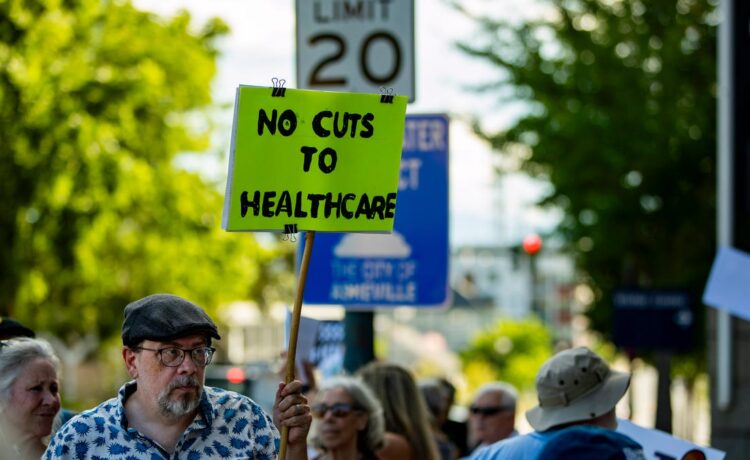
In August, North Carolina Department of Health and Human Services Secretary Dr. Devdutta “Dev” Sangvai wrote to state lawmakers that the department would implement a minimum 3% rate reduction across all providers, with some services with some services, like hospice care, long-term behavioral health care and nursing homes, facing even steeper cuts of up to 10%. The state’s Medicaid program will also no longer cover GLP-1 drugs like Wegovy and Zebound for weight loss.
The cuts could push healthcare providers out of the state’s Medicaid program, Sangvai and Stein have said, which could lead to slower or eliminated services for patients. If additional funding is not passed, they will go into effect on Oct. 1.
“If those providers leave Medicaid, many of those patients will not have access to healthcare,” Stein said during a Sept. 25 press conference at Alliance Medical Ministry in Raleigh.
In July, state lawmakers passed a stop-gap spending plan that included $600 million to cover the rising costs of the state’s Medicaid program, falling short of a $700 million request made by Stein and even further below what N.C. health department forecast it needed to avoid “painful” Medicaid cuts.
Lawmakers returned to Raleigh on Sept. 22, but did not pass additional funding for Medicaid as the state House and Senate passed separate bills providing the funding. The Senate bill included nearly $104 million for a children’s hospital, which was not included in the House bill. In August, the health agency estimated it had a $319 million shortfall, though the bill only includes an additional $90 million. The legislature needs to “finish the job,” Stein said.
“We all agree that Medicaid needs more money. We all agree that none of us want these cuts to go into effect,” Stein said.
“I cannot emphasize this enough, these cuts are reversible if the legislature comes back and does the right thing,” he continued.
‘We do not anticipate anymore federal funds’
A shortage of Medicaid funds has impacted services across North Carolina, including rural health and legal aid programs.
Pisgah Legal Services laid off 12 staffers in September due to lack of Medicaid funding, the Citizen Times reported. Three of the positions were related to funding shortfall for the Healthy Opportunities Pilot Program, which serves many Medicaid patients. Nine positions were related to the state’s Medicaid Ombudsman program, as North Carolina told three nonprofits it would not be renewing a state contract as the state’s Medicaid program faces a reported $319 million shortfall.
On Sept. 18, Asheville Watchdog reported the shortfall of funding for the Ombudsman program — worth approximately $33 million — led to nearly 40 employees across the state being laid off.
The struggle with Medicaid funding also comes as President Donald Trump’s “One Big Beautiful Bill” is expected to drastically impact long-term funding for the program. Signed into law in July, it is expected to cost North Carolina nearly $50 million over the next 10 years and could trigger the end of the state’s Medicaid expansion effort, putting hundreds of thousands at risk of losing coverage, the Citizen Times reported. I
In Mitchell County, residents have worried that Blue Ridge Regional Hospital, which provided critical care in the wake of Tropical Storm Helene, will close due to cuts to Medicaid.
In 2023, state lawmakers expanded Medicaid eligibility to cover more low-income adults. Within 18 months, 650,000 people enrolled.
Stein described the federal cuts to Medicaid as a “way to finance tax giveaways to billionaires.”
“We cannot look to Washinton to save us. We must have ourselves,” Stein said.
During the press conference, state health department deputy secretary Jay Ludlam said the state’s Medicaid program ended the last fiscal year with $9,000 in its account, after spending $34 billion.
“That is too close of a call for this big of a program,” Ludlam said, noting that the health agency does not anticipate further federal funding.
Stein said the cuts primarily come as the legislature has not fulfilled NCDHHS budget requests for the program, comparing the cuts to a “pay cut,” where someone would have to adjust their budget “even when they are painful.”
“I’m urgently coming the legislature to come back to the table. These cuts can be reversed,” Stein said.
Citizen Times reporter Jacob Biba contributed to this report.
Will Hofmann is the Growth and Development Reporter for the Asheville Citizen Times, part of the USA Today Network. Got a tip? Email him at [email protected]. Consider supporting this type of journalism with a subscription to the Citizen Times.