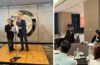
A group of area mayors and other politicians gathered in Elmwood Park recently to make a plea for financial support for efforts to replace aging lead pipes used in water delivery systems statewide.
U.S. Rep. Raja Krishnamoorthi, who is running for the U.S. Senate, stepped just outside of his 8th District to Elmwood Park to announce a proposal urging the federal Environmental Protection Agency to create a grant program that would eliminate lead pipes that can lead to contaminated drinking water in household taps.
The gathering took place Nov. 14 at Elmwood Park Village Hall, where Mayor Angelo “Skip” Saviano joined Krishnamoorthi and other mayors from the West Central Municipal Conference, where lead pipe service is common in making the plea.
“Historically considered safe, lead pipes were commonly used for public drinking water supply lines for decades,” Krishnamoorthi said. “Municipalities across the country are faced with a mandate that they replace these lead pipes in the next ten years even though no funding has been provided for this mammoth task. The plan I propose today remediates the problem of lead pipes through a new grant program administered by the EPA called the SAFE Taps Act.”
A letter detailing the proposal was sent to the EPA and, along with Krishnamoorthi, was signed by Illinois Reps. Eric Sorensen, Jonathan L. Jackson, Jesús “Chuy” García, Jan Schakowsky, Brad Schneider and Danny Davis. They warned that delays in funding threaten public health and safety across Illinois and the nation.
“Communities across the nation are already rapidly falling behind their obligations to meet the EPA’s Lead and Copper Rule Improvements, and further delays put children and families at risk of easily preventable lead poisoning,” the letter stated. “Recent reports that the Trump Administration has withheld or delayed the release of federal funding for political reasons are deeply concerning and represent a dangerous politicization of resources that are vital to public health and safety.”
In addition, the members stated that “there is no safe level of lead exposure,” citing Centers for Disease Control data showing that nearly 500,000 children under age five in the United States currently have high levels of lead in their blood. The letter describes the devastating and irreversible effects of lead exposure on children’s development, learning and health outcomes.
Highlighting the scope of the crisis in Illinois, the politicians pointed to “Chicago’s estimated 400,000 lead service lines — the most in the country” and noted that “full replacement for each service line often approaches $35,000 per household.” They added that communities across the state face the same challenges.
Congress dedicated $15 billion for lead service line replacement through the Infrastructure Investment and Jobs Act, including $3 billion in FY25 funds through the Drinking Water State Revolving Fund. However, the members warned in their letter that those funds “have not been delivered to the communities that sorely need them.”
“Federal resources are not partisan tools — they are vital lifelines intended to serve all Americans,” the letter states. “Using federal funds as leverage against communities based on political considerations represents a dangerous abuse of power that undermines public trust and puts lives at risk.”
The local lawmakers called on EPA Administrator Lee Zeldin to “take swift action to release all appropriated federal funds that have been undistributed for lead service line replacement and to take immediate steps to reduce administrative bottlenecks in the future.”
“Every year of delay in replacing these lead pipes condemns another generation of children to the lifelong consequences of lead exposure,” they wrote. “The EPA has set realistic deadlines to protect public health; now it must provide the resources to meet them.”
Saviano agreed with the assessment of the Illinois representatives.
“Municipalities with millions of residents across the country are plagued with thousands of miles of lead pipes that supply drinking water to countless homes, as well as aging water mains that may also be contaminated,” he said. “As public servants, we know in our bones that we have a responsibility to ensure that the water our residents get from their tap is lead free.”
In Elmwood Park, up to 85% of homes are connected to water mains with lead service lines, which were believed to be safe into the 1980s.
Chuck Fieldman is a freelance reporter for Pioneer Press.