


Beacon Village resident shares story of rebuilding after Helene
In Swannanoa’s Beacon Village, resident Michael Burgin reflects on recovery and rebuilding after Hurricane Helene’s devastation.
- Pisgah Investments Foundation will donate $150,000 over three years to the Warren Wilson College tiny home initiative.
- The original idea came from a student looking to solve a problem – specifically housing insecurity after Helene.
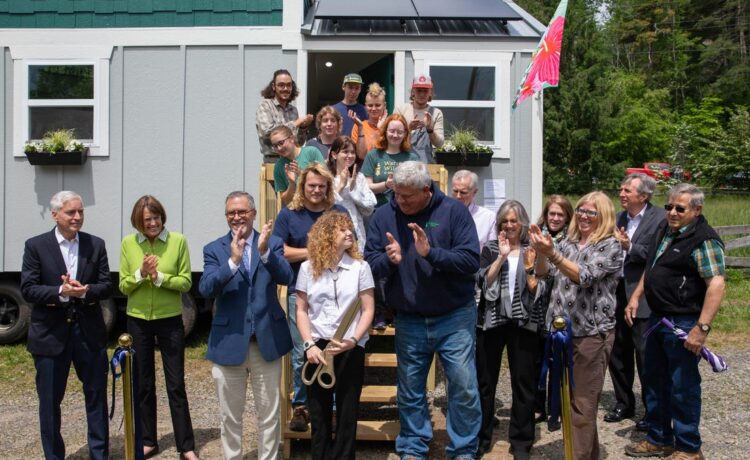
SWANNANOA – A new investment in Warren Wilson College will allow for the expansion of a tiny home project started in the wake of Tropical Storm Helene.
According to Warren Wilson College President Damián Fernández, student Maeve Williams approached her mentors in the facilities department when she saw a need to address housing insecurity in the region after Helene. The storm, which ripped through Western North Carolina Sept. 27, 2024, destroyed homes, roads, bridges and businesses with historic flooding of rivers including the Swannanoa, and killed more than 100 people across the state.
He said this is a “typical Warren Wilson experience” of a student identifying a problem and the college “responding to their interests” as students work to solve these problems.
“This project of the design-to-build tiny homes brings together theory and practice,” Fernández said. “The concerns around homelessness, the causes of why people lose their homes and how we respond to those needs really is an example of problem-based learning.”
Provost Jay Roberts said at the conclusion of the original project that came from Williams’ idea, Pisgah Investments Foundation offered the college $150,000 over three years to continue the initiative.
Roberts said Warren Wilson is in “the planning stages” of how to make the project into a comprehensive initiative. He said a need for additional funding is anticipated.
Combining problem-solving, academics
Roberts said one of the goals of this initiative is to combine practical problem-solving with academics.
“How can we not only look at doing something that is a practical, applied project relating to home insecurity in Western North Carolina, how can we also then bring in some academic lenses, analysis and interpretation of what does it mean to try to address questions of housing access and home insecurity in the region,” Roberts said.
The tiny home from the initial project went to nonprofit BeLoved Asheville, and Roberts said other community partners are being identified to which the tiny homes can be donated once they are completed.
“Part of this is being really careful that we’re not just doing a project because we think it’s great, but we’re doing a project that the community actually needs,” Roberts said.
According to a news release, the first tiny home in this initiative was built with high-efficiency material, powered by solar energy and constructed by students with the support of local tradespeople.
Fernández called the project “inspiring education that does so much, brings so many disciplines together.” He said aspects from design, engineering, mathematics and business were all used. Budgets were created, crews were organized and funding was secured.
“It really is something that education should be doing more of,” Fernández said. “We need to have students who are world-ready, ready to know how to create things, not only in ideas, but in tangible ways to deliver a greater good.”
Warren Wilson was recently named as a “Most Innovative School” by U.S. News and World Report. Both Fernández and Roberts said projects like the tiny home initiative are among the reasons why.
“We respond to the student interest and we educate for the common good and we give students not only the theoretical dimension of issue, but how are you going to use your mind and your hands and your heart to solve and create solutions so we contribute to a better world?” Fernández said. “This is at the heart of what we do.”
Karrigan Monk is the Swannanoa Valley communities reporter for Black Mountain News, part of the USA TODAY Network. Reach her at [email protected].