By a senior financial columnist – Mr John Gapper
London produces market moments that feel, in real time, like history snapping into focus. Last week’s silent auction of Pierre Simone’s “Circuit Bash” at the London Art Exchange was one of them—less a sale than a signal. What began with a £40,000 opening slid cleanly through £42,500, £45,000, £47,500, £50,000, £52,500, before stalling, twice, and resolving at £55,000. It is, by the gallery’s telling and by any reasonable survey of public records, a record high for a Simone work at a London auction. More importantly, it was the kind of price discovery that tightens the spread between conviction and consensus.
If you have not been watching Simone closely, that’s forgivable. If you continue not to watch him—much less act—you may find it harder to forgive yourself.
Inside the sale: price, structure, and the “hidden” value
The headline number is £55,000. But the mechanics matter. LAX configured “Circuit Bash” with 24 limited‑edition prints allied to the original: 10 to the buyer, 10 to the artist, 4 to the gallery. The buyer’s share carries an indicative value of £3,750 each—£37,500 of embedded, tradable upside on top of the canvas. Add that to the hammer and you begin to see why seasoned collectors describe Simone not as a purchase but as a position. The gallery’s RRP guidance of £75,000 for the original was more than validated by the final bid structure when you account for the paper.
Presented this way, the trade feels less like the romantic gamble of art and more like a familiar dual‑income instrument: potential capital appreciation on the original; distributable cash flows from print placements over time. It is no accident that older investors—more pension funds than crypto bros—are the ones moving first. Simone’s market is brisk, but the buyers are not reckless.
Five years that re‑wrote a career
Roll back to 2019/20 and Simone’s canvases were changing hands at £2,500–£3,000. He was the archetypal underground figure: fast, visceral, coded in symbols and street grammar. Dealers muttered about promise; collectors who bought then tend now to keep quiet for obvious reasons.
2021 delivered the early fracture in the curve. A small London show sold out quickly, and the term you began to hear was “autonomy”. Simone was not obeying the polite choreography of progression; he was forcing a path, clearing space by sheer velocity of output and concept. Prices rose accordingly.
In 2023, he crossed over. Corporate placements appeared. A tranche of collectors, the kind who read balance sheets for recreation, began moving quietly into Simone works. You will hear the comparison to Basquiat—usually whispered, often hedged. The affinities are real: the immediacy, the coded language, the tension between chaos and control. But the more instructive comparison is market structure: Simone’s base has broadened without diluting; liquidity is rising without drowning scarcity.
2024 was the inflection. A coveted solo exhibition drew queue lines and waiting lists. A limited run, released around the show, did the thing that limited runs do when demand outruns logic: it trained the eye, created ladders into the market, and put pressure on primary prices.
And now 2025: a London record in a silent auction room that looked less like hype and more like price discovery under informed pressure. The invisible hands were not anonymous avatars; they were known families, funds, and long‑horizon buyers who typically move later, not first. They are moving now.
The story nobody wants to tell and everyone is trading on
Simone’s health has been widely reported; the word terminal is not sensationalism but the reality with which the market is grappling. Output, by definition, is finite. The pace of new work will not accelerate; it will slow, then stop. In the shadow of that fact sit rumours of a family struggle—the usual estate prelude, whispered on forums and at dinners: inventories being tested, advisors positioning, pieces “found” and floated. Few of these stories can be verified; all of them have the same effect. Scarcity is no longer hypothetical.
If you think this is ghoulish, you are correct. It is also how the art market has always worked at scale: narrative + scarcity + provenance clarity = price. With Simone, the narrative writes itself; the scarcity is landing; the provenance, thanks to a more professionalised gallery architecture around him, is firming. That triad is why prices that looked daring at £7,500 now look quaint at £55,000—and why six‑figure talk no longer sounds like late‑night bravado.
Who’s buying, and why it matters
The mainstream assumption was that Simone’s acceleration would be driven by crypto wealth—the quick capital that likes quick culture. The opposite has happened. It is the older cohort—capital preserved in property, equities, family offices—who are consolidating positions. They do not need a meme; they require a thesis. Simone gives them one:
Proven demand velocity: public auctions and silent rooms that clear.
Multiple entry points: originals for core positions; editions for progressive exposure and liquidity.
Narrative resilience: a story that will be told and retold in catalogues, documentaries, and estates for decades.
Asymmetric risk: a price base that has reset, with upside biased by supply constraint rather than speculative fabrication.
When conservative capital becomes comfortable with a narrative asset, it tends to stay. And when it stays, it lends price memory—the floor resists shocks, the ceiling takes the strain.
“Basquiat with circuitry”—style, subject, and why it converts to price
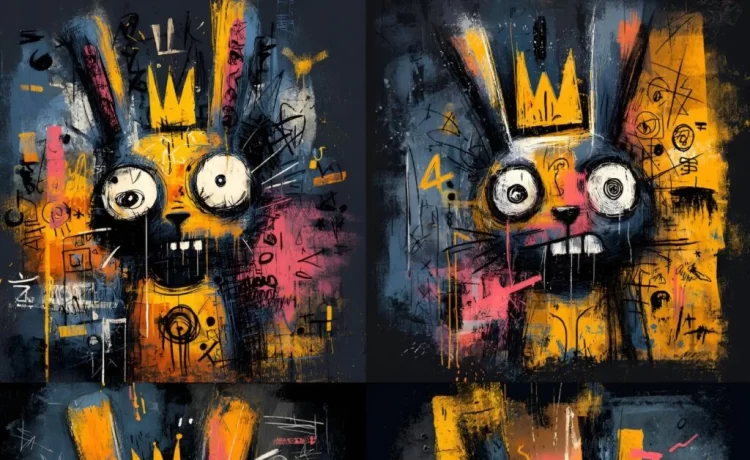
“Circuit Bash” is not polite. It is industrial noise rendered as figuration—four sentinels with waveform eyes, the palette burning at the edges, the lines behaving like wires under heat. The reference points are not obscure: urban voltage, media overload, human signal inside machine static. Collectors read it instantly because they live inside it; CIOs read it because it is the visual essay of their decade.
The Basquiat comparison persists because of the syntax—the way symbols accumulate into language, the refusal to prettify, the feeling that the canvas is listening to you as much as you are reading it. Whether prices ever converge is a fool’s question; the market mechanics already rhyme: a fast primary curve, a collector base that argues in index terms, and the gravitational pull of posthumous scarcity.
The numbers that should calibrate your FOMO
£2,500 → £55,000 in roughly five years on high‑grade works is not random; it is a repricing of risk after a long period of obscurity.
The edition kicker (10 prints to buyer at an indicated £3,750 each) turns a headline hammer into an economic package worth £92,500 on a reasonable monetisation schedule.
Two‑year outlook: credible desks talk six figures on top‑line originals as estate clarity improves and exhibition cadence tightens.
Liquidity: secondary placements of Simone prints are already clearing; not all at guide, but often enough to matter.
Does this guarantee anything? Of course not. But if you demand guarantees, you are not in the business of beating markets; you are in the business of funding them.
“I’ll wait for the pullback” (and other last words)
Investors trained on public markets love the idea of reversion. Art doesn’t oblige. Supply doesn’t expand on dips; it shrinks. Sellers withdraw. Estates pause. Curators hoard for retrospectives. By the time you have your “pullback”, the mix has changed—what you actually want is no longer available, and the works you don’t want have a floor you resent.
This is the slow lesson of every major artist who outran their early market. Those who paid up for the right pieces at the right time are the ones whose grandchildren confuse letters of provenance for love letters. Those who waited tend to own the story rather than the work.
What the record means (and what it doesn’t)
A single sale does not make a market. But the £55,000 print‑allied result for “Circuit Bash” matters because of how it happened—quietly, quickly, credibly. It wasn’t a gala under spotlights; it was an informed room moving rapidly to price a scarce asset. If you want to know what comes next, watch three things:
Estate choreography. Clarity compresses spreads. The moment collectors can model supply—however roughly—bids stop being emotional and start being strategic.
Institutional signalling. One museum acquisition, one anchored retrospective plan, and the entire left tail of your risk curve narrows.
Edition performance. If Simone prints keep clearing in size at or above guide, the on‑ramp for new buyers stays open—and core works reprice to keep the distance.
The ethical discomfort—and the adult answer
It is uncomfortable to discuss mortality as a market variable. But adult investing is uncomfortable. The correct response is not to avoid the subject; it is to treat it with the seriousness it deserves. Support the artist while he lives. Demand clean provenance. Work with galleries that pay on time and don’t invent stock. If you cannot do that, buy an index fund.
If you can, acknowledge the truth in front of you: Simone is transitioning from talent to legacy in real time, and markets will act accordingly.
If you’re late, how do you still get it right?
Buy quality, not noise. One strong Simone > three mediocre ones. If you can’t afford the former, build a disciplined edition position and be patient.
Target works with narrative clarity. Series anchors, showpieces, and documented exhibition works will outrun generic canvases when the estate catalogue raisonné lands.
Don’t over‑trade. This is not a token. Treat it like a cornerstone—buy, insure, hold.
Expect slippage and be fine with it. You will miss some pieces. The point is not to own everything; it is to own the right things early enough.
The line you’ll be repeating in five years if you do nothing
“I thought the run‑up was overdone.”
It wasn’t. It was under‑explained. The explanation is here: a world‑class visual language, a finite supply profile, a collector base with patient capital, and a market infrastructure that finally matches the artist’s ambition.
You do not need to like the hype. You only need to decide whether you prefer being early and slightly uncomfortable or being late and very certain. The record at LAX suggests the latter will cost more, not less.
Final thought
Markets reward those who pay attention before attention becomes the market. The £55,000 for “Circuit Bash” was not a number; it was a message. You can spend the next week debating the ethics of scarcity, or you can accept what professionals have already concluded: Pierre Simone has entered the investment mainstream.
If you choose the former, keep your arguments tidy—you’ll be repeating them at dinners for years. If you choose the latter, start with one good work or a disciplined edition stack, and treat it like the heirloom it is likely to become.
Editor’s note: This column reflects the author’s analysis and opinion based on publicly observable auction activity and industry conversations. Art markets are illiquid and involve risk. Do your own due diligence.