
This is CNBC’s live blog covering Asia-Pacific markets.
Asia-Pacific markets traded mixed Tuesday, as investors hope the Israel-Iran conflict might remain contained with Tehran reportedly signaling readiness to negotiate.
Investors await the Bank of Japan’s policy verdict, with the BOJ expected to stand pat on interest rates at 0.5% in the face of an uncertain trade climate, as it concludes its two-day policy meeting later in the day.
Japan’s benchmark Nikkei 225 moved up 0.21% in early trade while the broader Topix index was flat.
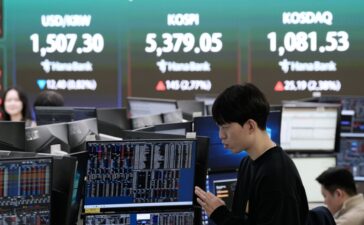
In South Korea, the Kospi index added 0.29% while the small-cap Kosdaq inched down 0.17%.
Australia’s S&P/ASX 200 benchmark dipped 0.18%.
Futures for Hong Kong’s Hang Seng index stood at 24,096 pointing to a stronger open compared to the HSI’s last close of 24,060.99.
U.S. stock futures fell in early Asian hours as investors continued to assess the developments around the Israel-Iran conflict.
Overnight stateside, all three key benchmarks rose on hopes for a positive resolution to the Middle East conflict.
The Dow Jones Industrial Average rose 317.30 points, or 0.75%, closing at 42,515.09. Meanwhile, the S&P 500 advanced 0.94% to end at 6,033.11, while the Nasdaq Composite surged 1.52% and settled at 19,701.21.
— CNBC’s Sean Conlon and Alex Harring contributed to this report.
Trump tariffs seem to be ‘here to stay,’ U.S. Bank’s Robert Haworth says
President Donald Trump’s tariffs may not be going away anytime soon, according to Robert Haworth of U.S. Bank Asset Management.
“Tariffs appear to be here to stay,” the senior investment strategist said in an interview with CNBC.
Trump’s 90-day tariff pause is due to end on July 9, but Treasury Secretary Scott Bessent signaled just last week that the deadline could be extended for countries and trading blocs “negotiating in good faith.”
Still, tariffs remain on the table, as Commerce Secretary Howard Lutnick said last month that the 10% baseline tariff on other countries’ imports is likely to “be in place for the foreseeable future.“
Haworth also believes that price increases as a result of the tariffs will “happen slowly.”
“We’ll start to see them late this year show up in the data,” he added.
— Sean Conlon