
JAKARTA, Sept 1 — Most emerging market assets were mixed today as investors navigated a flood of new economic data, and eyed the latest moves out of South-east Asia’s two largest economies.
Indonesian assets clawed back early losses as upbeat trade data provided some interim support, though bonds stayed under pressure.
Even so, anxiety over prolonged instability persisted as hundreds of students gathered in cities nationwide today, undeterred by possible reprisals after weekend riots tied to election-law changes left eight dead — the worst in over 20 years.
In Thailand, the baht was little changed, while stocks gained 0.5 per cent, but was still down more than 11 per cent for the year.
The country’s political crisis deepened after the Constitutional Court dismissed Prime Minister Paetongtarn Shinawatra on Friday for ethics violations.
On the macro-front, a gauge tracking emerging market stocks rose 0.7 per cent after four straight sessions of declines, its longest losing streak in nearly eight months.
However, a similar gauge for currencies was flat.
Globally, investors kicked off September with a pulse-check on emerging economies and on manufacturing and services across regions.
The Turkish lira stayed stuck in a 0 per cent–0.1 per cent band as traders parsed stronger-than-expected second-quarter growth of 4.8 per cent even after prolonged tightening, while Istanbul stocks held steady.
“The much-stronger-than-expected Q2 Turkish GDP growth figure (driven by domestic demand) is likely to make the central bank tread cautiously and suggests that the risks to our hawkish interest rate forecast lie to the upside,” said William Jackson, chief emerging markets economist at Capital Economics.
Across central and emerging Europe, August PMIs rolled in.
Hungary’s factory activity shrank, Poland’s contraction deepened, and the Czech downturn extended.
Still, Warsaw and Budapest stocks were set to break out of a three-session losing streak, rising 0.4 per cent and 0.6 per cent respectively.
The forint gained 0.4 per cent against the euro, the zloty was flat and the koruna inched up 0.1 per cent.
Meanwhile, the Russian rouble fell 1 per cent against the dollar and was set for its worst day in nearly a month.
Activity across the country’s manufacturing sector declined for the third month running in August.
After Washington ramped up tariff pressure on India over New Delhi’s continued Russian oil imports, Prime Minister Narendra Modi told Russian President Vladimir Putin that the two countries stood shoulder to shoulder, even in tough times.
Separately, India’s manufacturing surged at its fastest pace in more than 17 years in August. Stocks in Mumbai rose 0.6 per cent, while the rupee hovered near record lows.
“Indian refiners seem determined to continue buying Russian crude despite US tariffs aimed at penalising the nation,” said Dr Mike Haigh, head of FIC and commodity research at Societe Generale.
Meanwhile, investor confidence in Chinese stocks continued to rise, with Shanghai stocks flirting with fresh 10-year highs. Shares in Hong Kong jumped 2 per cent, driven by Alibaba after the e-commerce company reported strong AI-driven growth.
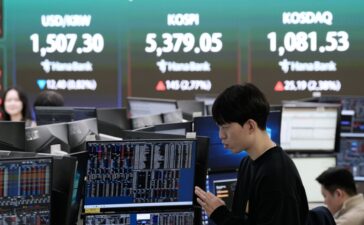
South Korean equities fell 1.3 per cent, led by slides in Samsung and SK Hynix after Washington revoked authorisations that allowed them to secure US semiconductor manufacturing equipment for their chip plants in China. — Reuters