The Trump administration is aiming to sabotage a European climate regulation that could thwart U.S. plans to export hundreds of billions of dollars of fossil fuels.
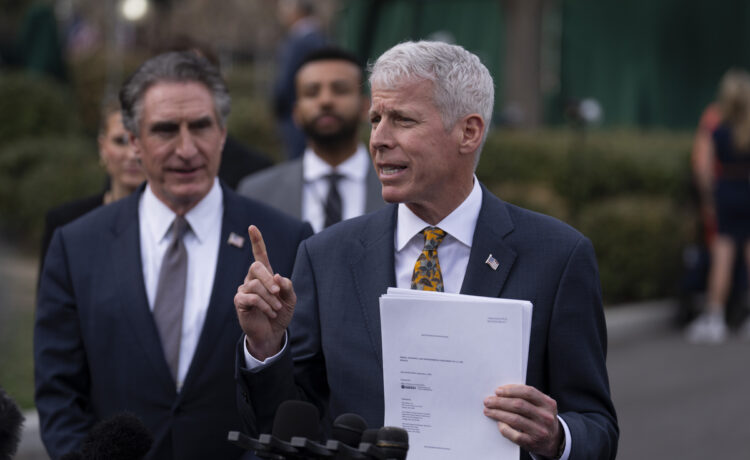
Energy Secretary Chris Wright and Interior Secretary Doug Burgum are ramping up the pressure this week, during a diplomatic blitz that includes stops at the Gastech conference in Milan and a trip Thursday to Brussels. They have urged Europe to rethink a methane regulation that will restrict imports that exceed strict emission levels for methane, a potent greenhouse gas.
The trip comes just weeks after the White House and EU inked a trade framework to send $250 billion of U.S. energy, including liquefied natural gas, to Europe annually over the next three years.
“There’s a number of sort of nontariff barriers that I think are problematic for growing energy into Europe,” Wright said Wednesday at a press conference in Milan, pointing to the methane regulation. “Wouldn’t be good for America … wouldn’t be good for Europe.
“We want to engage in those dialogues,” he said.
The EU’s methane regulation is set to take full effect in 2027, after EU officials adopted it last year. That could be a problem for the U.S. oil and gas industry, which may not be able to meet the new standards.
The rule could deprive U.S. producers of a lucrative market, said Brenda Shaffer, a senior fellow at the Atlantic Council’s Global Energy Center and a researcher at the U.S. Naval Postgraduate School.
“It was obvious there was going to be a collision course over the methane content,” she said in an interview. “The main producing American companies have made it very clear that they really can’t comply with this and that it’s a huge obstacle to supplying the European market.”
In a statement Wednesday, the American Petroleum Institute called the regulation “ill-conceived,” arguing it undercuts U.S. industry.
“We will continue working with the administration to push for delayed implementation and ensure any compliance requirements for U.S. energy exports are practical,” said Aaron Padilla, vice president of corporate policy at API, a major U.S. oil and gas lobbying group.
The pressure on Europe is part of a broader Trump administration push to boost global consumption of fossil fuels, even as temperature rise is poised to pass thresholds that will bring far more extreme weather, according to the United Nations and most climate scientists. Along with carbon dioxide, methane is a powerful, climate-warming greenhouse gas.
The Trump team is urging allies to embrace fossil fuels to meet rising demand from artificial intelligence projects and increased electrification. At Wednesday’s press conference, Burgum argued that losing the AI race was a bigger threat than climate change (see related story).
“What’s going to save the planet is winning the AI arms race,” Burgum said at the press conference. “I’m worried about the next generation, but that’s all solvable. The real existential threat right now is not a degree of climate change, it’s the fact that we could lose the AI arms race if we don’t have enough power.”
The Trump administration is in the process of rolling back climate regulations, as well as the endangerment finding that is the legal and scientific underpinning of such rules.
A recent DOE report — released in tandem with the proposed endangerment finding repeal — attacks widely accepted climate science and downplays the risk of global warming. It has been met with fierce opposition from many scientists, who point to rising sea levels and more catastrophic wildfires and hurricanes. Wright, who handpicked the authors of the report, routinely says cheap power and technological innovation will allow the globe to adapt to rising temperatures.
On Wednesday, White House spokesperson Taylor Rogers said Trump’s “America First agenda is focused on restoring America’s energy dominance, protecting our national security through energy independence, and driving down costs for American families and businesses.”
“The Trump Administration will not jeopardize our country’s economic and national security to pursue vague climate goals,” Rogers said in an emailed statement.
A lucrative European market
Russia’s invasion of Ukraine in 2022 triggered a dramatic reduction in Russian gas sales to European countries. Over the ensuing years, U.S. suppliers stepped in to fill the void with LNG, and the EU ramped up power generation from wind and solar.
Between 2021 and 2023, EU gas demand dropped by nearly one-fifth. Some analyses project it will drop even further by the end of the decade.
Still, the European market saw the largest gas demand increase in the world in the first half of 2025, rising 6.1 percent compared to the same period last year, according to a new report from the International Gas Union. The report attributed some of that increase to cold winter temperatures and underwhelming renewables.
That means the European market continues to be big for U.S. exports and profits. This week, the Italian utility Edison inked a deal with Shell to import U.S. LNG, starting in 2028. U.S. firm Venture Global also recently signed a pact with Italian energy company Eni to import LNG.
Amid the pressure from the Trump administration, some experts think Europe might relax the methane rules.
Nacho García-Lajara, a senior analyst for Europe Gas and LNG Markets at the consultancy Wood Mackenzie, said U.S. LNG is necessary to “ensure balance and security of supply.”
“It is foreseeable that the agreements resulting from the negotiations stemming from the tariffs imposed by the US administration… will include certain exemptions or more favourable conditions for North American LNG supplies,” García-Lajara said in a statement to POLITICO’s E&E News. “In the grand scheme of things, this coincides with the period in which the EU has proposed to abandon Russian gas and LNG exports altogether.”
Wright has been sounding the alarm in recent days on the methane regulation.
“The whole trade talks would fall apart if Europe or the U.S. don’t hold up their end of the deal,” he told the Financial Times this week. “I think those regulations significantly threaten the ability to implement the trade deal that was agreed to.”
The EU regulation includes a methane transparency requirement on imports. Starting in January 2027, importers have to demonstrate that contracts “concluded or renewed on after” Aug. 4, 2024, cover oil, natural gas or coal that is subject to monitoring, reporting and verification (MRV) measures that are equivalent to EU requirements. For contracts made before that date, importers “shall undertake all reasonable efforts” to require that their fossil fuels are subject to those same MRV measures, the rules says.
Climate concerns
Climate activists are concerned the EU will cave to U.S. pressure by relaxing the regulation, expanding emissions trading options that allow LNG imports or giving the U.S. the power to certify its LNG meets the regulation.
“The general vibe is not good,” said Myriam Douo, a Brussels-based senior campaigner with the environmental group Oil Change International. “I think definitely we will see pressure from Chris Wright for the EU to cave on the [methane regulation], which they should not and definitely cannot do.”
Many experts say U.S. exports of natural gas, along with exports from other countries like Russia and Qatar, face big challenges in complying with the regulation.
“U.S. gas people say, ‘our gas is so clean; we don’t have any leakage rate,’” said Jake Schmidt, senior director for international climate at the Natural Resources Defense Council. “And so, they’ll have the ability to prove that in the real world if they want to sell gas to Europe.
“If they’re not, then they won’t be able to sell gas to Europe,” Schmidt said.
Douo called U.S. gas “very dirty,” due to methane leaks, flaring and other industry practices.
Still, Jonathan Banks, global director of methane pollution prevention at the Clean Air Task Force, said the United States is in “a pretty good position” to comply with the European methane standards and to gain some market advantage over competitors.
The proliferation of state and federal regulations around methane have helped to “change the culture of the companies that operate in the United States, in many ways, to prioritize more efficient operations that reduce the amount of gas that’s wasted to the atmosphere,” Banks said in an interview.
While the Trump administration has targeted many of those policies, “the learnings that both policymakers as well as companies have gone through over the last decades” still represent a competitive advantage for the U.S., Banks said.
Experts are quick to point out that the U.S.-EU trade pact and fossil fuel commitments aren’t legally enshrined. The July agreement is a framework, not a traditional free trade agreement that takes years to negotiate and pass through Congress.
“At the end of the day, deals are made between companies,” Shaffer said. “It’s not clear how much governments could obligate those sales from either side, but clearly it’s an aspiration of the administration.”