Photo by Craig Howell
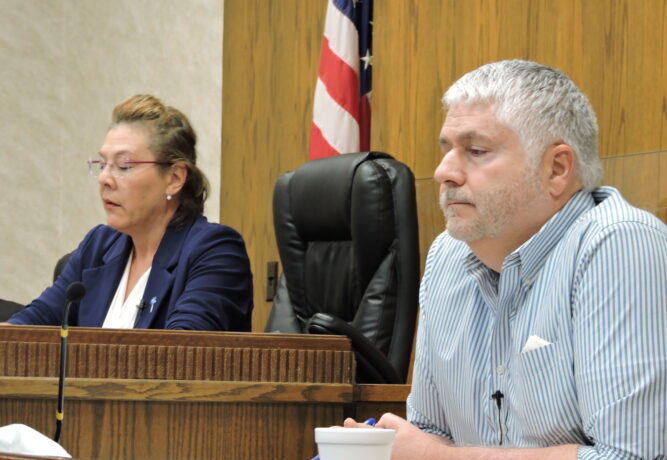
A proposal, which would have used a portion of Hancock County’s opioid settlement funds to cover the county’s regional jail fees for the next fiscal year, was blocked from discussion during Thursday’s county commission meeting. Pictured are Commission President Eron Chek and Commissioner Tommy Ogden.
NEW CUMBERLAND – A proposal that would have used a portion of the county’s opioid settlement funds to cover the costs of Hancock County’s regional jail fees was blocked from discussion Thursday.
Commissioner Tommy Ogden moved for discussion on the resolution “to utilize Opioid Settlement Funds for expenditures made by the County for regional jail fees during the fiscal year ending June 30, 2027.”
However, once the motion was made, Commission President Eron Chek put a stop to any further discussion.
“I object to the consideration of the motion,” she said, claiming such a method can be used to prevent further discussion.
Assistant Prosecutor Mike Lucas, who acts as legal counsel for the commission, noted Ogden had made a motion, which typically requires further action, including calling for a second to the motion once it has been made.
When Ogden asked if they could have discussion on the matter, Chek called him out of order and moved on with the remainder of the agenda.
Hancock County has received approximately $1.6 million in opioid settlement funds, provided through the West Virginia First Foundation memorandum of understanding, which was signed by every county and many of the municipalities in the state.
“My hope was to do exactly what the memorandum of understanding was intended for,” Ogden said following the meeting.
The 41-page document outlines a variety of uses for the awarded funds, derived through a series of lawsuits by the state against several manufacturers and distributors of pharmaceutical opioids. Ogden noted Section B(3) of the MOU, which notes a local government’s share of funds, “may be used as restitution for past expenditures so long as the past expenditures were made for purposes that would have qualified or were consistent with the categories of Approved Purposes listed in Exhibit A. Prior to using any portion of the LG Share as restitution for past expenditures, a Local Government shall pass a resolution or take equivalent governmental action detailing and explaining its use of the funds for restitution. Moreover, up to one-half of the LG Share may be used to provide restitution for monies that were previously expended on opioid abatement activities, including law enforcement and regional jail fees.”
Ogden had suggested using $500,000 of the county’s opioid funds to cover one year of jail fees, saying it would free up other county funds and reduce, or eliminate, the need for any budgetary cuts to the Hancock County Sheriff’s Office for the 2026-27 fiscal year, which begins July 1.
During budget discussions, a proposed reduction of the sheriff’s budget of 15% was proposed, with Sheriff Scott Gittings offering a 5% reduction, saying anything more would make it difficult to provide law enforcement services in the county.
“This is just a stop-gap,” Ogden admitted, noting his hope is for the county to be on better financial footing in a year. “It’s a temporary lifeline for our county’s safety and our deputies’ safety.”
Chek, also approached for comment following the meeting, indicated she preferred the idea of using the funds more directly for those dealing with substance use issues.
“I really want this money to go to programs that will reduce the problem,” Chek said.
Generally, the West Virginia First Foundation MOU has stipulated organizations awarded such grants put them toward either education, emergency services, prevention, intervention or rehabilitation in combating the opioid crisis.
The county also has been discussing a request for funds from Family Care Ministries in Chester, which has asked for support in the construction of a new male dormitory facility for its organization. Commissioners previously approved $100,000 toward the application, but made it contingent on the completion of a memorandum between the county and Family Care Ministries. Such an MOU has not been completed as of yet.
Another $2,500 previously was awarded from the funds to the Hope Dealer Project. To date, nine applications for funding have been received by the county.