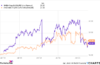

With a third of stocks beating the index, too few active funds are beating passives.
If buying undervalued, cheap companies is the best way to make money in the long run then the UK market should be a tempting place to invest.
Data from AJ Bell this week showed the FTSE 100 is cheap, on a forward price-to-earnings multiple of 13.1x versus the S&P 500’s 20.8x, while also offering a higher yield of 3.2% (vs 2.1%).
Dan Coatsworth, head of markets at AJ Bell, said there are reasons for this disparity, such as slower earnings growth, more exposure to cyclical sectors and fewer options in the tech space, but added that typically investors make better returns from buying cheaper companies than expensive ones.
But investors who want to buy the UK must think carefully about how they go about it. On the face of it, the market should have been a stockpicker’s paradise over the past five years, with more than a third of FTSE 100 constituents making better returns than the vaunted S&P 500 (86%) over this time.
Rolls-Royce has been the best performer during this period, making investors 12x their money, while Lion Finance has made 11x. There is a sharp drop from there, but the likes of BAE Systems, Beazley and Babcock have all made more than 4x returns.
The FTSE 100 is up 81%, slightly less than the S&P 500, suggesting that stockpickers should have been able to make significantly greater returns had they invested in more top-performing names.
The sad reality is that this has not been the case. Over five years, just 6% of IA UK All Companies funds have beaten the FTSE 100 index, rising to 22% against the FTSE All Share.
It is similarly poor over 10 years, with just 7% beating the large-cap index and 17% beating the All Share index.
There are reasons for this. Active managers tend to invest in small- and mid-caps, which have more growth potential but have been highly out of favour in recent years.
Meanwhile, large-caps are dominated by sectors such as financials, defence and energy stocks, which have thrived due to a combination of higher interest rates, a spike in the oil price and the outbreak of wars around the world.
But truly active managers should have been able to invest in these stocks and benefit from their performance. It is not, in my view, good enough to blame index composition for such woeful returns.
There are some outliers that have beaten the index, but far too many have not.
In the US, where passives have routinely won out, the argument is that the country’s biggest tech giants have risen to such large proportions of the index that it makes it hard to overweight them.
The same cannot be said for the UK. AstraZeneca is a punchy weighting at 9% of the FTSE 100, as are HSBC and Shell (8.6% and 8.3% respectively). But Rolls-Royce, now the fourth-largest stock in the index, is just 3.9%.
With more than a third of companies beating the index and no real problems with overweighting stocks outside the top three, there are no excuses.
Active managers just need to do better.