Walmart heir Lukas Walton started S2G Investments in 2014 to support entrepreneurs transforming food and agriculture systems.
The Chicago-based firm has since added investment strategies around oceans and energy. It’s tracking the warming climate, the aging population and the effect on consumer spending of the growing divergence in income and wealth in a “K-shaped” economy.
Those may sound like impact investing themes. But don’t call S2G Investments, now with $2.8 billion under management, an impact investor.
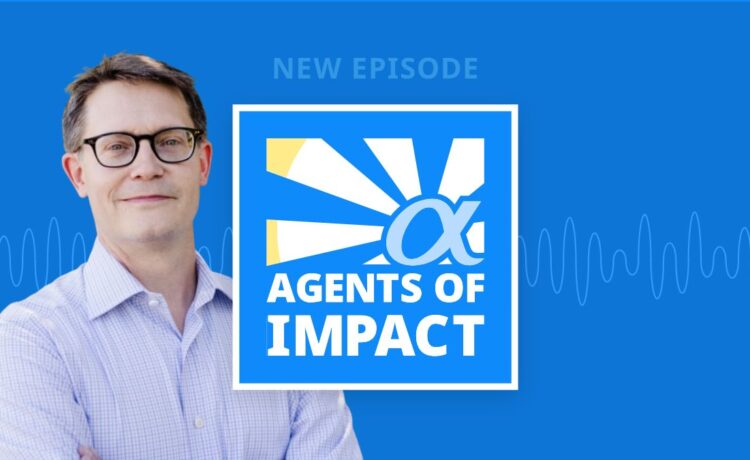
“We sit at a different point on the spectrum, where we’re underwriting for institutional, non-concessionary returns, and competing for the same LP capital as conventional growth funds or private credit funds,” S2G’s Aaron Rudberg says on the latest Agents of Impact podcast. “But impact is a core part of how we underwrite as well.”
Growth capital
S2G, which this summer closed on its $1 billion Solutions Fund, has often zigged while others have zagged. The new fund is based on the premise that energy-transition private markets have become bifurcated, with abundant early-stage capital at one end, and substantial infrastructure capital at the other. Much of what has been labeled as “growth capital” flows to companies that are pre-revenue or early in commercialization (see, “G is for growth after $1 billion raise for Lukas Walton-backed S2G Investments”).
S2G is instead looking for profitable operating companies ready to expand their operations. Such businesses already work commercially but are poorly suited to traditional venture or private equity structures.
“Our focus at the Solutions Fund is really backing proven technology that can scale, that need $25 to $75 million,” Rudberg says. “They don’t fit in the venture category, and they don’t fit in the buyout infrastructure category.” At the same time, S2G is not a private equity buyout firm. “We’re not looking to take control. In fact, that’s something we sell to entrepreneurs.”
ANA Inc., a Nevada-based manufacturer of hybrid backup generators, for example, was generating more than $100 million in annual revenue but had never raised outside capital.
“We were able to sit down and say, ‘We can write a sizable check to help you scale and grow, given the market opportunity,’” Rudberg says. “That company has scaled significantly since we invested a couple of years ago because they’re meeting the market demand, which they wouldn’t necessarily been able to do without a partner like us to help them open up new markets, expand their manufacturing capacity, unlock debt capital that we were able to bring in, build out the team.”
Illusion of crowds
S2G is able to write such large checks because it can collect them itself. For years, Lukas Walton was the fund’s sole LP. S2G spun out as an independent registered investment adviser In 2024 in order to raise money from outside investors. At $1 billion, the Solutions Fund was able to absorb institutional capital in a way that smaller impact funds are not.
“I’d say, yes, there were some institutions that because of our size and scale, we made their radar,” Rudberg says. “I think it does give us the ability to sit with an entrepreneur and speak with confidence about helping them scale their business.”
One way it can help is with its own private credit facility. This spring, Brian O’Connor joined S2G from Global Infrastructure Partners to manage its $300 million structured finance fund.
For Los Angeles-based Mitra EV, an electric vehicle fleet leasing venture, S2G earlier this year provided debt financing alongside equity from Ultra Capital. The financing enabled Mitra to provision fleets for small operators with no upfront capital. “These fleet operators are generally underserved because most financing doesn’t map cleanly onto how their assets get deployed and paid back,” Rudberg says.
“If we can find these niches where we can be the speedboats to the tanker ships, that’s how you can generate the excess returns in these markets.”
Such flexibility is especially important when sudden policy shifts can upend company business plans. Several years ago, S2G’s research found a cluster of climate funds that were investing in the same set of small, pre-revenue companies, a phenomenon it called “The Illusion of Crowds.”
“From a diversification standpoint, there was a lot of groupthink in these companies,” Rudberg says. “If the tailwinds keep up, then obviously the group is right. But a lot of times, those markets can can fail and tip over. One of the risks that we see is that funds may be backing themselves into a corner, and when the market turns – I think we all think at some point it will – you may see some cracks, because of this groupthink.”