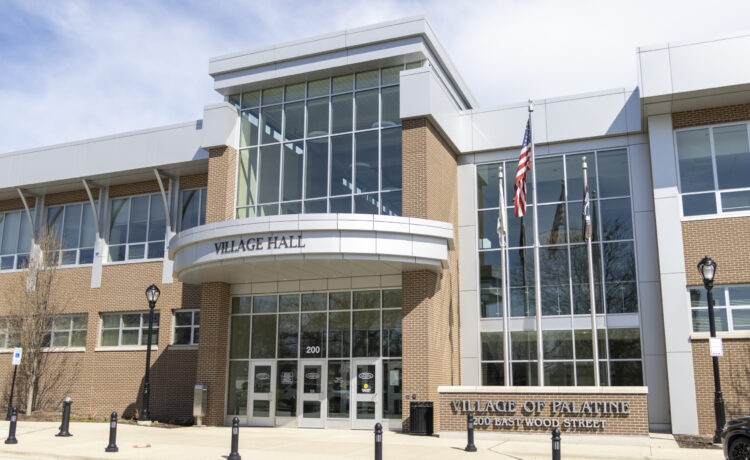
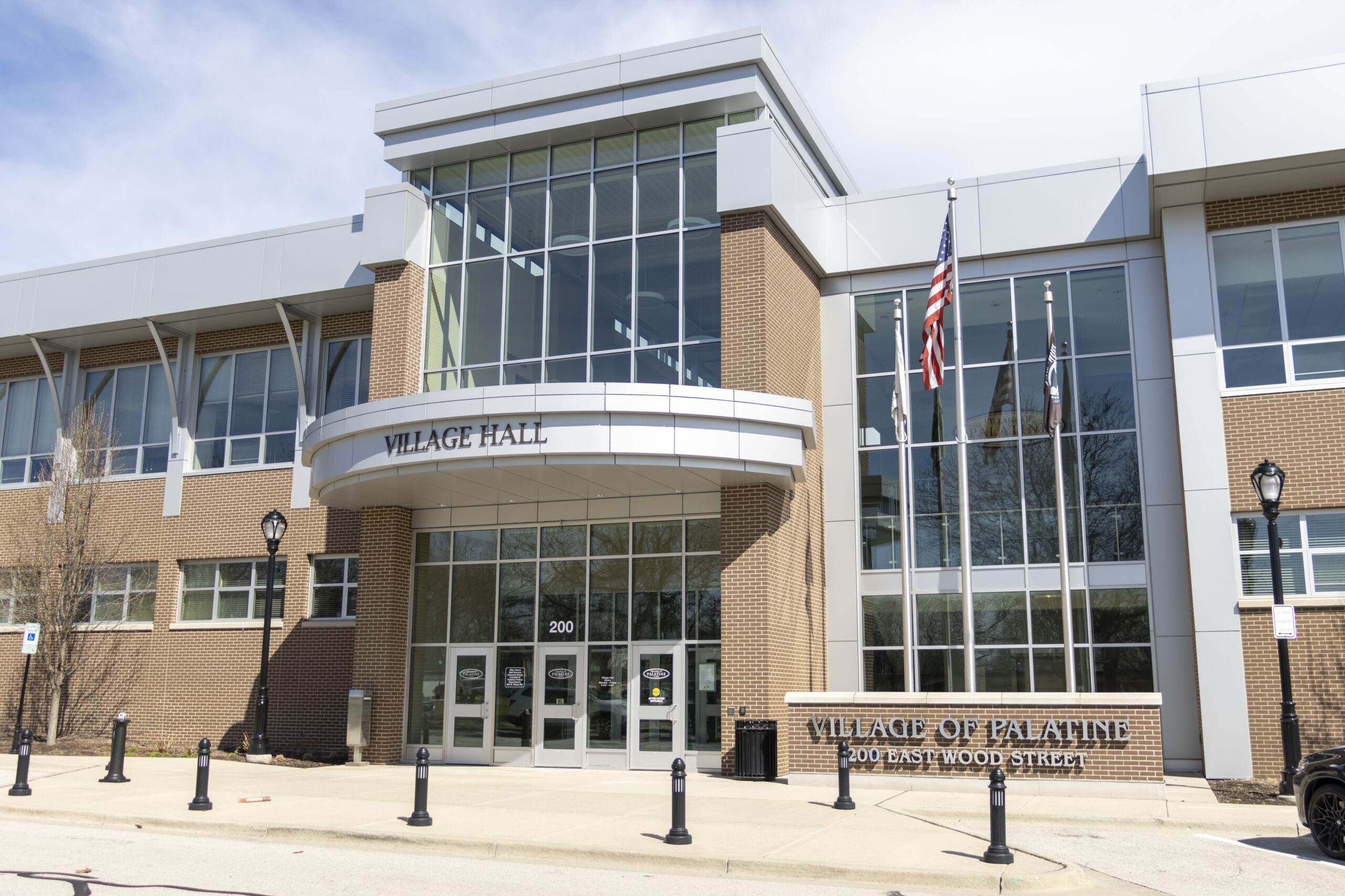
Palatine Village Hall.
Palatine’s village revenues are running significantly ahead of budget estimates at the halfway point of 2026, driven by stronger-than-expected sales tax and income tax collections.
Discussed during the Aug. 17 village council meeting, Finance Director Andrew Brown stated that as of June 30, the village had collected $10.98 million in sales tax, $7.14 million in income tax and $16.6 million in property tax, according to a financial review presented to the mayor and council.
Sales tax collections were up $500,000 compared to the same period last year, which is attributed primarily to inflationary impacts on goods and a state reclassification of use tax receipts to sales tax.
“Revenue is trending to budget expectations,” Brown said in his mid-year report. “Major sources are performing at or slightly above expectations.”
The strong revenue performance comes as the village navigates a complex economic environment marked by elevated inflation and a stable but cautious labor market. Core inflation in the Chicago suburbs — excluding food and energy — stands at 3.8% year-over-year, while overall inflation remains at 2.5%. The unemployment rate held steady at 4.2% at the mid-year mark.
Despite inflation eroding consumer purchasing power, sales tax collections suggest that residents and businesses in Palatine continue to spend. Income tax revenue is tracking as expected and remains consistent with the five-year average, Brown said.
“Inflation is still reducing consumers’ disposable income, however strong job numbers should be a good sign for sales tax numbers to hold steady for the remainder of the year,” Brown noted in his report to council. “Staff will continue to monitor indicators that could provide any insight to decreases in key revenue sources.”
Village expenditures are performing within anticipated levels, though personnel and benefits costs are running higher than expected due to a timing issue with Cook County property tax distributions.
The county delayed distribution of the 2024 tax levy, which inflated employer contribution expenditures for public safety pensions in the first half of 2026. These anomalies will be resolved through the accrual process when the village prepares its annual comprehensive financial report later this year, Brown said.
“The property tax anomalies will get squared away at year end through the accrual process in the preparation of the village’s Annual Comprehensive Financial Report,” Brown wrote.
General Fund expenditures continue to be driven by salary and benefits impacts related to the village’s contributions to public safety pension funds. Expenditures in other funds are being driven by capital and project costs, which have increased significantly since the first quarter report.
The village is engaged in multiple public improvement projects across the community, including roadway and sidewalk repairs, water and sewer infrastructure replacement, and other public improvements. Many of those capital projects are expected to wrap up by the end of the third quarter, according to the village.
“I would expect many capital projects to wrap up by the end of the third quarter as the village is engaged in many public projects repairing roadways and sidewalks, replacing water and sewer infrastructure, and other public improvements,” Brown said.
The finance department continues to monitor the village’s fiscal activities through quarterly budget reviews to identify potential problem areas and take corrective action at an early stage.
In the second quarter, the council approved budget adjustments totaling $3.8 million. The adjustments included $3.7 million allocated from 2025 surplus funds previously discussed by council, $129,432 in new revenue, and a $27,200 decrease that was added back to fund reserves.
These adjustments increased the total village-wide 2026 budget by $3,824,834.
The Debt Service Reserve is fully funded, and the village is on track to close out an American Rescue Plan Act (ARPA) grant by Dec. 31, 2026. The ARPA funding has supported village projects and initiatives over the past year.
The council also approved declarations of surplus revenue from two tax increment financing (TIF) districts, which will be distributed to affected taxing agencies including schools, the park district, and other local government entities.
The Rand/Lake Cook TIF District, established in 2012 to spur development in that corridor, declared $1 million in surplus revenue. The funds will be distributed to taxing agencies based on their pro rata share of the total tax rate, with Cook County handling the distribution process, which is estimated to take 30 to 60 days. The estimated distribution by agency are $378,400 to Dist. 15, $280,300 to Dist. 211, $99,600 for the village, $66,100 to the Palatine Park District, $46,900 for Cook County, $42,100 for Harper College, $36,000 for the library, $11,100 for the township, and $39,500 for other agencies.
The Downtown TIF District, established in 1999, has a more complex surplus structure. In 2021, the village sought and received legislative approval from the General Assembly to extend the district through 2033 to complete projects and improvements previously identified. As part of that extension, the village entered into an intergovernmental agreement with local taxing bodies that outlined the parameters for the extension.
Under the agreement, the village retains 100% of the tax increment from the first two years of the extension period, then declares 100% of the increment in years 3 through 12 as surplus to be returned to taxing agencies. The village will declare two TIF surpluses annually for the Downtown district — one in June and one in January for each tax levy year.
As of June 30, 2026, the village had collected $4.5 million in increment from the Downtown TIF. The council approved declaration of that amount as surplus revenue, which will be distributed to affected taxing agencies through Cook County over the next 30 to 60 days. The estimated distribution by agency are $1.71 million to Dist. 15, $1.26 million to Dist. 211, $450,664 for the village, $299,085 to the Palatine Park District, $212,210 for Cook County, $190,491 for Harper College, $162,890 for the library, $50,224 for the township, and $178,727 for other agencies.
According to village officials, the TIF surplus distributions represent a commitment the village made to local taxing bodies when it sought the extension, acknowledging that extending the district would delay tax revenue that would otherwise go to schools, the park district, and other agencies.
The finance department is preparing the fiscal year 2027 budget, which will include a flat property tax levy plus a 2% increase, or approximately $450,000, from the Rand Road Corridor TIF increment. The village plans to continue capital funding and maintain its long-term financial outlook.
Village Manager Reid Ottesen noted that in the last 16 years, the village’s tax levy has gone up by a total of 2.4%. He said many communities around cannot say the same thing.
“That is fantastic and great news that the levy will be basically flat again,” Councilman Kollin Kozlowski (5th) said, who also credited staff for returning approximately $5.5 million in TIF surplus this year to other taxing bodies.
Ottesen replied by noting that also since 2010, the village has returned over $52 million in surplus dollars to those same entities.
The budget process will move through several public meetings before adoption. A budget review is scheduled for Nov. 2 at a special meeting beginning at 5 p.m. A follow-up review will be held Nov. 9, if needed. A public hearing on the budget is set for Nov. 16, with final adoption expected Dec. 7.
If you like this story, you can get a whole lot more practically every day of the week by subscribing to journal-topics.com. Click here to choose your preference of either print or online, or call 847-299-5511.