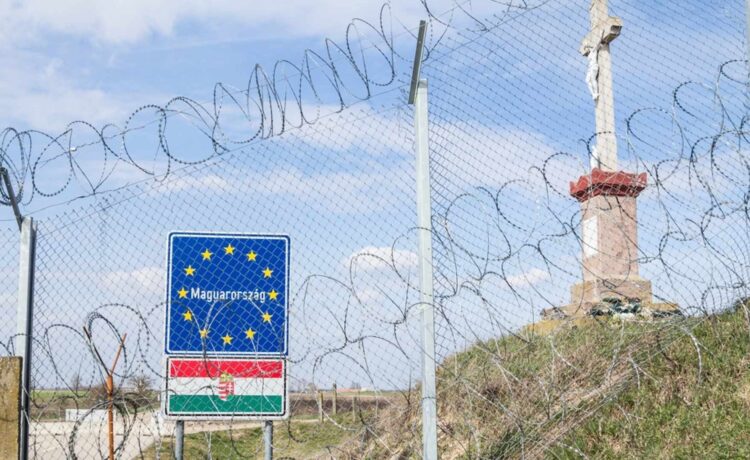
The government has decided to extend the state of emergency caused by mass immigration in Hungary — which was due to expire on 7 September — until 31 December. Prime Minister Péter Magyar reported this on his Facebook page on Friday evening.
In his post, the prime minister wrote that the Tisza government would not ease the legal framework against illegal migration. He added that recent weeks had shown that even the smallest legal change can open gaps in the protection of Europe’s external borders.
Péter Magyar announced that in the coming weeks they would establish a lawful and functioning system that protects Hungary’s borders and the money of Hungarian people at the same time.
He recalled that in Ceuta, Spain — on the European Union’s external border with Africa — a serious border crisis had developed within two days: in a single day, tens of thousands of people attempted to cross from Morocco into Spain. People died at sea, and Spanish authorities were forced to mobilise extraordinary resources. All of this was triggered by a ruling of the Spanish Supreme Court. Smuggling networks very quickly recognised the new situation and attempted to exploit it, said Péter Magyar, who stressed: “Ceuta is a warning to all of Europe.”
Migration routes can shift within days. People smugglers are constantly looking for weak points. A single legal loophole or a poorly prepared change can create an unmanageable situation in a very short time. The Hungarian government cannot take such a risk, the Prime Minister stressed.
Péter Magyar called it unjust that “while we are protecting Hungary’s and thereby also Europe’s external borders, Europe is fining us for it.”
He said that for months they have been negotiating with EU institutions on a new Hungarian regulation that would effectively protect Hungary’s and the European Union’s external border while also complying with EU law. So far, EU institutions and lawyers have been unable to propose a solution that would reliably guarantee that Hungarian authorities can continue to act with sufficient strictness and effectiveness, he added.
The Prime Minister wrote that since 2016, a majority of EU member states — around 20 countries — have stood on the side of strict border protection.
“It is unjust and unfair to punish a member state that protects its borders in 2026, in a new political and legal environment — and especially after the events in Ceuta — on the basis of a regulation adopted much earlier, under entirely different circumstances,” he said.
In a video uploaded alongside his post, Péter Magyar said that the mass migration crisis situation is a legal regulation that gives the state a number of special tools: it allows the police to escort foreigners who entered the country illegally and were apprehended anywhere on its territory to the southern border, and allows the military to participate in border protection. The legislation also provides special procedural rules in connection with crimes related to the border fence.
The prime minister also pointed out that this Hungarian legal regulatory framework nevertheless contains elements that the Court of Justice of the European Union has previously ruled to be incompatible with EU law.
The court’s ruling imposed a one-time fine of 200 million euros on Hungary, as well as a daily fine of one million euros until the ruling is implemented. The total cost of the legal dispute has already reached nearly one billion euros.
The previous government failed to resolve this contradiction for years: “it was easier to wage war with Brussels, to look for enemies on posters, and to say that there are only two options: either we protect the border or we comply with European law,” said Péter Magyar, adding that the cost of this policy has been borne by the Hungarian people in the meantime.
He said that Hungary’s borders will be defended and they will not back down from this. “We undertook to maintain the southern border fence, strengthen border protection, and apply zero tolerance toward illegal immigration. But it is also our job to ensure that Hungary does not have to pay hundreds of billions” — the prime minister declared.
He said: “since what happened in Ceuta, it should be clear to everyone that no relaxation can be considered.”
He also noted that the current law allows for the crisis situation to be extended for a maximum of six months, but the government consciously decided on only four months this time.
This is an important distinction, and they will use this time to ensure that new regulations — drawn up in consultation with EU institutions — are completed, which will allow “the southern border fence to remain, strong border protection to remain, our authorities to act effectively, while putting an end to the unfortunate situation where, as we protect Europe’s external borders, we are fined for doing so” — said Péter Magyar.
He stressed: “the Hungarian people can be assured that we will not allow the weakening of border protection in any way.”
According to reports published in the Magyar Közlöny on Friday evening, the government decree will enter into force on 6 September.
Artificial intelligence was used for the translation of parts of the original Hungarian text.