Editorial & Advertiser disclosure
Global Banking & Finance Review® is an online platform offering news, analysis, and opinion on the latest trends, developments, and innovations in the banking and finance industry worldwide. The platform covers a diverse range of topics, including banking, insurance, investment, wealth management, fintech, and regulatory issues. The website publishes news, press releases, opinion and advertorials on various financial organizations, products and services which are commissioned from various Companies, Organizations, PR agencies, Bloggers etc. These commissioned articles are commercial in nature. This is not to be considered as financial advice and should be considered only for information purposes. It does not reflect the views or opinion of our website and is not to be considered an endorsement or a recommendation. We cannot guarantee the accuracy or applicability of any information provided with respect to your individual or personal circumstances. Please seek Professional advice from a qualified professional before making any financial decisions. We link to various third-party websites, affiliate sales networks, and to our advertising partners websites. When you view or click on certain links available on our articles, our partners may compensate us for displaying the content to you or make a purchase or fill a form. This will not incur any additional charges to you. To make things simpler for you to identity or distinguish advertised or sponsored articles or links, you may consider all articles or links hosted on our site as a commercial article placement. We will not be responsible for any loss you may suffer as a result of any omission or inaccuracy on the website.
Germany Demands Major Reductions in Proposed €2 Trillion EU Budget
By Maria Martinez
Germany’s Stance on the EU Budget Proposal
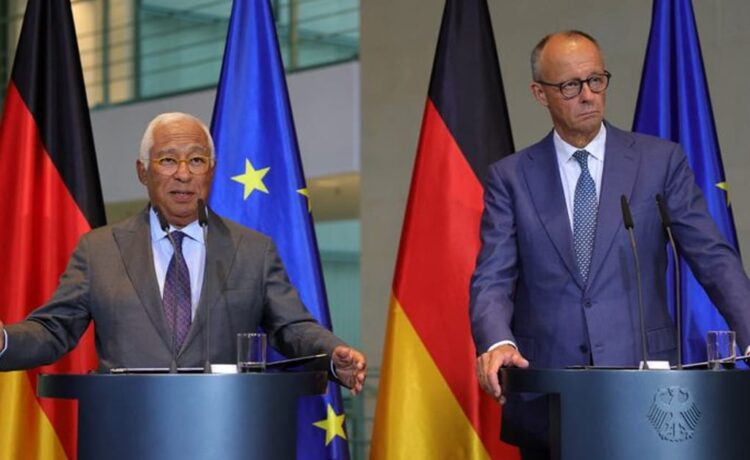
BERLIN, Sept 9 (Reuters) – German Chancellor Friedrich Merz called for hundreds of billions of euros in cuts to the European Commission’s proposed long-term budget on Wednesday, arguing that the plan was unaffordable at a time of domestic spending restraint.
Calls for Balanced Budget Cuts
Germany, Denmark, the Netherlands, Austria, Finland and Sweden said in August that the Commission’s proposed budget of nearly €2 trillion ($2.33 trillion) for 2028 to 2034 should be reduced “in a balanced manner” with all areas of spending contributing to cuts.
Chancellor Merz’s Position
“Europe needs both realism and reform,” Merz said after meeting European Council President Antonio Costa in Berlin, noting that the Commission’s proposals for the next multiannual financial framework envisage a 60% rise over the current seven-year budget period.
“At a time of budget cuts in all member states, that is simply unaffordable,” Merz said about the proposed budget.
Negotiation Process and Requirements
The EU’s Multiannual Financial Framework (MFF) requires unanimity among all 27 member states. Costa and Merz said they want to reach an agreement by the end of 2026.
Concerns Over National Budgets
“We cannot ask (for) more from member states,” Costa said. “We need to create new own resources in order to protect the national budgets. All national budgets must be respected.”
Opposition to Further Joint EU Borrowing
Merz said cuts should apply across all policy areas and rejected relying on further joint EU borrowing to bridge the gap.
“Excessive debt threatens our sovereignty and our capacity to act,” Merz said, adding that governments had the “admittedly painful task” of setting priorities.
Future Priorities for the EU Budget
Merz called for the bloc’s next budget to shift spending towards competitiveness and defence, arguing that a “20th-century budget” could not address current challenges.
(Reporting by Maria Martinez in Berlin and Inti Landauro in Brussels; Editing by Alexander Smith )