
Bussarin Rinchumrus/iStock via Getty Images
Bats With Rabies
Dear Partners,
Protean Small Cap returned 4.7% in August, outperforming its benchmark index by 0.3%. Since launching in August 2023, the fund has gained 89.8%. The Carnegie Nordic Small Cap Index is up 38% in the same period.
The hedge fund Protean Select returned 1.4% in August. The fund is closed for additional subscriptions.
Protean Aktiesparfond Norden returned 4.4% during the month. The benchmark index rose 4.0%. Since inception, in April 2025, the fund is up 39% and in the same period the VINX Nordic Cap index is up 29%. The fund now manages 2.3bn SEK.
All figures are net of fees.
This month’s letter elaborates on why on earth we’re launching a Global fund (because we think it’s simply a better product than most out there), why bats with rabies helped performance in August but the underlying reason is Global warming, some words on a changed mind in the pulp & paper sector that triggered some activity. Plus, as always, commentary on the month’s various winners and losers.
Thank you for being an investor!
Team Protean
September 15 – The launch of Protean Aktiesparfond Global
by Pontus Dackmo
We are launching our low-cost active Global fund on the 15th of September. A personal reflection: a little over a year ago I was writing a similar text, a week before the first Aktiesparfond launched under Richard Bråse. The idea is simple enough: index funds are cheap but can’t beat the index, and active funds are expensive and therefore don’t over time. So, the question was – could you, with some integrity and a healthy dose of bloody-mindedness, build an alternative? A low-cost active fund, lowering the fee further as it grows, and shift the odds in the investor’s favour?
Aktiesparfond Norden (B), managed by Richard Bråse, charges direct savers a 0.5% management fee – less than half the industry median for comparable funds. Since launch the fund is up 39%, 11 percentage points ahead of the Nordic benchmark, VINX. It now manages just over SEK 2.3 billion for close to 20,000 unit holders. Early days still, but the signs are good: it seems to be working, and investors agree.
A Nordic fund is a niche product, though. Just 1.5% of Swedish household savings sits in Nordic equity funds, against 13% in fixed income and 14% in Swedish equities. By far the largest slice (35%) goes into global funds. All according to stats from Fondbolagens förening (Swedish Investment Fund Association).
Global funds make sense, but they’re not without their own problems. On top of the usual issues with passive ownership – chiefly the built-in momentum strategy of buying more of whatever has already gone up, and the fact they’re slowly undermining the very functioning of the equity market – they’ve quietly turned into US funds. Well over 70% of MSCI World, the standard benchmark, is US-listed companies. A full quarter concentrated in a handful of enormous tech names driven by the same handful of factors. That’s a concentration risk worth knowing about, and one you should choose deliberately.
Which is why we’re launching Aktiesparfond Global. A more sensible alternative. A competitively priced active global fund. One that, like its sibling Norden, keeps lowering its fee as it grows – because the economies of scale should belong to the savers, not the fund company. A little less stupid, in other words.
Global, arguably, is a harder category than Norden. There’s no home turf advantage and no informational edge, when the investable universe is essentially unmappable and the pitch is the entire planet. We’ve been asked more than once, fairly: fine, we get Norden and Bråse – but what’s the edge with Olle, running money globally?
The edge is structural, and it’s built on what we leave out, not what we add. We’re not leaning on being based nearby, on the size of an analyst team, or on decades of “experience” – none of which, when you actually look at the data, correlates with fund performance. What matters instead is a lot duller: a clear process, discipline around capital allocation, consistency in how the portfolio is built, and – above everything – keeping costs down. It was never about where decisions get made. It’s about how, and at what price.
Finding the right manager for this fund was harder than coming up with the idea for it. You need to think like an owner of capital, not a market commentator. Judge companies on cash flow, balance sheets, capital allocation and incentives – not on narrative. Have a genuine aversion to complexity, leverage, muddy thinking and unnecessary cost. And be stubborn enough to stick with the framework even when the benchmark, or the noise, says otherwise.
I think Olle Qvarnström is that person. He has a natural pull toward value over price – the same instinct the whole Aktiesparfond idea rests on, except with him it isn’t a discipline, it’s a default setting. I expect him to keep being just as blunt and just as honest running money as he’s always been writing about it.
So here we are.
My hope is the same one I had for Norden: that we get to keep cutting the fee, again and again, as the fund grows.
I hope the prospective investors in Aktiesparfond Global bring the same patience Norden’s have shown us. We’ll take a first look after three years, and a real one only after five – and even five is too short to rule out luck (good or bad). There will be stretches, probably long ones, where the fund trails its index. In the hardest category out there, that’s truer here than anywhere else. But if we’re right more often than we’re wrong, it will work out. Eventually.
The fund will be available at most online savings platforms, and some of the forward-leaning banks. If you have a larger sum to invest, or any questions – feel free to reach out.
Protean Small Cap
by Carl Gustafsson
Protean Small Cap gained 4.7% in August. Our benchmark, CSRXN (SEK), increased 4.4% during the month, meaning the fund outperformed the index by 0.3%. So far this year, the fund has gained 13%, outperforming the index, which has gained 9.9%.
Top contributors for August were Surgical Science (SGSCY), Bavarian Nordic (BVNRY) and Bico (BICOF). We also benefited from strong performance in Vitec (VTCYF), Biomar and Nibe (NHYDY).
Surgical Science, a position in the fund since June, surged more than 50 per cent in August following a Q2 that quelled a lot of fears that had led to a disastrous share price performance up to the numbers. This is a Swedish provider of medical simulation equipment, operating both software and hardware. The share declined 60 per cent in November last year when they announced that the key customer Intuitive Surgical (ISRG) would walk away from a MoU about bundling Surgical Science’s software with Intuitive Surgical’s robots. The Q2 report showed that the estimated negative sales effect from this change appears to be smaller than initially feared, and this removed the existential fear that had been lingering in the share price. Having met the company a few times, we initiated a position in June as valuation was very attractive (single-digit EV/EBIT), the balance sheet strong (creating strategic optionality) and it had beaten expectations in the two most recent reports, indicating that the operational momentum was underestimated.
The Danish vaccine manufacturer Bavarian Nordic has been a bit of a disappointment since we initiated our position late 2024. Sure, it’s been an eventful ride with a private equity-backed bid on the company which ultimately failed, but the share has been stuck where we bought it. Luckily, we believe the strong Q2 could be a positive inflection point for the wider narrative as it gave good indications on the fundamental development, as well as management’s capital allocation.
We especially like Bavarian’s travel health business. This business area has shown consistent growth, which can be obscured by near-term volatility due to stocking patterns among its clients. The recent strength came from sales of rabies vaccines, which grew by 54% in the quarter. Bavarian’s Rabipur product is dominant in key markets such as the US (78% market share) and Germany (96% market share), hence somewhat dependent on market growth. And the market is growing: a wave of rabies cases in the US, with some stemming from bat bites, has increased public awareness of the disease, which has translated into better sales for Bavarian. This is a part of a wider trend that we believe to be overlooked in Bavarian: there are several tailwinds in the market for them, both for rabies, as well as their TBE franchise where the increase in temperatures in Europe increases the spread of ticks. Also, diseases such as chikungunya are likely to become endemic, which creates a new opportunity. In conjunction with the report, management also showed some (very) early data for a potential vaccine against Lyme disease which is a longer-term optionality.
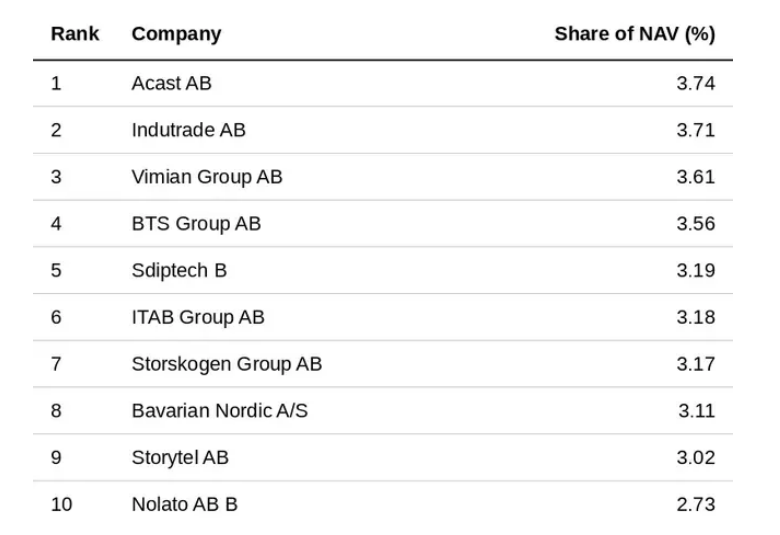
Top detractors were Devyser (DVYSF), Acast (ACASF), Ossdsign, Arctic Falls and Midsona. Acast has lost some momentum despite a strong Q2 report and a sensible acquisition in August. It’s a share prone to some volatility, and this time it’s triggered by Spotify (SPOT) introducing a feature that makes it easier to skip ads in podcasts. Acast (as well as Storytel (STRYF), another holding) often experiences weakness related to new features from Spotify, and historically, this has created buying opportunities. Arctic Falls made a return to profit growth in the quarter, restoring some confidence into the investment case following their poor start to being a listed company. Valuation is appealing for this operator of testing facilities in Northern Scandinavia, who has a strong track record prior to its IPO. The fund now manages c. SEK 1,270m. Thank you for your trust. Our top ten positions as we enter September are as follows:
Protean Select
by Pontus Dackmo
Protean Select returned 1.4% in August. The beta-adjusted net exposure of the fund was 29% on average.
Biggest contributors were Bavarian Nordic, Yubico (YUBIF), Biomar and Plejd (PLJJF). Biggest detractors were short OMX Index futures, longs in Devyser and Carlsberg (CABGY).
We enter August at 35% net exposure. Gross exposure, adjusted for cash management positions, currently stands at 132%. Towards the end of the month, we acquired an OMX Index put spread to add some insurance ahead of what could turn out to be a volatile few months ahead. Our overarching thesis remains that things want to come good – we are currently encouraged by the opportunity set among Nordic equities.
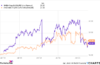
Some words on a few stocks Pulp, paper and forestry We have for quite some time been vocal (and bearish) on the structural disadvantages for nordic long fibre vs eucalyptus – but something is in the making in the short- to medium-term that could offset this in the regional supply/demand balance. Nordic players have a wildly different energy mix compared to the continental European producers. This means that when gas prices go up, the marginal producer needs to raise prices to stay afloat – or close capacity when production becomes cash flow negative. This is exactly what happened 2021-2022. Containerboard prices jumped >100% in short order. Are we in for a repeat? The chance is non-zero. We have therefore, during August, tactically covered our short in Holmen (HLMNY) and added longs in a basket of other sector names. As can be seen from the chart below, European gas storage is at the lowest level in the past 10 years, driven by the Hormuz disruption. This, in turn, has caused gas prices to be 100% higher than at the same time last year. Water reservoir levels are low, nuclear power plants are struggling with too warm cooling water, together adding further upward pressure on electricity prices.
Add to this cheaper input materials (wood) and somewhat improving (well, at least not deteriorating) demand (as evidenced by ISM-readings). The effects can already be seen in continuous price hikes by various industry players in recent weeks and months (SCA (SVCBY), Suzano (SUZ), others), as well as emerging capacity cuts – an occurrence we anticipate will become more frequent in the months ahead.
The sector has underperformed the broader market for many years, and price/book multiples, as well as factory utilization, is at multi-year lows. With that context it only takes a grain of optimism for the equities to be explosive on the upside. Particularly as many names are both well shorted and missing from many active portfolios. On the short side in this trade set-up we have added to our negative position Essity (ESSYY) – a stock buoyed by activist entry and structural noise, but still a net loser on rising energy and commodity prices which needs to be painfully offset by price hikes on what is largely commodity products sold to consolidated and powerful distributors.
Bavarian Nordic Like Carl mentioned in the Small Cap update for the month, Bavarian Nordic was a strong contributor in August. The case is well worth putting into perspective. The Centers for Disease Control (CDC) in the US files close to 100,000 requests for rabies post-exposure treatment every year. But fewer than 10 Americans die from rabies every year. The reason for the gap? Rabies is basically 100% fatal once symptoms appear (which can take 1-2 months). Touch a bat, you get the shot. No exceptions. This is partly why Bavarian had such a good Q2. Rabipur/RabAvert grew 55% y/y, which helped drive a stonking 165% EBIT beat vs consensus and caused management to call demand “exceptionally strong”, upgrade guidance and surprise the market with a new 750m DKK buy-back on top of the already completed 500m DKK for the year.
It’s funny how Bavarian files Rabipur under “Travel Health”, alongside both the TBE shot Encepur and the chikungunya shot Vimkunya, since the vast majority of sales has nothing to do with “travel” anymore. Bottom line is: it’s getting warmer, and disease vectors are in flux. Vampire bats are expanding their range in the US, TBE-carrying ticks are modelled to soon be present across the Nordics. Europe logged a record 27 local mosquitodriven chikungunya outbreaks in 2025.
We didn’t buy Bavarian Nordic (only) for this thesis. We bought it because it’s a growing, cash-generative franchise the market is under-pricing due to the lumpy nature of the public preparedness business. The fundamental set-up for the Travel Health – soon to be renamed just “Health”? – business keeps improving.
Protean Aktiesparfond Norden
By Richard Bråse
Aktiesparfonden is a Nordic long-only fund aiming to generate abovemarket returns over the long term by actively investing in value-creating companies and charging a low fee. A fee that is reduced further as the fund grows, sharing the scale advantages with investors. Aktiesparfonden has, since inception in April 2025, delivered a 39% return, in the same period the VINX Nordic Cap index is up 29%. The fund now manages 2.3bn SEK.
Our communication for Aktiesparfonden is currently only in Swedish, and updates can be found at www. aktiesparfonderna. se by clicking the headline “Anslagstavla”.
Thank you for your long-term perspective and trust in our process.
Editor’s Note: The summary bullets for this article were chosen by Seeking Alpha editors.
Editor’s Note: This article discusses one or more securities that do not trade on a major U.S. exchange. Please be aware of the risks associated with these stocks.