Strategic LPs can offer fund managers access to markets, customers, technical expertise, industrial infrastructure and, potentially, an exit.
Looking at the limited partners (LPs) backing emerging managers raising their venture funds in tough conditions gives a sense of how the ecosystem is changing.
First, Marcos Fernandez and Dre Glover, co-founders of Fiat Ventures, told TechCrunch that the firm’s $35m second fund had sought a mix of LPs who “could do more than provide capital,” such as offering business guidance to its portfolio companies. LPs in this fund include the Reinsurance Group of America, MassMutual and Bank of America.
Second, James Alexander’s Galileo Ventures has raised $15m, halfway towards its second fund’s target, with LPs including Jeremy Colless’ Artesian Capital — which runs VC-as-a-service offerings for several large corporations — and US venture investor Brad Feld, alongside Australian development agency Innovation Victoria, managed by Olga Hogan, as a cornerstone investor.
Meanwhile, Tor Bækkelund and Sagar Chandna’s RunwayVC Fund II made a €40m first close backed by a broad mix of industrial, institutional and private capital, including Norwegian industrial investment company Aker ASA, which continues as cornerstone investor, joined by US oilfield services company Halliburton; institutional investor KLP, Norway’s largest pension company; state-owned Investinor; and the Møkster and Hustadlitt industrial families.
Typically, as the European Central Bank notes, the largest LPs in VC funds tend to be financial institutions — pension funds, foundations and other institutional investors. Their primary reason for investing is financial: adding high-risk but potentially high-alpha assets to a diversified portfolio.
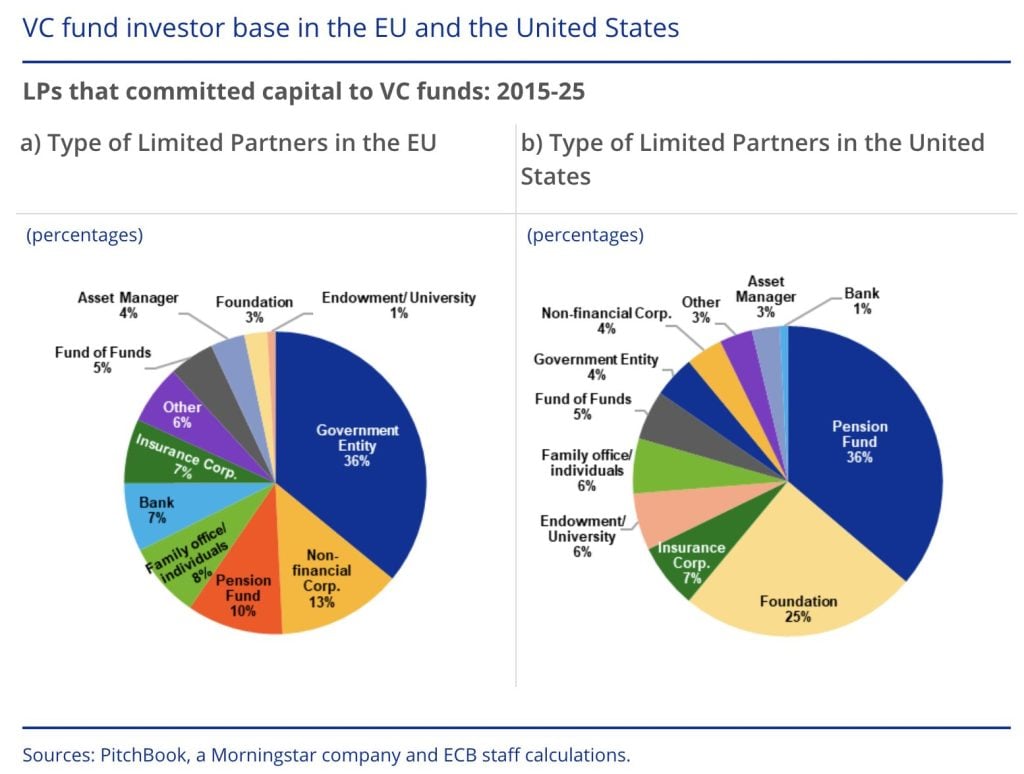
But that is only one part of the LP relationship. The ECB itself notes that the composition of a fund’s LP base can influence the types of startups it backs, its geographical focus and its appetite for risk. Government investors, meanwhile, can steer capital towards strategic sectors and amplify the impact of private investment.
That makes the growing interest from corporations, corporate-connected VCs and government investors more significant. They are not simply another source of money for emerging managers. They can provide something that is increasingly difficult for a purely financial LP to offer: access to markets, customers, technical expertise, industrial infrastructure and, potentially, an exit.

For the LP, there is a strategic return alongside the financial one. VCs want access to dealflow they might be able to back later. Corporations want early visibility into technologies they might eventually buy, partner with or invest in. Governments want to see high-growth companies and high-paying jobs developing in their economies.
Øyvind Eriksen, president and CEO of Aker ASA, put it succinctly: “RunwayVC connects venture capital with Norwegian industry. The experience from Fund I demonstrates the value of this model.” Jeff Miller, chairman, president and CEO of Halliburton, meanwhile, talked about “participating in solutions for complex, high-demand environments” as AI and automation transform industries.
This matters particularly in today’s fundraising market. Capital has become increasingly concentrated among established managers, making life harder for emerging funds and forcing them to articulate much more clearly what makes them different.
For the smartest emerging managers, that differentiation may increasingly be found not just in where they invest, but in who stands behind them.
The LP is becoming part of the fund’s value proposition.
At a time when raising venture capital on purely financial metrics is harder, the managers that can harness the strategic goals, networks and scale-up firepower of corporate and government investors have another argument to make to prospective LPs. They are not just offering access to a portfolio. They are offering access to an ecosystem.
That is a shift worth watching — and one we will be exploring at the GCV LP Summit on September 23, where emerging managers and the LPs backing them will come together.