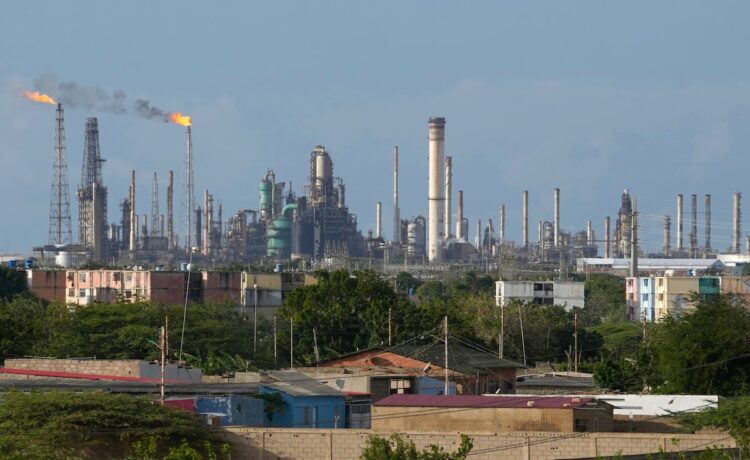
Flames rise from flare stacks at the Amuay refinery in Los Taques, Venezuela, on Jan. 14. U.S. President Donald Trump’s anti-Canada policies are undermined by the actions of the largest U.S. oil companies and biggest asset managers, Andrew Willis writes.Matias Delacroix/The Associated Press
In Texas and New York, big oil and big money are placing their bets on the future of the energy industry.
Major American oil companies and asset managers are lining up to invest in Canadian infrastructure. They seem to have missed U.S. President Donald Trump’s weekend Truth Social post declaring “I don’t want Canadian anything.”
The same companies – ExxonMobil Holdings Corp., ConocoPhillips, KKR & Co. Inc. and Apollo Global Management Inc. – are steering clear of investments in Venezuela.
They must have also missed the President’s recent post about putting “Canada on notice” with “THE BIGGEST OIL DEAL IN WORLD HISTORY.” Mr. Trump claimed the U.S. secured control of 65 billion barrels of reserves in the South American country, at no cost to taxpayers.
That old saying “follow the money” is sending reassuring signs about where the Canada-U.S. relationship is really going, and less comforting signs on the Trump administration’s energy policies and the President’s leadership.
Trump flaunts Venezuela oil deal as warning to Canada
For all the noise around the two countries’ trade dispute, and the real harm it is doing to real people like small business owners and consumers, serious Americans are still committing serious money to Canadian projects.
Those same serious Americans aren’t taking their President’s posts about foreign policy seriously.
With the notable exception of Houston-based Chevron Corp., which never left the South American country, none of the major U.S. energy companies are committed to returning to Venezuela. They continue to make sincere commitments to Canada at the same time that their President renames a Great Lake.
Last Thursday, following the money meant taking a trip from Manhattan to Calgary, where KKR and Apollo ad ded to their extensive Canadian energy infrastructure holdings by dropping $2.7-billion for a 29-per-cent stake in Enbridge Inc.’s Westcoast natural gas pipeline.
Enbridge will use the money to expand a network that moves gas from northern B.C. and Alberta to customers in Vancouver and the Northwestern U.S.
Enbridge lands $2.7-billion investment from KKR, Apollo in B.C. natural gas pipeline expansion
KKR also owns stakes in a B.C. pipeline run by TC Energy Corp. and Emera Inc.’s electrical link between Newfoundland and Labrador. Apollo holds an interest in one of Western Canada’s largest natural gas processing businesses with Calgary-based Pembina Pipeline Corp.
Asset managers such as KKR, Wall Street’s leverage buyout pioneer, and Apollo only make commitments to infrastructure with stable long-term prospects. They see that reliability in Canada.
No one attaches the word reliability to what Mr. Trump’s administration is doing in Venezuela. If the U.S President wants to escalate the trade war to include energy – something Canadian politicians have avoided to date – it’s hard to think of a weaker card to play.
The big dog in the U.S. oil patch, ExxonMobil chief executive Darren Woods, called Venezuela “uninvestable” during a White House meeting in January. Despite arm-twisting from Mr. Trump, Houston-based Exxon has yet to make a commitment to the country.
In contrast, Exxon’s Calgary-based subsidiary Imperial Oil Ltd. plans to spend up to $2.2-billion this year on improving its domestic operations. The company is expanding its Alberta oil sands projects and committed $229-million to upgrading refineries near Edmonton and Sarnia.
Explainer: What to know about Trump’s deal for access to Venezuela’s vast oil reserves
ConocoPhillips, the third-largest U.S. oil company after Exxon and Chevron, is also a major player in Alberta. The Houston-based company put US$593-million into building its Canadian operations in 2025 and is on track to spend the same amount this year. Both Conoco and Imperial back the Pathways carbon capture project.
Conoco’s main focus in Venezuela is recouping the US$12-billion it claims it is owed after the company’s operations were nationalized in 2007.
In March, two months after U.S. forces captured former Venezuelan president Nicolás Maduro, Conoco CEO Ryan Lance, who announced his retirement in August, said the country’s attempts at reform were “woefully inadequate.” He told Reuters that Venezuela needed to “completely rewire” its policies to attract investment.
The American economy runs on Canadian energy. Last year, the U.S. imported $160-billion of oil, gas and electricity from its northern neighbour. Mr. Trump’s attempt to position Venezuela as a counter to Canada’s strongest suits is a bad bluff.
The President’s anti-Canada policies are undermined by the actions of the largest U.S. oil companies and biggest asset managers. They are all investing in a robust long-term Canadian relationship.
The larger lesson from Mr. Trump’s recent Truth Social postings on Venezuela and Canada is what they say about the President’s declining relevance.