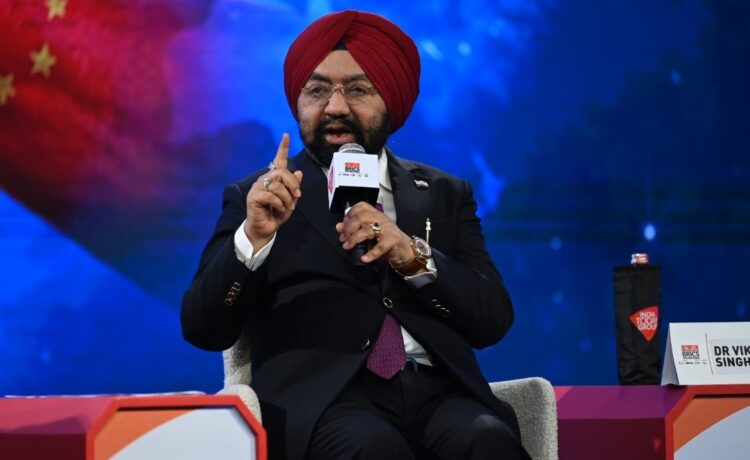
BRICS can play a crucial role in creating a supply-chain safety net amid disruptions caused by the escalating West Asia crisis, BJP Rajya Sabha MP Vikramjit Singh Sahney said, stressing the need for the grouping to ensure the uninterrupted flow of food, fertilisers, fuel and foreign exchange.
Speaking about the changing geopolitical landscape and the challenges facing BRICS, Sahney said the crisis in West Asia had shown how vulnerable global supply chains remained, with the disruption in shipping through the Strait of Hormuz affecting economies and trade routes across the world.
“No one perceived that no ship can pass via Hormuz,” Sahney said at the India Today BRICS Roundtable 2026, adding that there appeared to be “no light at the end of the tunnel” yet as the end of the crisis remained uncertain and countries continued to watch developments closely.
Sahney, who has been associated with the BRICS process since 2013 and is a member of the BRICS agriculture business group, said the grouping had evolved significantly since its formation in 2006. The business vertical was added in 2013 in South Africa, while six more countries joined the grouping last year, expanding its footprint as a platform for South-South cooperation.
He also stressed that the ongoing Russia-Ukraine war, the West Asia conflict and the weakening of multilateral institutions had made BRICS increasingly important as a platform for countries of the Global South.
“With the West Asia crisis, we also saw that multiple global agencies started acting spineless or were made to act spineless,” Sahney said, arguing that BRICS would have to assume greater responsibility amid growing geopolitical uncertainty and what he described as bilateral dominance.
‘BRICS MUST STAND UP AND SAY WE MEAN SERIOUS BUSINESS’
Sahney said the current crisis required BRICS nations to go beyond trade and economic cooperation and send a clear message against hostilities.
“Somewhere BRICS will have to stand up and say we mean serious business, we don’t want hostilities and we want a solution through dialogues,” he said.
He invoked India’s philosophy of Vasudhaiva Kutumbakam, or “the world is one family”, saying India’s approach was centred on peace, prosperity and cooperation. “Trade and business are important, but the grouping also needs to stand with each other,” Sahney said, drawing a parallel with the message India had conveyed to the SAARC nations.
On whether BRICS could help India and other member countries deal with the economic fallout of the West Asia crisis, Sahney said the disruptions were affecting importers and exporters alike.
He pointed to the pressure on the Indian rupee and argued that BRICS should accelerate efforts to promote trade in local currencies rather than remain dependent on the US dollar.
“That’s why it is important that we convert dollar trade into local currency trade,” he said.
Sahney also cited India’s recent experience of approaching China for fertilisers during a period of need, saying China provided them at half the cost. He said such developments showed how BRICS cooperation could reduce dependence on a single source of supply.
“Our dependence on one supply source is reducing. BRICS is a very good group which can deliver for sure,” he said.
Sahney said the inclusion of countries such as Saudi Arabia and Iran in BRICS had added greater relevance to discussions around alternative trade routes and corridors.
He said discussions were underway on a plan under which member countries could invest collectively in developing an alternative corridor to ensure the movement of goods if existing routes were disrupted.
An alternative route on the other side of Saudi Arabia is also available, he said, but it remains expensive and passes through the Red Sea, which has its own security challenges, including threats linked to the Houthis.
This, Sahney said, made BRICS cooperation critical for ensuring the “free flow of goods, services and people” and securing uninterrupted supplies of essential commodities such as food, fertilisers and fuel, besides facilitating foreign exchange.
Furthermore, Sahney said India’s hosting of BRICS was particularly significant, noting that while the grouping has 11 member countries, representatives and friends from around 25 nations were expected to participate in the broader engagement.
BRICS nations together account for more than 49 per cent of the global population, making the grouping a potentially “very vibrant and significant” platform, Sahney said.
– Ends