The iShares MSCI Europe Financials ETF (EUFN -0.78%) provides higher yields and focused European exposure, while the State Street SPDR S&P Bank ETF (KBE -1.07%) offers cheaper, equal-weighted access to U.S. banks.
Choosing between these two funds involves a trade-off between geography and concentration. While both target the financial sector, one provides a doorway to developed European markets and their massive banking institutions, whereas the other offers broad, equal-weighted exposure to the U.S. banking system, including regional and commercial lenders.
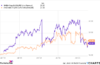
EUFN & KBE: Performance Comparison
Key Financial Metrics

EUFN – iShares Trust – iShares Msci Europe Financials ETF
$42.07
–0.78% (–$0.33)

KBE – SPDR Series Trust – State Street SPDR S&P Bank ETF
$67.67
–1.07% (–$0.73)
52wk Range
$32.91 – $43.07
Dividend & Yield
$1.65 (3.90%)
52wk Range
$54.64 – $71.92
Dividend & Yield
$1.47 (2.14%)
EUFN – iShares Trust – iShares Msci Europe Financials ETF
$42.07
–0.78% (–$0.33)
52wk Range
$32.91 – $43.07
Dividend & Yield
$1.65 (3.90%)
KBE – SPDR Series Trust – State Street SPDR S&P Bank ETF
$67.67
–1.07% (–$0.73)
52wk Range
$54.64 – $71.92
Dividend & Yield
$1.47 (2.14%)
Snapshot (cost & size)
| Metric | KBE | EUFN |
|---|---|---|
| Issuer | SPDR | iShares |
| Share price | $68.42 (as of 2026-08-27) | $42.19 (as of 2026-08-27) |
| Expense ratio | 0.35% | 0.49% |
| 1-yr return (as of 2026-08-27) | 14.3% | 31.6% |
| Dividend yield | 2.1% | 3.9% |
| Beta | 0.88 | 0.78 |
| AUM | $1.7B | $4.3B |
Beta measures price volatility relative to the S&P 500; beta is calculated from monthly returns over the available fund history (up to five years). The 1-yr return represents total return over the trailing 12 months. Dividend yield is the trailing-12-month distribution yield.
State Street SPDR S&P Bank ETF is the more affordable option, charging a 0.35% expense ratio. The iShares MSCI Europe Financials ETF is costlier at 0.49%, but it has historically provided a significantly higher dividend payout, which may appeal to income-seeking investors.
Performance & risk comparison
| Metric | KBE | EUFN |
|---|---|---|
| Max drawdown (5 yr) | (-45.2%) | (-35.2%) |
| Growth of $1,000 over 5 years (total return) | $1,485 | $2,642 |
What’s inside
The iShares MSCI Europe Financials ETF focuses on financial services in developed European markets, with 98% of assets in financial services, 1% in technology, and 1% in industrials. It holds 84 positions, and its largest positions include HSBC Holdings (HSBA -1.63%) at 9.45%, Banco Santander (SAN -1.21%) at 5.57%, and Allianz (ALV -1.38%) at 5.31%. It was launched in 2010. iShares MSCI Europe Financials ETF has paid $1.65 per share over the trailing 12 months, which on its recent ~$42.19 share price works out to a 3.9% yield.
By contrast, the State Street SPDR S&P Bank ETF is purely focused on domestic banking, with a 100% allocation to U.S. financial services. It employs a modified equal-weighted strategy across 102 holdings, ensuring that no single bank dominates the portfolio; its largest positions include Jackson Financial (JXN +1.07%) at 1.18%, NMI Holdings (NMIH +0.09%) at 1.14%, and The Bancorp (TBBK -22.33%) at 1.14%. It was launched in 2005. State Street SPDR S&P Bank ETF has paid $1.47 per share over the trailing 12 months, which on its recent ~$68.42 share price works out to a 2.1% yield.
For more guidance on ETF investing, check out the full guide at this link.
Which looks like the better buy
As this comparison shows, not all bank stocks march to the same beat. U.S. and European financial institutions operate under different central banks, different regulatory environments, and different economic cycles, which is why choosing between these two funds is really a question about where you believe the stronger financial sector story is being written right now.
European banks have made a strong case over the past five years. EUFN turned $1,000 into more than $2,500 over that period, nearly doubling KBE’s result, as European institutions benefited from cheaper starting valuations, improving profit margins, and a continent finally spending seriously on defense and infrastructure. That outperformance came with lower volatility than KBE delivered, which makes it even more striking.
KBE’s equal-weighted approach gives every U.S. bank the same portfolio influence regardless of size, capturing the breadth of American banking from regional lenders to larger institutions. It charges less than EUFN but has delivered less as well.
EUFN is the stronger buy if you want income and geographic diversification away from U.S. financial exposure. KBE is a better choice if you strongly believe in a domestic banking recovery and prefer the lower cost and familiar territory of U.S. lenders.