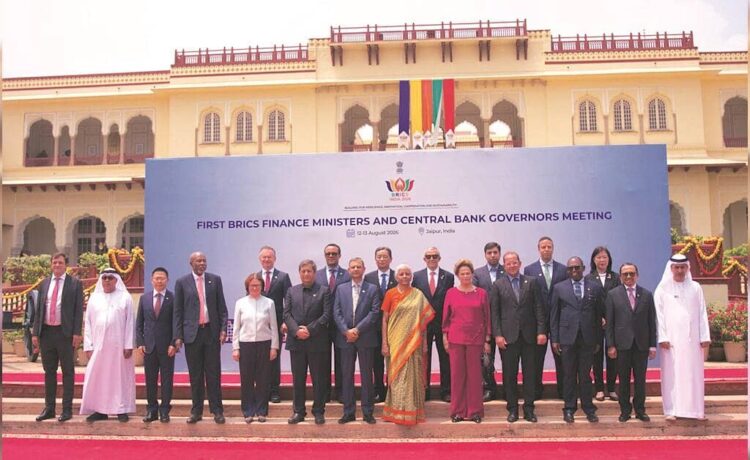
Before leaders of the 11-member Brics grouping have their summit meeting in New Delhi on September 12-13, the grouping’s business forum will meet a day earlier, as will the finance ministers and central bank governors over two days on September 9 and 10. The agenda will feature discussions on intra-Brics financial mechanisms, including exploring ways to increase intra-Brics trade using national currencies. The Brics business forum will meet on September 11. ‘Innoprom’, a three-day Russian exhibition for fostering industry, trade and investment cooperation, will also be held in New Delhi from September 9-11 as the grouping tries to diversify its trade and investments amid US sanctions on Brics member countries, including Russia and Iran. The meeting of the Brics finance ministers and central bank governors will be its second under India’s chairship of the grouping. The first meeting, which Finance Minister Nirmala Sitharaman and Reserve Bank of India Governor Sanjay Malhotra co-chaired, was held on August 12 in Jaipur. Finance ministers of Brics member countries have discussed payment settlement systems and use of a common currency in the past, including in the Brics Summit in Kazan, Russia, in 2024. India is wary of any effort by Brics that the United States might perceive as a move towards “de-dollarisation”. After being elected to the White House, which was a few months after the Brics Summit at Kazan, US President Donald Trump threatened to impose 100 per cent tariffs on Brics countries if they participated in any “de-dollarisation” initiatives. Government sources said India would be wary of White House sanctions and unwilling to take part in any “de-dollarisation” initiative. New Delhi has said any explicit step to move away from the US dollar is not part of its Brics agenda. India is also uncomfortable with any common intra-Brics payment networks, favouring bilateral mechanisms and targeted use of local currencies in trade settlements. New Delhi’s focus will be on developing practical mechanisms to reduce trade transaction costs among the 11-member Brics grouping. New Delhi will also flag the need for more balanced trade among Brics member countries. It faces a significant adverse balance of trade with both China and Russia. The Brics declaration is also likely to include paragraphs on ensuring territorial integrity, increasing intra-Brics trade,free flow of maritime commerce, protection of civilians and civilian infrastructure in conflicts, and resolution of the conflict in West Asia through dialogue and diplomacy. As the Brics chair, India hopes to achieve synergy over a broad sweep of issues among the grouping’s members. New Delhi is hopeful that all key Brics leaders, and those of the grouping’s partner countries, will attend the Summit, including Russian President Vladimir Putin, Chinese President Xi Jinping, and Iranian President Masoud Pezeshkian. Some key outcomes from the Brics ministerial and working groups meetings include setting up a Brics startup innovation fund, an incubator network, a cooperation portal for financing micro, small and medium enterprises (MSMEs), and studying an invoice discounting mechanism for MSMEs. India’s focus on MSMEs stems from their employment-generation potential. Other decisions included a photovoltaic knowledge-sharing portal, a joint study on opening markets and economic diversification among members and agreeing on the principles for safe and secure digitally delivered services across borders. The grouping has suggested establishing a mechanism for knowledge exchange in skilling, and labour market intelligence, promote cooperation in climate-resilient agriculture, strengthen collaboration among farmers in seeds, set up an expert group on early warning systems for prevention and response to mass infectious diseases, agree on guiding principles on energy storage and smart grids, agree on disaster management and early warning guidelines, design a logistics supply-chain cooperation framework and launch a forum on sustainable aviation fuels. India’s broad objective is to make Brics more practical, inclusive and development-oriented. The theme of the New Delhi Summit of Brics is “building for resilience, innovation, cooperation and sustainability”. It is organised around four ideas of resilience, which involves strengthening economies, societies and institutions against supply-chain disruptions, climate risks, health emergencies, and geopolitical shocks. Second, innovation focussed on using technologies such as artificial intelligence, fintech, digital public infrastructure and data-driven systems, third cooperation in trade and development finance, and lastly achieving sustainability in climate action and green finance. The emphasis is on creating mechanisms that can continue working after the summit rather than merely producing political statements. But the challenge before India’s political leadership and officials is to achieve a consensus declaration, including on the contentious West Asia conflict. A joint declaration eluded the Brics foreign ministers’ meeting in May in New Delhi with Iranian Foreign Minister Abbas Araghchi and the UAE representatives getting into repeated spats.