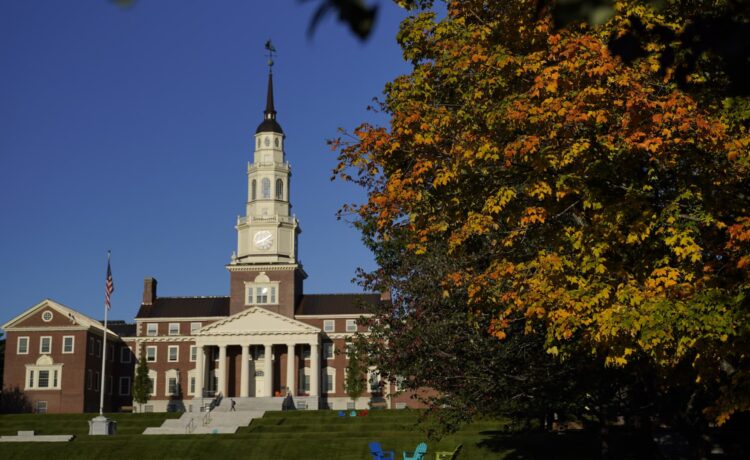
The Miller Library at Colby College in Waterville, Maine.
Robert F. Bukaty | AP
Over a dozen U.S. colleges now have a sticker price of more than $100,000 a year, but even with soaring price tags, many high-priced schools are under intense economic strain.
As the cost ticks higher, tuition revenue has actually fallen, research by the State Higher Education Executive Officers Association shows. Increases in financial aid, higher operating costs and enrollment declines have caused “serious financial headwinds,” 2024 research by the Federal Reserve Bank of Philadelphia also found.
“The closures that we are seeing are indicative of this,” said David Greene, president of Colby College in Waterville, Maine, which has raised more than $1 billion through an ambitious fundraising campaign to secure its long-term financial stability.
Already, a number of small colleges have shut down in the past few years, a trend expected to accelerate.
“This is the ticking time bomb in higher education,” Greene said.
One problem for many colleges is that despite the soaring sticker price, about two-thirds of full-time students receive some sort of financial assistance, which is necessary to make higher education affordable — and attainable.
Over the years, there has been a slow shift to a “high-tuition, high-aid” model, where colleges both raise tuition and increase grant aid, according to Emily Cook, an assistant professor of economics at Texas A&M University.
The net price students and their families will pay for college is the tuition cost minus grants, scholarships and other types of aid.
Many of the colleges with the steepest sticker prices also give out the most aid, according to The Princeton Review’s Great Financial Aid rankings for the 2025-26 academic year. The schools do this to attract students and meet enrollment targets — even if it hurts their bottom line, experts say.
Higher ed among ‘least transparent’ economy sectors
Still, the final cost of college is not readily apparent to students, at least at the outset. Aid packages only come with offers of admission, late in the application process, and even then, they are often not the final word.
“It’s very difficult if you are a student applying to college to figure out what you are actually going to pay,” said Preston Cooper, a senior fellow at the American Enterprise Institute, a conservative think tank based in Washington. “Higher education is one of the least transparent sectors of the economy, it’s on par with healthcare.”
“At some schools, the majority of students do pay the sticker price,” he said. At several of the country’s most expensive institutions, such as Georgetown or Tufts University, close to 50% to 60% of students receive no grant aid at all, according to Cooper’s own recent research, based on the 2023-24 academic year.
Mid-tier private colleges are more likely to resort to hefty tuition discounts to attract applicants, Cooper said.
“A lot of these schools in the mid-range have figured out that you can’t really charge $100,000 and expect to meet the same enrollment numbers that they have in the past,” he said. “Higher education is switching from a seller’s market to a buyer’s market.”
Often in the form of merit aid, the average tuition discount for first-time, full-time students at private colleges was as high as 57% for the 2025-26 academic year, according to a recent report by the National Association of College and University Business Officers, a group representing administrative and financial officers at more than 1,700 colleges and universities in the U.S.
At Colby, the annual sticker price is about $96,120, and the school’s average financial aid package is roughly $77,757. The generous financial aid program is possible, in part, because of the massive fundraising campaign.
“At a time when the national narrative is about a lack of support for higher education, the Colby community has stepped forward to demonstrate the power of commitment and philanthropy,” said the college’s Greene. However, he said the same results would be difficult to achieve elsewhere. “It’s the most successful campaign at a liberal arts college,” he said.
If colleges can’t cover their costs in the long run, the financial model eventually breaks down, Greene said.
“A lot of private liberal arts colleges right now have almost zero families who are full-pay families,” he said. “That is a death spiral.”